







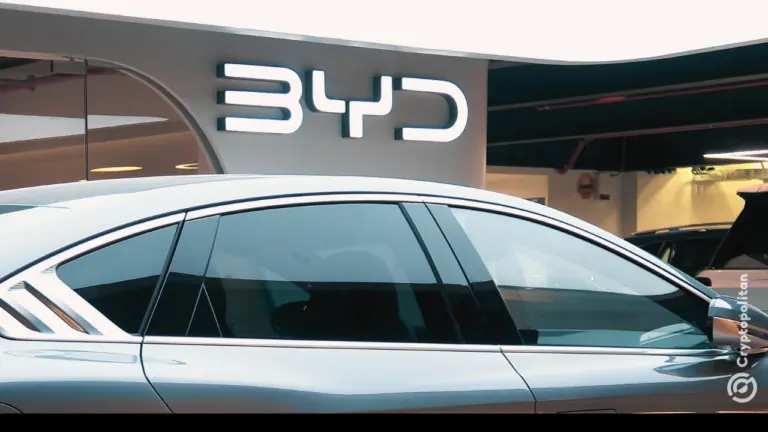
- BYD shares plunged almost 5% Hong Kong on Monday.
- The firm saw a downturn in its domestic market, contrary to its overseas markets.
- Foreign automakers have also seen a rough patch in China.
BYD shares dropped nearly 5% in Hong Kong following Friday’s mid-year earnings release. While the EV giant managed to break its five-quarter losing streak, it did so only because exploding international sales—now over half its total revenue—bailed out a starkly slowing Chinese market.
The company’s mid-year numbers show overseas revenue jumped 34% to $27 billion, representing more than 50% of its total business. The international expansion successfully cushioned a painful 31% decline inside Greater China.
However, the domestic price war still weighed on the bottom line, dragging total first-half revenue down 7.1% to 344.8 billion yuan ($51 billion) and trimming shareholders’ net profit by 20.5% to 12.3 billion yuan ($1.8 billion).
Nonetheless, data from Citi show that the EV giant’s Q2 net profit surged 30% from the previous year to 8.2 billion yuan, equivalent to about $1.2 billion.
BYD has made progress in overseas markets despite geopolitical risks
For some time, BYD has been feeling the heat at home due to brutal competition from companies like Geely and Xiaomi. With government subsidies drying up, the EV maker had no choice but to push hard into Europe and other global markets to keep growing.
The firm’s growing footprint in foreign markets, nonetheless, coincides with escalating global trade friction, particularly as Europe introduces protectionist policies designed to shield its domestic automotive sector from Chinese competition.
In its latest earnings report, the firm even acknowledged that the global market has become much more complicated due to rising political tensions.
Though it also recognized that weak consumer demand in China, coupled with aggressive local competition and escalating costs for commodities, raw materials, and semiconductors, has heavily compressed its profit margins. Following the release of its report, its stock is down almost 5% in Hong Kong.
Nonetheless, the firm still managed to beat Tesla in total EV sales for the first six months of the year, even though sales slowed down at home in China.
Overseas revenue made up the majority of BYD’s first-half sales for the first time, supported by a 68% increase in exports to 792,000 vehicles. Moving forward, the EV maker is also betting on its Denza brand to establish a stronger presence in Europe’s premium market and counter price competition in China.
BYD faces a difficult road ahead
BYD’s overseas growth provides a buffer against weakness in China, but the company’s international expansion will not come without its challenges.
BYD faces higher shipping costs, trade barriers, tariffs, regulatory barriers, and increasing scrutiny from governments concerned about the impact of Chinese EV imports on local manufacturers in China. This may be preventing BYD from meeting the same international growth rate.
But the sharp decline in domestic revenue also underscores the pressure on the core of the company’s business. BYD may have to balance aggressive overseas expansion with an effort to protect margins in China.
As international sales have helped offset weak domestic demand, investors are increasingly worried that the strategy won’t deliver sustainable profit growth as competition intensifies and trade barriers intensify.
Foreign carmakers are also struggling in China
Besides BYD, Legacy foreign automakers are also facing a sharp reversal of fortune in China, a market that previously fueled decades of exponential growth. Second-quarter data reveal a severe downturn, with Chinese sales at Volkswagen, Mercedes-Benz, BMW, and Porsche plummeting between 30% and 41% year-over-year.
All of these automakers suffered a year-on-year drop in Chinese revenue of more than 20% during the first half of the year. This steep domestic decline heavily compressed their global profitability, effectively erasing financial gains achieved in other international markets.
According to independent auto analyst Lei Xing, German carmakers just experienced some of their most severe quarterly sales contractions on record in China.
Citing the declines, some analysts have explained that Chinese drivers now see once-popular foreign cars as too expensive and out of touch. Even US giant General Motors is feeling the pain—the company used to pull in $2 billion a year in profit from China, but it has actually lost significant money there over the last two years.
Chinese regulators are also clamping down on the automotive industry, promising a rigorous audit of rapid development cycles to prevent safety compromises in newly released models. The emphasis on more regulations is also driving away foreign and local carmakers.
While Chinese manufacturers are now leaning heavily on European hybrid sales, the European Union has been considering new tariffs on Chinese hybrid vehicles.
This regulatory headwind builds on existing EU penalties on pure-electric imports—tariffs that nations like Brazil and Mexico have also adopted to curb the aggressive influx of Chinese automotive goods.
The smartest crypto minds already read our newsletter. Want in? Join them.
FAQs
Why did BYD shares fall nearly 5%?
BYD shares fell nearly 5% after its first-half results showed a 7.1% decline in revenue and a 20.5% drop in net profit. Weak Chinese demand, intense domestic competition and rising costs weighed on the company's overall performance despite stronger overseas sales.
How much did BYD’s overseas revenue increase?
BYD’s overseas revenue increased 34% to about $27 billion in the first half of the year, accounting for more than half of the company’s total business for the first time. Exports also rose 68% to 792,000 vehicles.
Is BYD still growing despite weakness in China?
Yes. BYD continues to expand internationally, with overseas sales helping offset declining demand and intense competition in China. However, tariffs, trade barriers, geopolitical tensions and regulatory scrutiny could make its global expansion more challenging.

Nellius Irene
Nellius is a Business Management and IT graduate with five years of experience in the cryptocurrency industry. She is also a graduate of Bitcoin Dada. Nellius has contributed to leading media publications, including BanklessTimes, Cryptobasic, and Riseup Media.









