






Scott Bessent’s Treasury to buy back $6 billion in debt after defending yen intervention

- Treasury plans to buy back up to $6 billion of US government debt.
- Long-term Treasury yields kept rising after the announcement.
- US federal debt has passed $40 trillion as inflation worries grow.
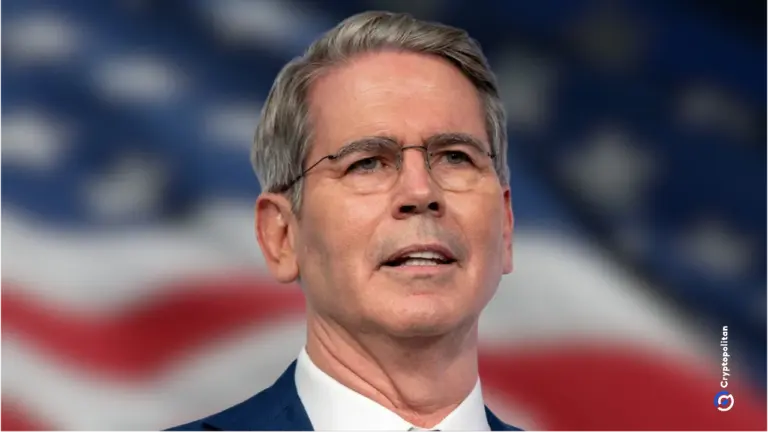
Scott Bessent’s Treasury Department is getting ready to buy back as much as $6 billion of US government debt after Scott defended action around the yen.
Treasury announced the plan on Wednesday and said the goal is to keep trading in government bonds running smoothly. The amount is about three times larger than usual. Scott had already said on Aug. 19 that Treasury planned to buy at least twice the normal amount of older securities.
Treasury also said later operations will be worth at least $4 billion each. This week’s buyback will target 10-year and 20-year notes, where trading tends to be lighter than in shorter-dated debt.
According to authorities, the bigger buy will help maintain liquidity in the markets, whereas the traders are looking at how the move will affect the growth in yields, which are at a level not seen since the pre-2008 crisis period.
Treasury buys more debt as long-term yields keep moving higher
The market was not acting in the manner that would suit the Treasury’s interest. The yields continued to climb after the announcement, and longer-term bonds even went up by as much as 5 basis points before coming back down. It should be noted that higher yields increase the cost of borrowing. One basis point is equal to 0.01 percent.
The 10-year yield hit 4.841% at press time, while the 20-year yield reached 5.314%. The 30-year yield rose about 5 basis points and moved through the closely watched 5.3% level before settling near 5.307%. Treasury’s buyback will take place on Thursday in a 20-minute window ending at 2 p.m. ET.
A few things are pushing yields higher. Federal debt has gone past $40 trillion. Tariffs and the war with Iran are adding to inflation concerns. Energy prices have jumped too, with crude oil breaking above $100 a barrel on Wednesday. Trading is usually quieter at the long end of the Treasury curve than in shorter maturities, even though the US government bond market is the biggest and most liquid sovereign debt market in the world.
Treasury is also issuing more debt. Supply this year is 11.8% higher than in 2025, while publicly held debt has climbed to $31.8 trillion, up 8.2%. Investors are being asked to take on more government paper while inflation worries are getting harder to ignore.
Iran war pushes inflation higher as Kevin Warsh faces pressure from Trump
The Federal Reserve is dealing with a harder inflation picture. Prices rose faster earlier this year as the Iran conflict drove energy costs higher.
The annualized inflation rate reached a three-year high in May before falling to 3.4% in July. Even after that drop, it was still 0.7 percentage point higher than a year earlier, with energy prices responsible for much of the increase.
President Donald Trump said Wednesday that oil prices probably would not fall before the midterm elections. After saying Iran “can’t hold out any longer,” Donald said its leaders are “desperate to try and affect the election.” He then predicted, “Right after the election, oil prices are going to be tumbling downward.”
Brent crude went above $100 on Wednesday for the first time since July as fighting in the Middle East got worse. More expensive energy could force the Fed to consider raising rates again, even though the White House wants the opposite. Last week, Donald said the Fed “must get smart” and lower rates. He also wrote, “A STRONG COUNTRY MEANS A LOWER INTEREST RATE.”
Federal Reserve Chair Kevin Warsh took over in May. Kevin said at Jackson Hole in August that it was “the Fed’s job to deliver stable prices,” but he stopped short of saying whether the central bank would raise rates soon.
Stanley Druckenmiller, who leads Duquesne Family Office and used to mentor Scott, criticized Treasury’s move in a Wall Street Journal opinion article. Stanley wrote:
“Once markets believe Treasury is defending a price, every rise in yields becomes a test of official resolve, and the operations must grow to survive the tests.”
He added that: “Governments defending prices against fundamentals always lose. The only variable is how much they spend before conceding.”
If you're reading this, you’re already ahead. Stay there with our newsletter.
Disclaimer. The information provided is not trading advice. Cryptopolitan.com holds no liability for any investments made based on the information provided on this page. We strongly recommend independent research and/or consultation with a qualified professional before making any investment decisions.

Jai Hamid
Jai Hamid has been covering crypto, stock markets, technology, the global economy, and the geopolitical events that affect markets for the past 6 years. She has worked with blockchain-focused publications including AMB Crypto, Coin Edition, and CryptoTale on market analyses, major companies, regulation, and macroeconomic trends. She has attended London School of Journalism and thrice shared crypto market insights on one of Africa’s top TV networks.









