






- CME and the CFTC are clashing over how prediction markets should be regulated.
- Insider-trading cases are adding pressure for tighter prediction-market controls.
- Kalshi’s expansion into crypto perps could bring the dispute into crypto derivatives.
The confrontation that broke out on Thursday at a CFTC-led meeting could be seen as more than a play for regulation. Prediction markets like Kalshi and Polymarket increasingly tap into crypto settlement systems, while the regulator involved in the conflict is deciding which approach to take for regulating event contracts and perpetual futures in the US.
The stakes are quite high as the size of the prediction market ballooned to $63.5 billion in 2025, compared to $16.5 billion in 2024. Whether Washington will implement regulation at the federal level for the prediction market or leave it to the states to regulate it independently may determine whether liquidity is smoothly consolidated or fragmented. CME Group’s CEO Terrence Duffy noted on Thursday that the existing regulatory system can also be exploited by dishonest actors.
Duffy calls out self-certified contracts
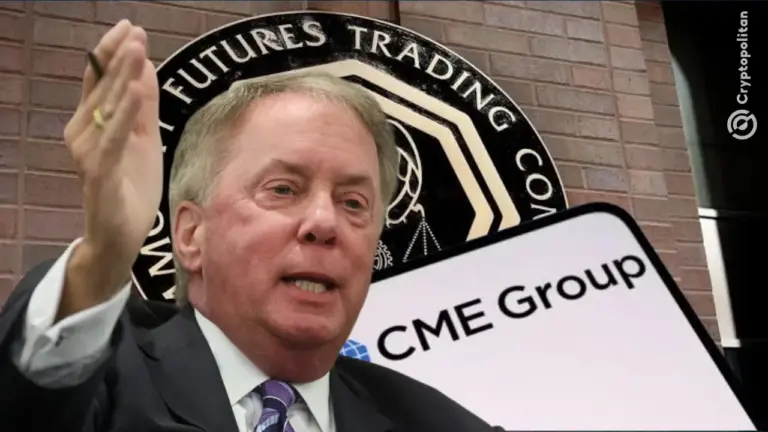
At the CFTC’s Innovation Advisory Committee meeting, Duffy criticized the number of event contracts that exchanges have self-certified rather than submitted for review. He pointed to contracts involving what President Donald Trump might say in his State of the Union address and when Venezuelan President Nicolás Maduro might be removed from power.
“There are definitely people who are manipulating these contracts,” Duffy said, according to The Block’s Sarah Wynn. “That is not good for our industry. That is horrible for our industry.”
There is a certain irony to his warning. CME embraced event contracts, announcing in February that it had cleared 100 million such contracts since launching the product in December. Duffy pointed to this as evidence of demand coming from “the next generation of potential traders.”
However, on Thursday, he tied the integrity of the marketplace to Trump’s vision of the U.S. becoming the “crypto capital of the world,” saying that questionable contracts jeopardize that endeavor.
Selig fires back with “fake news”
CFTC Chair Michael Selig immediately challenged Duffy’s examples, saying the contracts he cited were never listed in the United States.
“This occurred offshore, and that’s fake news,” Selig said.
Duffy held his ground. “I’m just bringing it up, that’s not good for markets,” he answered.
This situation illustrates a larger battle over jurisdiction. While Selig contended that the CFTC had “exclusive jurisdiction” over prediction markets, including sports contracts, many states insist that such products are gambling products subject to state law.
The commission is considering additional rule changes and stronger retail protections. “We’ve heard the concerns of public commenters about inadequate consumer protections for retail loud and clear,” Selig said Thursday.
Insider-trading scandals feed the backlash
Congress is also examining prediction markets following two cases that received much media attention. A U.S. soldier has been charged with placing bets about the capture of Venezuela’s President Maduro using classified information. Meanwhile, a well-known teleprompter operator of Donald Trump is suspected of betting on Kalshi about events occurring at the State of the Union address following tip-offs about them.
Lawmakers have proposed restrictions on sports and casino-style contracts, while the Senate has passed a measure barring its own members from trading on prediction markets. Kalshi and Polymarket have both announced new controls aimed at manipulation and insider activity.
The tensions became personal when Kalshi COO Luana Lopes Lara asked Duffy whether CME had ever faced manipulation.
“I have more people in my regulatory department than you and your entire company,” Duffy replied.
“Maybe you should learn a bit about efficiency then,” Lopes Lara shot back.
“Maybe you should learn about credible markets,” Duffy answered.
Why crypto traders should track this
The dispute is already in court. As Cryptopolitan has reported, CME sued the CFTC and Selig in June over the agency’s approval of Kalshi, arguing that the products should fall under swaps rules rather than futures regulation.
That decision matters well beyond prediction markets. Kalshi has since expanded into crypto perpetuals, offering contracts across 13 cryptocurrencies after BTCPERP launched on June 3.
If CME succeeds in challenging the CFTC’s framework, the precedent supporting those products could also weaken. That would put not only prediction markets but also some of crypto’s newest regulated derivatives rails under renewed legal scrutiny.
                     U.S. FEDERAL GOVERNMENT
                              │
                              ▼
                ┌──────────────────────────┐
                │           CFTC           │
                │ Commodity Futures        │
                │ Trading Commission       │
                └────────────┬─────────────┘
                             │
              Federal derivatives authority
                             │
         ┌──────────────────┴─────────────────┐
         ▼                                    ▼
  ┌───────────────┐                    ┌───────────────┐
  │    KALSHI     │                    │  OTHER DCMs   │
  │ prediction    │                    │ / derivatives │
  │ market        │                    │    venues     │
  └───────┬───────┘                    └───────────────┘
          │
          │
          │          DISPUTE
          │             ▲
          ▼             │
 ┌──────────────────────┴─────────────────────┐
 │             STATE AUTHORITIES               │
 │ Gaming regulators + state attorneys general │
 └──────────────────────┬─────────────────────┘
                        │
                Gambling-law claims
                        │
                        ▼
              ┌────────────────────┐
              │   FEDERAL COURTS   │
              │ Decide whether     │
              │ federal authority  │
              │ preempts state law │
              └────────────────────┘
This is the actual story: there isn’t one straight hierarchy. There are three overlapping power centers:
- CFTC says federally regulated derivatives/event contracts fall under federal commodities law.
- States argue that sports/event contracts can constitute gambling under state law.
- Federal courts increasingly have to decide where federal jurisdiction ends and state authority begins.
Recent litigation demonstrates that this is not theoretical. Washington ordered Kalshi to restrict several markets, while the CFTC has taken the opposite position in its broader fight with state regulators.
If you're reading this, you’re already ahead. Stay there with our newsletter.
FAQs
What did CME's Terry Duffy say about prediction markets?
Duffy said some event contracts are vulnerable to manipulation, called the practice "horrible for our industry," and pointed to self-certified bets on Trump's State of the Union remarks and Maduro's ouster as examples.
Why is CME suing the CFTC?
CME filed suit against the CFTC and Chair Michael Selig in June over the agency's approval of Kalshi's perpetual futures, arguing the crypto-style products should be regulated as swaps rather than futures.
How large are prediction markets right now?
They generated $63.5 billion in volume in 2025, more than triple the prior year, and Kalshi and Polymarket alone combined for $52.7 billion in the first 86 days of 2026, according to Artemis.
Disclaimer. The information provided is not trading advice. Cryptopolitan.com holds no liability for any investments made based on the information provided on this page. We strongly recommend independent research and/or consultation with a qualified professional before making any investment decisions.

Ashish Kumar
Ashish Kumar is a crypto and financial journalist with eight years of newsroom experience. He covers what’s happening with crypto markets, regulation, DeFi, and exchange ecosystems. He has worked with Coingape, Todayq, and Newsroompost. Ashish holds a PGDP in English Journalism from the IIMC. He has also interviewed industry figures including Arthur Hayes, Yat Siu, Austin Federa, and more.









