






China’s police force gains humanoid recruits as robotics push enters new stage

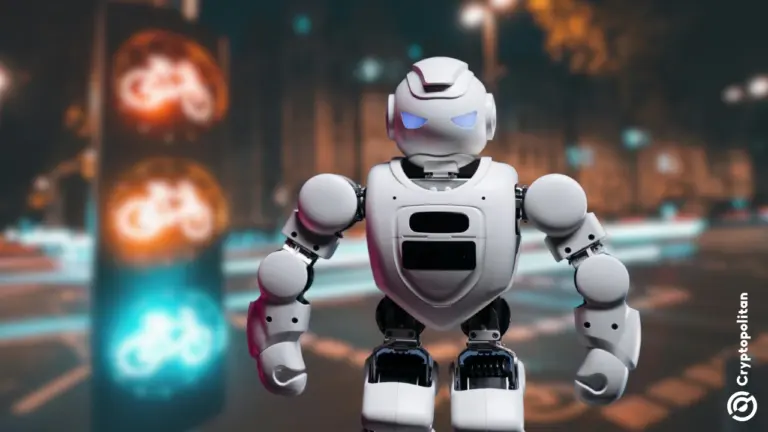
- Hangzhou has run 15 humanoid traffic robots around West Lake since May.
- The robots direct traffic and log violations, but cannot stop or fine anyone.
- Municipal police contracts like this could help a Chinese robotics industry struggling to find paying customers.
As the 2026 World Robot Conference kicked off in China on August 19 with roughly 3,000 products on display, the humanoid robots that have patrolled the Hangzhou West Lake area have stolen the headlines as a signal that the country is ready to move robots from exhibition halls to the streets.
The fifteen-humanoid unit that started to operate on May 1 is not exactly the full Robocop experience, as they cannot make arrests or even issue fines.
Their job, as far as they are currently deployed, is to guide pedestrians and give directions. They also record traffic violations, such as helmetless e-bike riders, riders carrying illegal passengers, vehicles stopping past the marked line, and pedestrians crossing against the signal.
Enforcement decisions are still reserved for human officers.
How China’s ‘robocops’ work
Local Chinese startup SUPCON Information built the wheeled humanoid “robocops” currently deployed in Hangzhou. The dimensions of the unit that the firm named the T2 come in at 1.88 meters in height and 98 kilograms in weight.
The T2 has two seven-jointed arms programmed with eight traffic-command gestures approved by the Ministry of Public Security. The robots cycle through those gestures in sync with traffic signals.
Cao Hui, who leads SUPCON’s intelligent unmanned systems innovation center, told Reuters that the T2 does its job with a system of cameras, radar, and onboard computing.
When the T2 humanoid robot’s cameras spot a violation, it issues at least three voice warnings and writes and files the incident to the traffic police bureau’s early warning center. That’s as far as the robots go. From there, a human assesses the report and decides what follows.
Officials talking about the workflow said it simultaneously frees officers from repetitive street duty, shouting warnings and blowing whistles, while also protecting citizens from getting tickets over malfunctions from automated systems.
SUPCON told Reuters it is already looking at expanding its eight-city, 50-robot fleet to around 200 by the end of 2026.
As for international growth, which is the natural next step for China’s best, local certification and data-protection hurdles are expected to be higher than those for typical tech exports such as cars, for example.
The domestic robotics scene is running hot
The street deployments arrive as China stages a broad show of robotics ambition. The 2026 World Robot Conference opened in Beijing on August 19 with ping-pong-playing humanoids and helper robots that spent several minutes failing to fold a shirt among the roughly 3,000 products on display, according to the Associated Press.
The same day, Unitree Robotics listed in Shanghai and closed up more than 600%, as reported by Cryptopolitan.
The reason city contracts matter to that valuation is simple: China shipped tens of thousands of humanoids in the first half of this year, and outside laboratories, public buyers are among the few customers actually paying for them.
The commercial demand problem the sector keeps citing has not been solved by one city buying 15 units, but public procurement tends to be patient in a way consumers are not.
The smartest crypto minds already read our newsletter. Want in? Join them.
FAQs
What can China's robot traffic police actually do?
They direct traffic with approved hand gestures, detect violations such as helmetless riding and crossing against signals, and answer tourists' navigation questions through an onboard speech model. They cannot detain or fine anyone; they log violations and forward them to a human-run early warning center.
How many robot traffic police has China deployed?
SUPCON deployed 15 in Hangzhou starting May 1, and told Reuters that close to 50 now operate across about eight cities in three provinces, with deployments expected to reach nearly 200 by the end of 2026.
Why did Unitree's stock market debut draw attention?
Unitree listed in Shanghai on August 19 and closed up more than 600%, according to Cryptopolitan, marking the first mainland listing by a Chinese humanoid robot maker and a milestone for Beijing's robotics ambitions.

Hannah Collymore
Hannah is a writer and editor with nearly a decade of blog writing and event reporting experience in the crypto space. At Cryptopolitan, Hannah contributes to the news page, reporting and analyzing the latest developments in DeFi, RWA, crypto regulation, AI and frontier tech industries. She graduated from Arcadia university with a degree in Business Administration.









