






Prediction markets land on ESMA radar over insider trading, authorization questions

Source: ESMA website.
- ESMA warned in a Thursday risk report that Polymarket, Kalshi and other prediction markets lack the authorization needed to serve EU users.
- The authorities said their contracts may already breach binary options bans, MiCA or national gambling rules.
- Insider-trading enforcement only applies where a contract counts as a financial instrument, leaving a gap that the regulator has now flagged.
The European Securities and Markets Authority (ESMA) has said that Polymarket and Kalshi do not hold the authorization required to sell event contracts to users across the bloc.
Several countries are making moves to either regulate or outrightly ban prediction market platforms due to concerns about insider trading, manipulation and much more.
Why are prediction markets not authorized in Europe?
The European Securities and Markets Authority (ESMA) has said that “the marketing and sale of event contracts in the EU generally requires an EU authorisation” which apparently the largest prediction market platforms, including Kalshi and Polymarket, currently do not hold.
ESMA said it is unclear why all EU member states are not blocked and went further to question whether the sites can realistically stop users from masking their location with a VPN.
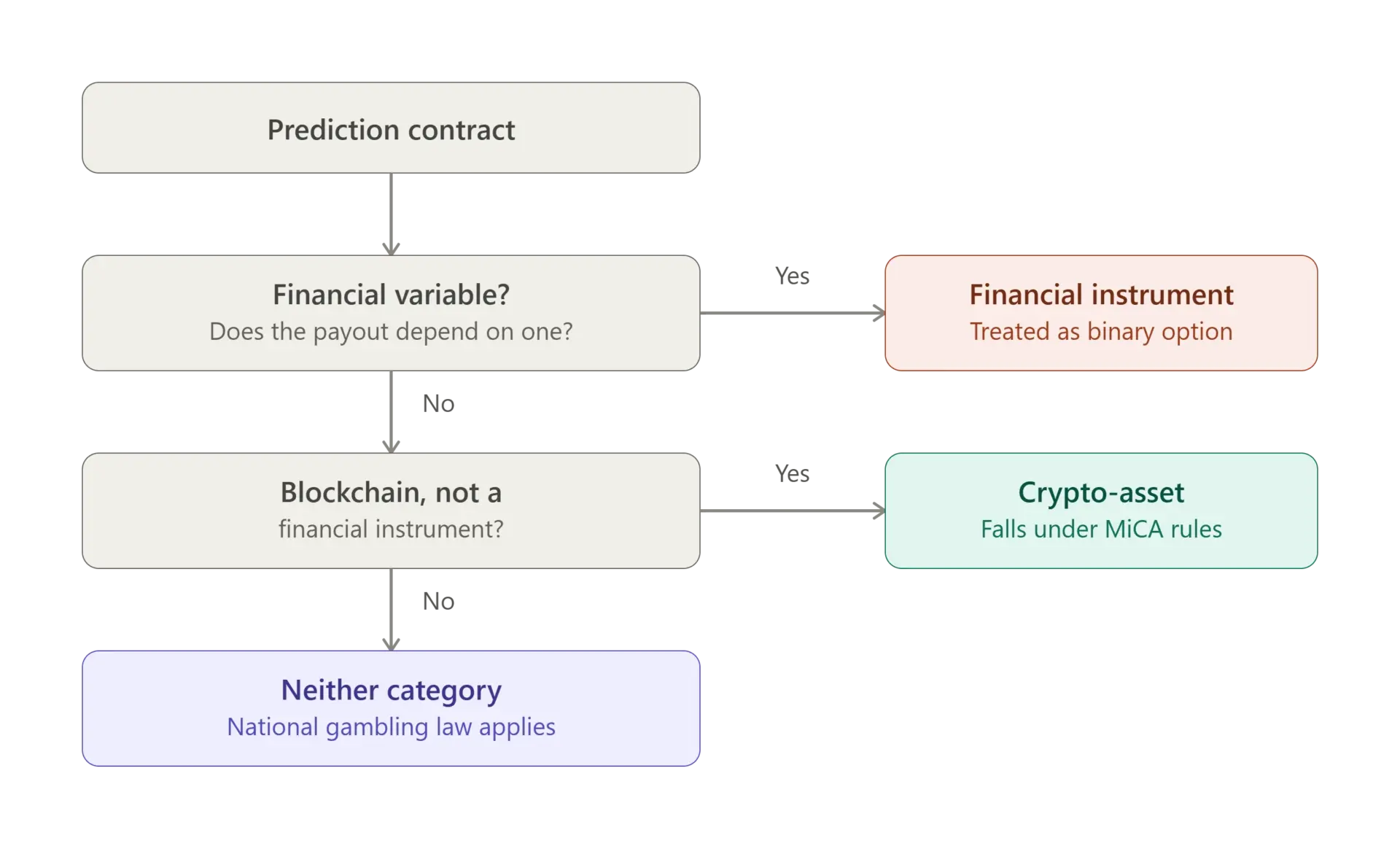
Prediction contracts, depending on what they reference, can belong to one of three regimes.
For instance, in a situation where a contract’s payout hinges on a financial variable, ESMA treats it as economically close to a binary option, the all-or-nothing product the EU barred from retail investors years ago after heavy consumer losses. National intervention measures already ban the marketing, distribution and sale of those to retail clients.
If a contract uses blockchain technology but is not a financial instrument, it may fall under the Markets in Crypto-Assets (MiCA) rules, and if it fits neither of the previous two categories, then it falls under national gambling laws, which differ from one EU country to another.
Back in July, ESMA already said that existing binary options rules cover event contracts that count as financial instruments. The law firm Norton Rose Fulbright traced this same logic back to MiFID II, the rulebook that defines what a financial instrument is. Analysts cited by the firm think prediction-market volumes could reach $1 trillion by 2030.
Do Europe’s insider trading rules apply to prediction markets?
Europe’s rules against insider trading only apply when a contract counts as a financial instrument.
Cryptopolitan reported that nine European gambling regulators moved against unlicensed platforms during the FIFA World Cup. Swiss authority Gespa director Manuel Richard’s reasons for acting against the platforms include insider trading, manipulation and money laundering, among other risks that these sites carry with no required safeguards.
France ordered internet providers to cut off Polymarket in July, adding to blocks from Switzerland, Poland, Belgium, Portugal, Spain, Singapore and Brazil.
Spain’s Consumer Rights Ministry used ISP-level DNS and network blocks to temporarily ban both Kalshi and Polymarket in May due to their missing gambling licenses.
If you're reading this, you’re already ahead. Stay there with our newsletter.
FAQs
Why does ESMA say Polymarket and Kalshi are not authorized in the EU?
ESMA said selling event contracts in the EU generally requires an EU authorization that the largest prediction-market platforms do not currently hold, and it questioned why the sites restrict some member states but not all.
How can a prediction-market contract be regulated in the EU?
Depending on what it references, a contract can be treated as a binary option under existing financial rules, fall under the MiCA framework if it is on distributed-ledger technology and not a financial instrument, or count as gambling under national law.
Which European countries have already blocked prediction markets?
France ordered providers to block Polymarket in July and Spain imposed a temporary ban in May, adding to restrictions from Switzerland, Poland, Belgium, Portugal, Singapore and Brazil.
Disclaimer. The information provided is not trading advice. Cryptopolitan.com holds no liability for any investments made based on the information provided on this page. We strongly recommend independent research and/or consultation with a qualified professional before making any investment decisions.

Hannah Collymore
Hannah is a writer and editor with nearly a decade of blog writing and event reporting experience in the crypto space. At Cryptopolitan, Hannah contributes to the news page, reporting and analyzing the latest developments in DeFi, RWA, crypto regulation, AI and frontier tech industries. She graduated from Arcadia university with a degree in Business Administration.









