






SpaceXAI to SpaceXSI: Musk takes Trump’s rebrand further than any other tech CEO

Photo by Samuel Regan-Asante (Unsplash)
- Trump’s September 29 executive order directs the federal government to call artificial intelligence “super intelligence.”
- Elon Musk fully endorsed the “better” name and teased renaming SpaceXAI as SpaceXSI.
- Polls, California’s governor, and some Republicans have already rejected the relabel.
Elon Musk has jumped onboard the “super intelligence” train after President Donald Trump’s order to drop the artificial intelligence name that has become mainstream since OpenAI’s ChatGPT popularized the technology in 2022.
Musk expressed his commitment to the cause on Sunday, posting on X that “No more AI. SI. It’s better.” Asked whether super intelligence will replace artificial intelligence in the SpaceXAI name, Musk replied, “Yes, we will make that change,” referring to renaming his company as “SpaceXSI.”
In another X post on the same day, the billionaire wrote “SpaceX is a super intelligence company.”
Musk is ready for the Trump super intelligence era
President Donald Trump’s order to rename artificial intelligence “super intelligence” across the federal government will take some getting used to, even for Musk, who has given his endorsement for the super intelligence rebrand.
The xAI founder had to correct himself after using the “AI” term when he spoke at the September 29 White House summit. He even earned a Trump pat on the elbow when he corrected himself after the slip.
Musk’s commitment to “SI,” to the point of teasing renaming his company, is further along on the spectrum than other attendees and major tech executives, who have mostly reserved using the new name at government meetings.
Google, Anthropic, Meta, OpenAI, xAI, and Nvidia executives were all present at the White House summit and signed the Accord on Super Intelligence pledge.
President Trump signed Executive Order 14434 on September 29, telling executive departments and agencies to replace “Artificial Intelligence” and “AI” with “Super Intelligence” and “SI” in official capacities, including public communications, websites, reports, and other non-statutory documents. In places where the law allows, the order also gave the directive to stop acknowledging the older terms.
The order does not roll back existing regulations, contracts, or past presidential actions.
The next development on the renaming front should come within 60 days of signing the order, when Trump is expected to receive proposed legislative language defining “Super Intelligence” from the Assistant to the President for Science and Technology.
Why Trump wants a new name for AI
AI and the data centers that power them had a negative reputation hung on them, from AI agents hacking third-party sites, including government domains, to broader pushback against data centers from communities.
Some in Washington and the industry see a different name without all the negative baggage as a damage-control lever. Trump also favored dropping “a fake word” for “the word super.”
Nvidia’s Jensen Huang has already adopted the super intelligence name, now choosing to refer to data centers as “super intelligence factories.”
Newsom, a skeptical public, and a contested word
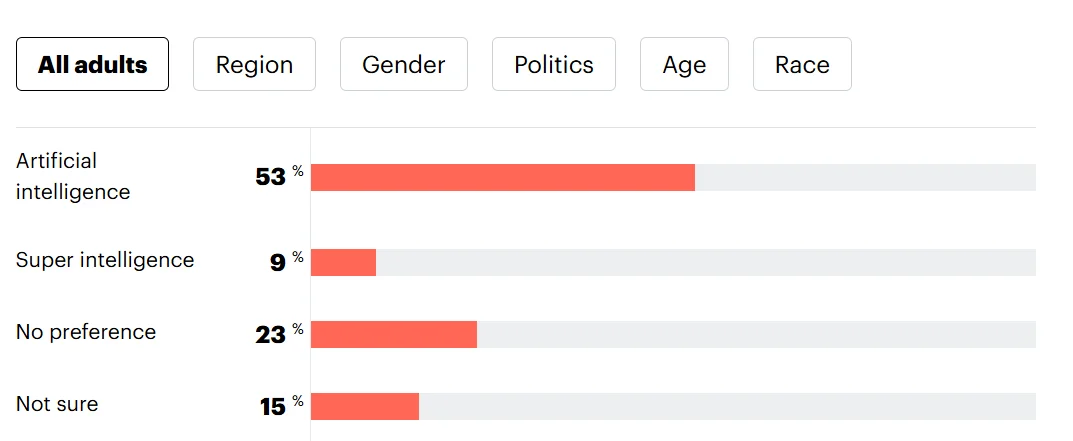
The new name, as much as POTUS likes it, is not very popular outside a small circle. 53% of respondents of a YouGov poll preferred “artificial intelligence” over the 9% who supported the new “super intelligence” name.
By September 30, California Governor Gavin Newsom had signed his own order to stick to the “artificial intelligence” name. Newsom called out the tactic, saying that renaming something “cannot distract a person of normal intelligence” from the failure to address its safety risks.
David Krueger, an AI professor and founder of the Evitable nonprofit, called the move a “word games” that add confusion, as “Superintelligence is already a word, and it means something different than AI.”
The label has even opened a rift on the right, after Florida Governor Ron DeSantis took a shot at Huang on September 30, posting “Superintelligence factories = surveillance centers.”
This president likes to rename things
The AI-to-SI switch fits a pattern. Cryptopolitan has previously reported on Trump’s habit of renaming landmarks and institutions, from declaring the Gulf of Mexico the Gulf of America and restoring Mount McKinley over Denali, to floating “Lake America” for Lake Ontario and recasting the Pentagon as the “Department of War.”
One executive, speaking to Axios, compared the SI push directly to the Gulf of America relabeling, which some oil companies adopted and others ignored.
So far, the leading AI labs have not renamed their models, and several told Axios they expect “SI” to live mostly inside dealings with the president.
If you're reading this, you’re already ahead. Stay there with our newsletter.
FAQs
What did Trump's executive order on AI actually do?
Executive Order 14434, signed September 29, directs executive branch agencies to use "Super Intelligence" and "SI" instead of "Artificial Intelligence" and "AI" in non-statutory documents and public communications, while leaving existing regulations and contracts untouched.
How did Elon Musk respond to the rebrand?
At the White House summit Musk caught himself mid-sentence and corrected "AI" to "SI," later reverted to "AI" in an X post that day, then on Sunday posted "No more AI. SI. It's better," giving the rename its strongest tech-CEO endorsement.
Do Americans and officials support calling AI "super intelligence"?
Largely no. A YouGov poll found 53% preferred "artificial intelligence" versus 9% for "super intelligence," California Governor Gavin Newsom ordered state agencies to keep using "AI," and Florida Governor Ron DeSantis mocked the related "superintelligence factories" phrasing.

Hannah Collymore
Hannah is a writer and editor with nearly a decade of blog writing and event reporting experience in the crypto space. At Cryptopolitan, Hannah contributes to the news page, reporting and analyzing the latest developments in DeFi, RWA, crypto regulation, AI and frontier tech industries. She graduated from Arcadia university with a degree in Business Administration.









