







- FinCEN cut MEXC Global off from the US financial system on November 6 using Section 9714.
- The order takes effect 30 days after it is published in the Federal Register.
- MEXC founder Vugar Usi is using that window to open talks with the agency through US law firms.
MEXC Global founder Vugar Usi has indicated that the crypto exchange is ready to fight to avert the blacklisting the exchange faces in the United States.
The one-month countdown to the US cutoff started when the Financial Crimes Enforcement Network (FinCEN) sent out a November 6 order under Section 9714 of the Combating Russian Money Laundering Act. The 30-day timer starts on the date the order appears on the Federal Register.
How MEXC is responding to the FinCEN order
Usi is treating the 30-day runway as the time to open a negotiating channel with the US agency. On X, he said MEXC had opened a line to FinCEN “through the support of top-tier U.S. law firms” and that the agency confirmed it received MEXC’s written request yesterday morning, US time.
“We are ready to fully cooperate,” Usi wrote, adding that the platform “continues to operate normally.”
MEXC’s corporate account struck the same note days earlier, saying it was reviewing the November 6 order with its legal and compliance teams and that user assets remained secure. The exchange also opened an independent review of its anti-money-laundering and sanctions controls.
What is the Section 9714 order?
Section 9714 is an authority that FinCEN can use to specifically target foreign firms that it deems a “primary money laundering concern in connection with Russian illicit finance.” By invoking the order, it can block such firms from sending or receiving funds from US institutions.
The agency does not often invoke Section 9714. In fact, before MEXC, it had only hit two firms with that designation: Bitzlato and PM2BTC in January 2023 and September 2024, respectively. Neither of the targets then was anywhere near the scale of the MEXC exchange.
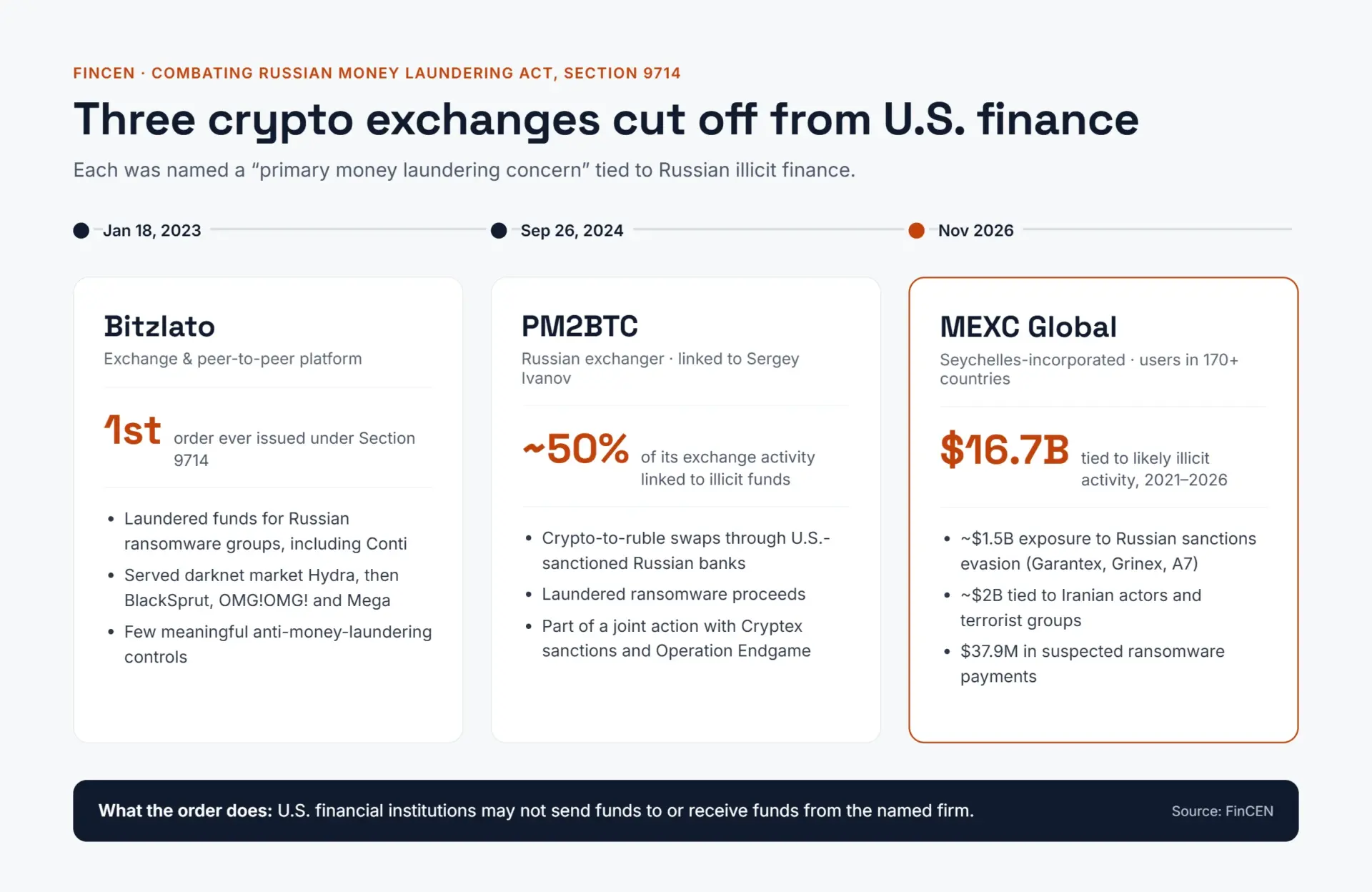
The FinCEN order noted that the exchange processed more than $1 billion in daily transaction volumes and had about $5 billion in reserves as of June 2026. The exchange saw near $810 million over the last 24 hours, per CoinMarketCap data.
Why FinCEN is targeting MEXC
FinCEN is targeting the exchange in a case going from May 2021 to May 2026, as Cryptopolitan reported. The agency alleges that MEXC processed roughly $1.5 billion linked to Russian sanctions evasion as part of a five-year period in which it processed around $16.7 billion in illicit activity transactions.
The exchange was also implicated over its ties with the Russian state-backed payments network, A7, which also issues the A7A5 ruble-pegged stablecoin. Cryptopolitan reported in early October that the US Treasury hit A7 with a significant transnational criminal organization designation.
The FinCEN order prohibits US institutions from sending or receiving funds from MEXC. It does not apply to firms registered outside the US, and the exchange’s non-US business is not expected to be affected.
OKX founder Star Xu has already warned users not to send funds directly from MEXC to OKX following user complaints that USDT deposits were being flagged and frozen. Binance has also announced that it will stop processing transfers involving the exchange.
Don’t just read crypto news. Understand it. Subscribe to our newsletter. It's free.
FAQs
What did FinCEN actually prohibit?
FinCEN barred US financial institutions from transmitting funds, in fiat or crypto, to or from MEXC Global under Section 9714, with the restriction taking effect 30 days after Federal Register publication. It does not order MEXC to shut down or bind firms outside US jurisdiction.
Why was MEXC targeted?
FinCEN found MEXC processed roughly $16.7 billion in illicit-linked transactions between May 2021 and May 2026, including about $1.5 billion tied to Russian sanctions evasion and $232 million moving directly with sanctioned entities, plus activity connected to the A7 network and its A7A5 token.
How has MEXC responded?
Founder Vugar Usi said on X that MEXC has established communication with FinCEN through US law firms, that the agency confirmed receipt of its written request, and that the platform is operating normally; the exchange has also begun an independent review of its AML and sanctions controls.
Disclaimer. The information provided is not trading advice. Cryptopolitan.com holds no liability for any investments made based on the information provided on this page. We strongly recommend independent research and/or consultation with a qualified professional before making any investment decisions.

Hannah Collymore
Hannah is a writer and editor with nearly a decade of blog writing and event reporting experience in the crypto space. At Cryptopolitan, Hannah contributes to the news page, reporting and analyzing the latest developments in DeFi, RWA, crypto regulation, AI and frontier tech industries. She graduated from Arcadia university with a degree in Business Administration.









