





EU calls on industry to write tokenization standards as ECB races to head off fragmentation


- The ECB, European Commission and ESMA have opened nominations for an industry-led group to draft common standards for tokenized securities.
- Applications are due November 27, work starts in January 2027 and the first standards are not expected until early 2028.
- The institutions say fragmentation across incompatible DLT platforms and unclear national rules could split Europe’s tokenized market before it scales.
Applications have opened for participants who want to join the industry group drafting common standards for tokenized finance markets in Europe on Monday, November 9, and will stay open through November 27.
The nomination window was declared open by the trio of the European Central Bank (ECB), European Commission and the European Securities and Markets Authority (ESMA), becoming the latest development in a year-long tokenization framework push in 2026.
Notably, the group’s first rules draft is not due until early 2028.
Who can apply for the EU’s tokenization group?
The ECB, ESMA and the European Commission have confirmed that the application for membership in the European Tokenisation Standards Group (ETSG) is open to trade associations, global institutions, private firms, fintechs and technical providers operating within the bloc.
The application, which the regulators declared open on November 9 will continue to receive applicants until November 27. Work begins for the selected applicants in January 2027.
ETSG members are tasked with the mandate of reaching a consensus on the technical details and market standards for holding and settling tokenized securities across different distributed ledger technology (DLT) platforms, while maintaining compatibility with the financial systems already operating across the EU.
The ETSG is also meant to build a monitoring system for EU authorities to track whether members actually use the standards. The group may also recommend a framework to ensure broad adoption.
The ECB, the Commission and ESMA will only hold observer roles without any voting power within the ETSG. All the active roles, including group chair, are reserved for the industry participants added to the ETSG.
Why the EU is pushing the ETSG
The trio of European institutions leading the ETSG push shares a joint perspective that the bloc’s tokenized market could split into smaller factions without deliberate effort to ensure cohesion.
The EuroGroup warned in a July 2026 statement that “without shared standards, the multiplication of DLT networks risks recreating and compounding the fragmentation.”
The mandate makes the same argument now that the silos that became a feature of the legacy system should first be cleared as the bloc opens up to tokenization.
ECB Executive Board member Piero Cipollone noted the scale of the fragmentation at a Frankfurt symposium in August. Cipollone pointed to the 31 central securities depositories, 14 central counterparties and 323 trading venues operating across Europe to make his point.
More than 95% of securities transactions settled inside a single depository, with thin cross-border settlement as of 2023, according to Cipollone, who is concerned that adding a new generation of incompatible platforms would only compound the fragmentation problem.
The EU’s 2026 tokenization sprint
The ETSG sits alongside a broader tokenization push across Europe. Asset interoperability and standards sit in the first of Appia’s six building blocks. Appia is the Eurosystem roadmap for an integrated tokenized financial market, published by the ECB in March 2026.
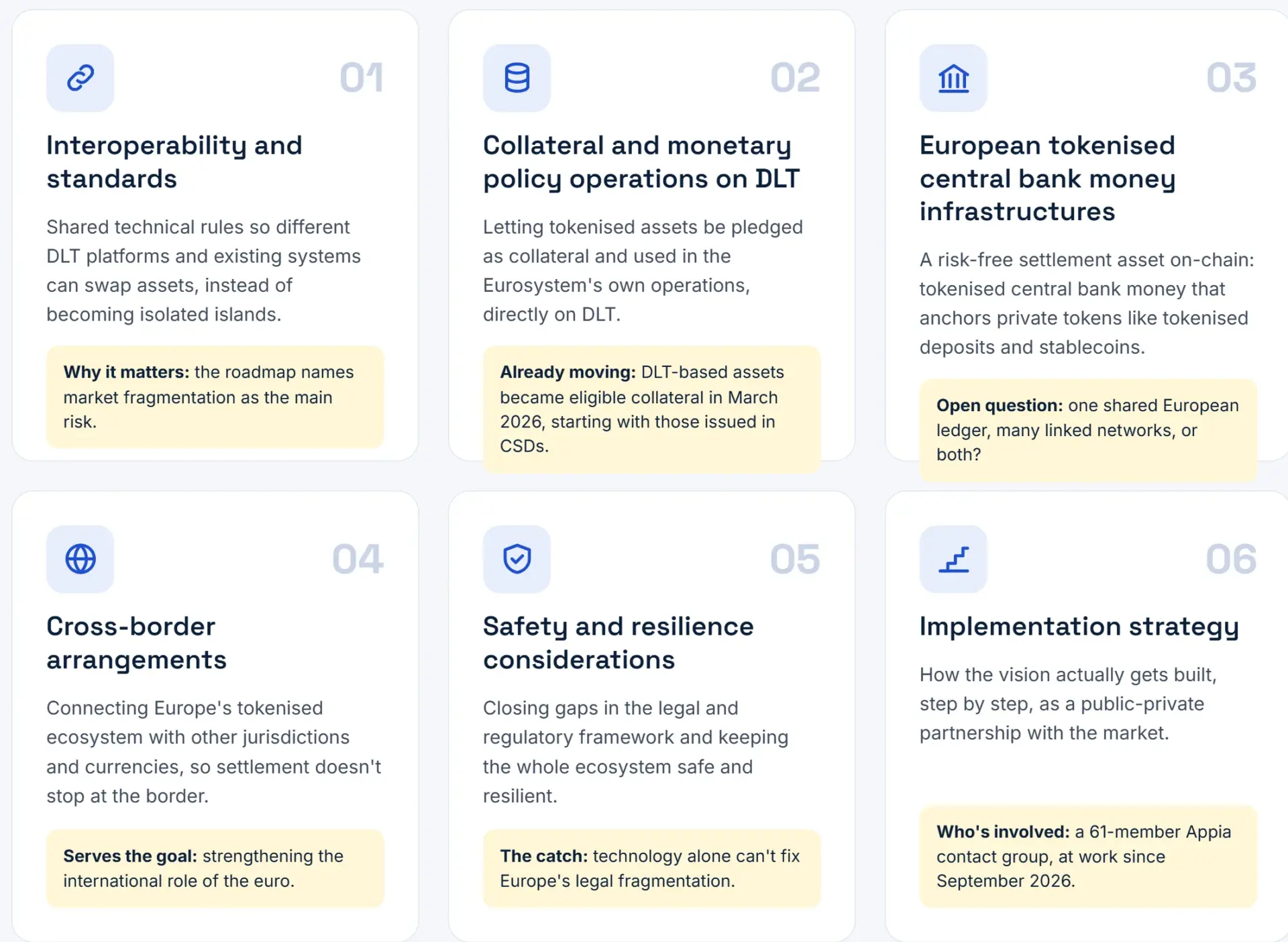
The Eurosystem launched Pontes in September 2026, as Cryptopolitan reported at the time. The system links private DLT platforms to the ECB’s settlement services so the cash leg of a tokenized trade can settle in central bank money.
Cipollone has argued that access to central bank money is a condition for tokenized finance to scale safely, not an add-on feature. He pointed to tokenized assets on public blockchains rising roughly fivefold between March 2025 and March 2026 as a sign the market is moving from testing toward early use.
The ETSG’s next goal is to publish an initial set of standards by early 2028, the same timeline the ECB set for its Appia blueprint.
Cipollone has flagged that technology alone will not close it. Advanced systems, he said in August, cannot make up for fragmented law, and he called for clearer, harmonized legal rules alongside the technical work.
ESMA is chasing part of that separately: it has a running call for evidence on whether tokenized collateral can survive a market crisis, with responses due by January 15, 2027.
The smartest crypto minds already read our newsletter. Want in? Join them.
FAQs
What is the European Tokenisation Standards Group?
It is an industry-led group set up by the ECB, the European Commission and ESMA to agree on common standards for holding and settling tokenized securities across DLT platforms. Industry participants will chair it, while the three institutions act as observers.
When can firms apply, and when does the work begin?
Applications close on November 27, 2026, and the selected members start work in January 2027, according to the ESMA call for nominations. An initial set of standards is targeted for early 2028.
Why do EU authorities say standards are needed now?
They warn that a proliferation of incompatible DLT platforms could deepen the fragmentation already present in Europe's capital markets, where Cipollone counted 31 central securities depositories, 14 central counterparties and 323 trading venues, with over 95% of 2023 transactions settling inside a single depository.
Disclaimer. The information provided is not trading advice. Cryptopolitan.com holds no liability for any investments made based on the information provided on this page. We strongly recommend independent research and/or consultation with a qualified professional before making any investment decisions.

Hannah Collymore
Hannah is a writer and editor with nearly a decade of blog writing and event reporting experience in the crypto space. At Cryptopolitan, Hannah contributes to the news page, reporting and analyzing the latest developments in DeFi, RWA, crypto regulation, AI and frontier tech industries. She graduated from Arcadia university with a degree in Business Administration.









