








- The ECB launched Pontes, allowing banks settle tokenized asset trades in euro central-bank money through the existing TARGET system.
- It reinforces the ECB’s position to keep central-bank money as the settlement anchor rather than ceding that role to stablecoins.
- Pontes begins as a limited pilot, with a round-the-clock version and a longer-term project called Appia both targeted for 2028.
The European Central Bank (ECB) delivered its new Pontes Eurosystem rail on Monday, allowing banks to exclusively settle tokenized asset trades in money issued by the central bank, locking out privately issued stablecoins or bank deposits from the digital payment system.
ECB President Christine Lagarde confirmed the launch following the Eurogroup meeting, with the president due to make opening remarks at a Pontes roundtable in Frankfurt at 17:00 CET. The ECB’s schedule shows Executive Board member Piero Cipollone chairing a panel afterward.
What is the ECB’s Pontes platform?
Pontes, which translates as “bridges” in Latin, is an ECB’s project that connects distributed-ledger technology platforms run by market operators to the apex bank’s TARGET Services, which already allows banks to move large-value euro payments.
Axiology, one of the four distributed ledger technology (DLT) operators, along with Cashlink, Clearstream and SWIAT, runs a permissioned stack derived from XRP Ledger technology.
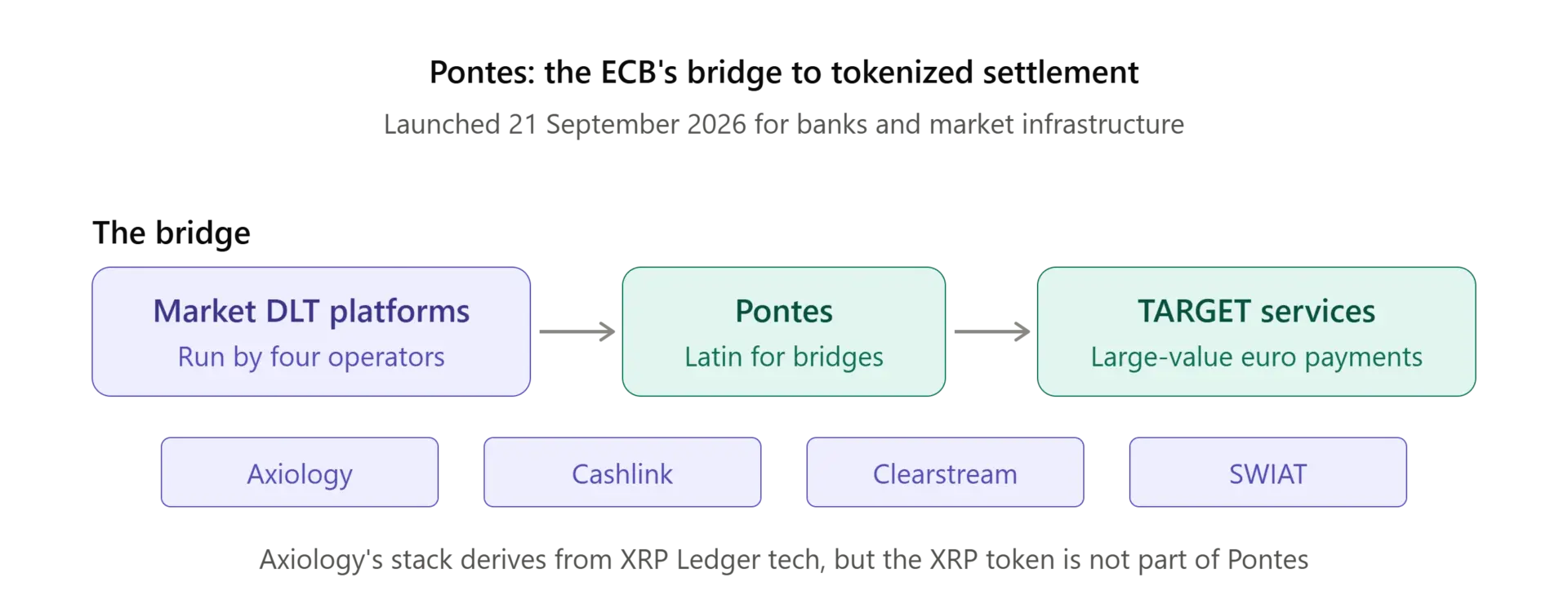
However, that does not mean that the XRP token or XRPL is included in the ECB’s Pontes project, which settles exclusively in euros issued by the central bank itself.
Pontes is separate from the digital euro that the ECB is developing for retail and households. The platform is built specifically for financial institutions and market infrastructure.
Why the ECB chose its own money as the anchor
The ECB’s choice of euro-denominated central-bank settlement over using stablecoins to settle the cash leg is in line with the central bank’s position regarding stablecoins and CBDCs, as Cryptopolitan has covered before.
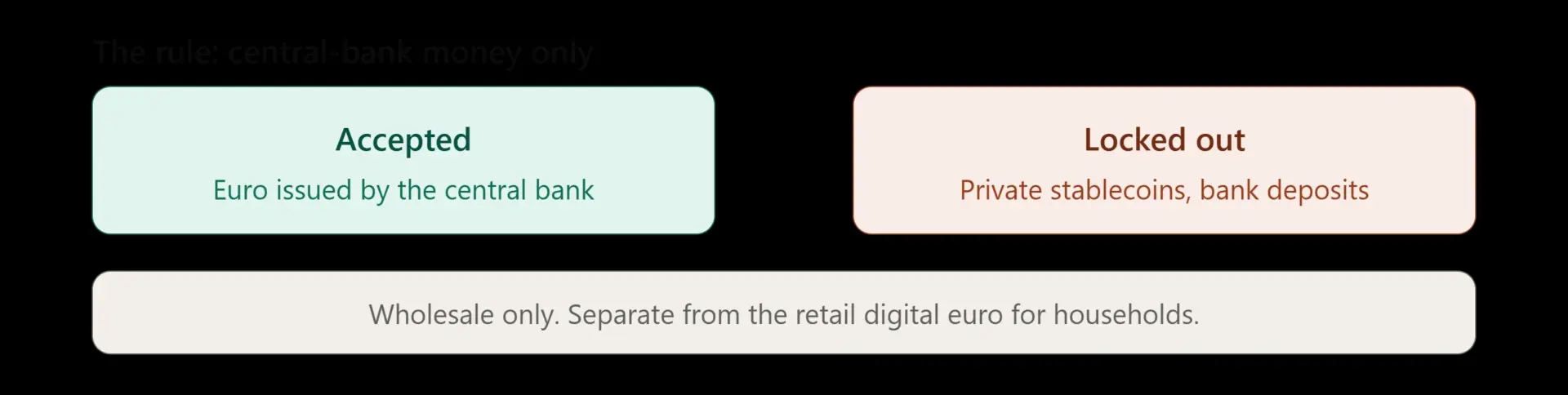
The Eurosystem’s perspective that tokenized commercial-bank deposits and regulated stablecoins may take on a larger role as markets adopt DLT, but that central-bank money “should remain the anchor for settlement,” was built into how Pontes works.
Pontes offers a dual-settlement model:
- Participants can settle using digital tokens that represent central-bank money on a Eurosystem DLT platform
- The other option is to settle in T2, the existing payment system.
Either way, the trade is only final once it is recorded in T2, which is what gives every settlement the same legal certainty the euro payment system provides today.
Built on €1.5 billion of testing
Pontes did not arrive from nowhere. Between May and November 2024, the Eurosystem ran more than 50 trials with 64 market participants, testing how DLT-based wholesale transactions could settle in central-bank money. A separate ECB assessment cited by EU Today put the value processed during that phase at more than €1.5 billion.
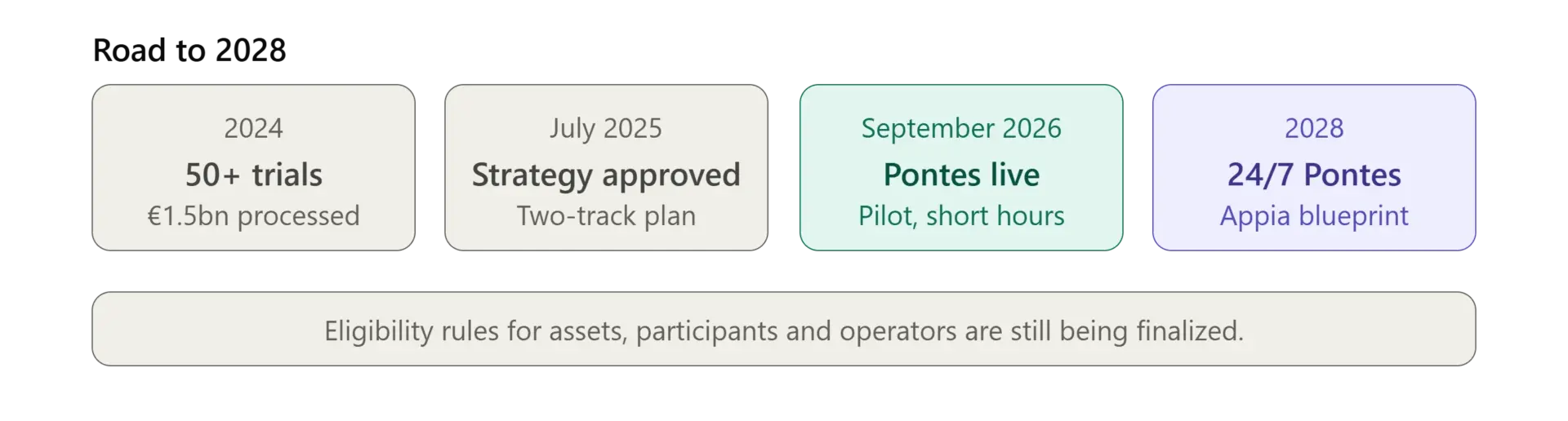
The ECB approved its tokenization strategy in July 2025 as a two-track plan, token-city.com reports. Pontes is the near-term track built to reach the market quickly; a second project, Appia, looks further ahead at a more deeply integrated ecosystem, with a blueprint expected in 2028.
Pontes itself starts as a focused pilot with limited operating hours, and an enhanced version designed to run around the clock is also targeted for 2028. The ECB is still finalizing eligibility criteria for the assets, participants and DLT operators that can join.
The smartest crypto minds already read our newsletter. Want in? Join them.
FAQs
What is Pontes and who can use it?
Pontes is a Eurosystem DLT solution that links market blockchain platforms with the ECB's TARGET Services so tokenized wholesale trades can settle in central-bank money. It is aimed at credit institutions and market infrastructure, not consumers.
Is Pontes the same as the digital euro?
No. The digital euro is a proposed retail currency for everyday payments by households and businesses and remains subject to the EU legislative process, while Pontes operates behind the financial system for wholesale settlement between banks and market participants.
When did Pontes launch and what comes next?
Pontes went live on Monday, September 21, 2026, starting as a focused pilot with limited operating hours. An enhanced version designed to run around the clock is expected by 2028, alongside a longer-term project called Appia.
Disclaimer. The information provided is not trading advice. Cryptopolitan.com holds no liability for any investments made based on the information provided on this page. We strongly recommend independent research and/or consultation with a qualified professional before making any investment decisions.

Hannah Collymore
Hannah is a writer and editor with nearly a decade of blog writing and event reporting experience in the crypto space. At Cryptopolitan, Hannah contributes to the news page, reporting and analyzing the latest developments in DeFi, RWA, crypto regulation, AI and frontier tech industries. She graduated from Arcadia university with a degree in Business Administration.









