







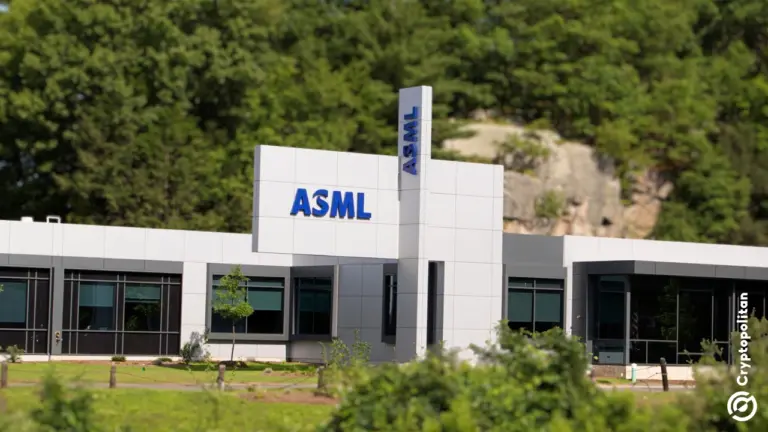
- ASML raised its 2026 revenue forecast and plans to expand chipmaking equipment capacity by 30%, reinforcing its pivotal role in the AI semiconductor supply chain.
- As the world’s only supplier of EUV lithography machines, ASML remains central to AI chip production, fueling speculation it could become Europe’s first trillion-dollar company.
- Investors will watch whether strong AI demand continues despite geopolitical export restrictions and manufacturing bottlenecks.
The biggest ASML story is no longer just its earnings—it is the growing belief that the company could become Europe’s first trillion-dollar company. It is expected to be driven by its dominant position in the AI semiconductor supply chain. ASML has increased its forecast revenue for 2026 to a range of between €43 billion and €45 billion ($49 billion to $51 billion), and it announced an expansion of manufacturing capacity by 30% in the next two years.
The significance of the news extends beyond the Netherlands-based provider of chip-making hardware. ASML is the sole supplier of the extreme ultraviolet (EUV) lithography system in the world; the company’s capability to manufacture more equipment will help eliminate one of the main limitations hampering the race for global AI capabilities.
For most of the past year, the pace of AI technology growth has been tied to a single corporation located in Veldhoven. ASML’s EUV systems can produce the highest-quality chips for Taiwan Semiconductor Manufacturing Co. (TSMC) and memory manufacturers Samsung and SK Hynix. But this time, the company provided more than just advertising of their growth plans.
The yearly Low-Numerical Aperture (NA) EUV production capacity might grow from 65 in 2026 to 85 in 2027, and Deep Ultraviolet (DUV) immersion capacity – from 130 to 170 units. In addition, they are examining the possibility of roughly a 30% increase in production capacity by the year 2028.
These figures reflect one of the telltale signs of easing the bottleneck of semiconductor production.
What the quarter showed
ASML reported second-quarter revenue of €9.3 billion and a net profit of €2.9 billion, with a gross margin of 54.0%, in its July 15 earnings report. During the quarter, ASML sold 86 new lithography machines, with basic earnings per share of €7.59.
Chief Executive Christophe Fouquet said customer orders remained “extremely strong” during the first half of the year as chipmakers continued accelerating capacity expansion. That confidence prompted ASML to lift its annual outlook for a second time this year. As Cryptopolitan previously reported, the new revenue forecast is about 16% higher at the midpoint than its earlier guidance of €36 billion to €40 billion.
The production roadmap also offers a glimpse into where the AI industry is headed. Since EUV systems take months to manufacture and install, ASML’s capacity plans reflect customer demand well beyond the next few quarters.
Can the run last?
ASML shares have risen by about 75% since the beginning of the year, reflecting investor expectations for healthy levels of AI investments. Nevertheless, the aggressive production goals of the company will have to be converted into products sold, and clients will have to keep transforming their expansion ideas into purchase orders.
Geopolitical issues are still a concern. An analysis by the Center for Strategic and International Studies revealed the proposed Multilateral Alignment of Technology Controls on Hardware Act, which would impose stricter regulations on the export of advanced lithography machines from ASML and Nikon as well as Canon from Japan. CSIS estimated that China contributed as much as 27% to ASML’s 2025 revenue, giving weight to any increased restrictions on exports.
In conjunction with its profits, ASML stated that during the quarter, it has made buybacks of about €1.1 billion in shares and announced an interim dividend of €1.88 per share for 2026, which must be paid on Aug. 5, 2026. The next test will be the ability of the customers to keep placing orders and the ability of ASML to fulfill its plan of upping annual EUV capacity to around 85 systems by 2027. If ASML succeeds in this effort, the company would not only be able to put an end to the AI chip shortage but would certainly remove one of the crucial barriers for the industry.
Where the bottleneck moves next
As lithography production continues to increase, other segments of AI production may face significant challenges. These include advanced packaging, high-bandwidth memory, and the power and cooling systems required for the large AI data centers being developed by companies such as Google and Amazon to support OpenAI and Anthropic models.
This change has already been reflected in the general predictions of the sector. SEMI anticipates that the global sales of semiconductor equipment will hit a historic maximum of $165.9 billion in 2026, which will be an increase of 23.2% from the previous year, and achieve at least $229.5 billion in 2028. Vice President of SEMI, Ajit Manocha, claims that the investment in the field of AI is responsible for the overall growth of expenditures related to modern logic elements, advanced memory, testing, and packaging.
When combined, ASML’s production projections and SEMI’s predictions imply that the foremost obstacle for this industry is going from chip-making to packaging, memory integration, and data center infrastructure.
The smartest crypto minds already read our newsletter. Want in? Join them.
FAQs
Why has ASML been a bottleneck for AI chips?
ASML is the only company that makes extreme ultraviolet (EUV) lithography machines needed to produce advanced logic and memory chips, and it can build only a few dozen a year, which limited how fast the sector could scale.
How much is ASML expanding capacity and raising its forecast?
The company pledged to add 30% to its capacity in each of the next two years and lifted its 2026 revenue outlook to €43 billion to €45 billion ($49 billion to $51 billion), about 16% above its earlier €36 billion to €40 billion range at the midpoint.
How large is the semiconductor equipment market expected to get?
SEMI forecast on July 14, 2026 that global semiconductor equipment sales will reach a record $165.9 billion in 2026, up 23.2% year on year, and grow to $229.5 billion by 2028, driven by AI demand.
Disclaimer. The information provided is not trading advice. Cryptopolitan.com holds no liability for any investments made based on the information provided on this page. We strongly recommend independent research and/or consultation with a qualified professional before making any investment decisions.

Ashish Kumar
Ashish Kumar is a crypto and financial journalist with eight years of newsroom experience. He covers what’s happening with crypto markets, regulation, DeFi, and exchange ecosystems. He has worked with Coingape, Todayq, and Newsroompost. Ashish holds a PGDP in English Journalism from the IIMC. He has also interviewed industry figures including Arthur Hayes, Yat Siu, Austin Federa, and more.









