







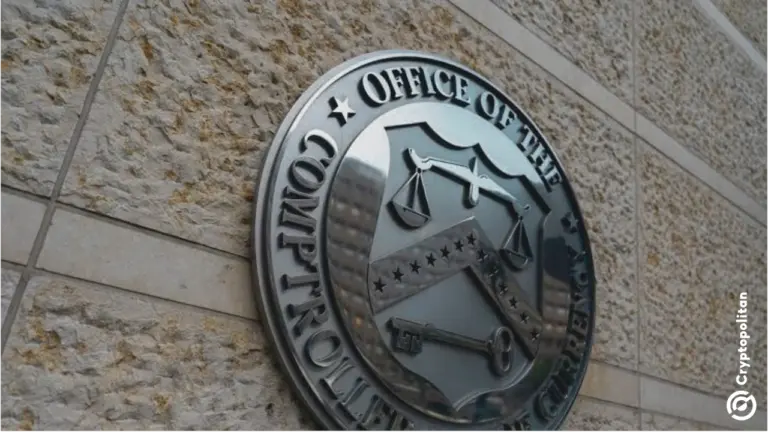
- The OCC’s final GENIUS Act stablecoin rule, published Wednesday and effective January 18, 2027, dropped a proposed presumption against certain third-party reward deals while keeping case-by-case enforcement of the ban on issuer-paid yield.
- Banking groups the ABA, BPI, and ICBA say the change undercuts Congress and threatens deposits and local lending, while the Blockchain Association calls it faithful to the statute.
- The OCC rule, not a stalled Congress, now governs whether crypto platforms can pay rewards on stablecoins.
Three American banking advocacy groups criticized the final stablecoin rule that were unveiled by the Office of the Comptroller of the Currency (OCC) on October 21, 2026. They raised their concerns about how the use of third-party rewards may lead to people withdrawing money from banks and it will negatively impact lending. Cryto advocates welcomed the changes saying that this is in accordance with the original intentions of Congress.
Three banking groups challenge the OCC
American Bankers Association (ABA) CEO Rob Nichols has made accusations against the regulator for allowing crypto companies to provide rewards in spite of the intentions of Congress to protect the lending industry. He stated that the harm may already be done before deposit outflows become apparent as was reported by The Block.
The ABA added that such practices might create confusion connected with the usage of stablecoins and traditional bank deposits.
Bank Policy Institute executive Paige Pidano Paridon condemned the ruling, saying it “replaces clarity with ambiguity.” Through her comments, she expressed that the unclear rules might expose banks to loss of deposits.
Similarly, Rebeca Romero Rainey, the CEO of Independent Community Bankers of America (ICBA), called for measures that will protect community banks in terms of lending.
What the OCC changed, and what it kept
The GENIUS Act prohibits the issuers of stablecoins from directly paying interest to the holders. However, there are still questions about the rewards received through exchanges and other intermediaries.
According to the proposal in February, some kinds of situations would be considered illegal unless they could be justified otherwise. But the final rule has abandoned this presumption. The regulators will assess each situation individually.
The OCC still has the right to act against any attempts to bypass the ban. The rule will be in force on January 18, 2027.
Crypto advocates welcome the change
Blockchain Association policy chief Lindsay Fraser welcomed the move, saying that it brings the regulation closer to what Congress was looking for. According to her, this could pave the way for more dollar-backed payments being made under federal authorities.
According to Jaret Seiberg of TD Cowen, however, uncertainty persists since both courts and future regulators might take different views of which reward arrangements are allowed.
Dueling numbers: $850 billion against $2.1 billion
ICBA estimates that the adoption of stablecoins could mean a decline in community bank lending of at least $850 billion. However, this figure represents a forecast rather than a set amount lost.
A different scenario was considered by the White House Council of Economic Advisers. Its April 2026 study concluded that the ban on stablecoin yield would result in a mere increase in lending of $2.1 billion but would introduce a welfare cost of $800 million.
Both estimates capture different effects and employ different assumptions.
The findings of a BIS analysis showed stablecoins and bank deposits competing for funds to a certain extent, without proving lending losses on either scale.

Why the dispute matters globally
The debate isn’t limited to U.S. banks.
Circle CEO Jeremy Allaire told Reuters that the company plans to expand into around 40 emerging markets. He pointed to growing demand across Asia, Africa, Latin America and the Middle East.
As more people worldwide turn to dollar-backed stablecoins, U.S. rules on rewards could influence how banks and digital payment providers compete for customers.
The smartest crypto minds already read our newsletter. Want in? Join them.
FAQs
What did the OCC change in its final stablecoin rule?
The OCC removed a proposed presumption that certain third-party reward arrangements count as banned yield, and will instead review such arrangements case by case while still enforcing the ban on issuers paying interest directly.
Why are banking groups opposed to the rule?
The ABA says it undermines Congress's intent to protect local lending, the BPI warns that case-by-case enforcement creates ambiguity and deposit-flight risk, and the ICBA estimates stablecoin adoption could cut community bank lending by at least $850 billion in coming years.
When does the OCC stablecoin rule take effect?
The final rule takes effect on January 18, 2027, the same day the GENIUS Act itself becomes effective, according to The Block and Cryptopolitan's reporting.
Disclaimer. The information provided is not trading advice. Cryptopolitan.com holds no liability for any investments made based on the information provided on this page. We strongly recommend independent research and/or consultation with a qualified professional before making any investment decisions.

Ibiam Wayas
Ibiam Wayas has covered the crypto news beat since 2019. He studied Computer Science at National Open University of Nigeria. His work has appeared on various crypto news platforms, including Coinfomania, Crypto News Australia, and AltcoinBuzz. Drawing on his background in Computer Science, he now focuses on crypto, robotics, and longevity news.









