







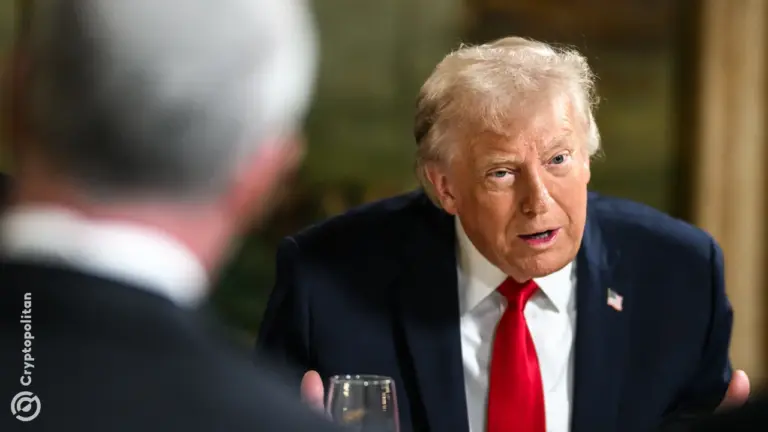
- The Trump administration is reportedly close to a national AI framework that would replace state-by-state AI rules with a single federal standard.
- The proposal aims to simplify AI regulation by centralizing oversight while addressing AI safety, deepfakes, and cybersecurity.
- Open-source AI remains the biggest unanswered issue, with no clear plan yet for regulating open-weight models.
The Trump administration is close to establishing a national framework for artificial intelligence, according to The Information. The initiative may cause a substantial change in the regulation of artificial intelligence, not only in the USA, but also in the global tech sector. This framework will take AI policy-making to Washington, clearing the way for the pile of state rules that the developers have to face nowadays.
This is significant because many of the best AI technologies are developed by American companies. The regulations that are enacted in Washington will undoubtedly have an effect on the work of businesses and other authorities outside of American borders. However, one vital issue still remains open: how will open-source AI be handled by the U.S. government?
Washington wants one rulebook instead of fifty
The main focus of the issue is the White House’s National Policy Framework for Artificial Intelligence, which was published on March 20, 2026. Though the title might suggest otherwise, the report is not a regulation or an executive order. The experts from Georgetown University’s Center for Security and Emerging Technologies (CSET) think that the framework is merely a legislative proposal for Congress and cannot be considered a working policy.
According to CSET analysts Mina Narayanan, Jessica Ji, and Vikram Venkatram, the document should be viewed as a starting point for negotiations. Instead of assuming Congress will accept the framework as is, they see it as a way for the administration to express its priorities and still allow Congress to create its own AI laws.
The core idea behind this proposal is simple: to abolish the many AI regulations in different states and come up with a single federal standard. The initiative was based on an executive order that was issued in December 2025, which directed White House officials to develop recommendations regarding a nationwide policy on AI.
This initiative follows the lack of progress by Congress on proposals to prohibit states from enforcing new AI laws or require certain federal funding to be conditional on states limiting their own AI regulations. These proposals were an indication of the concern that companies that build AI systems could have to deal with a plethora of different rules.
This issue is no longer hypothetical. Colorado’s AI Act has put in place rules preventing algorithmic discrimination in high-risk AI. Texas has also reportedly announced its own transparency and consumer protection rules, and California continues to work on issues related to AI legislation for frontier models and AI-generated content. Although the approaches differ, they all add to an increasingly fragmented regulatory landscape.
The White House claims that a unified federal framework would provide developers with more transparent guidelines while dealing with such issues as child safety, AI-generated deepfakes, and innovative opportunities provided by regulatory sandboxes. If Congress takes this step, businesses will be able to spend less time adjusting their products to comply with each state’s laws and more time developing them.
Trump’s AI strategy goes beyond Congress
Legislation passed by Congress is just one component of the administration’s plan. On June 2, 2026, President Donald Trump signed Executive Order 14409 titled, “Promoting Advanced Artificial Intelligence Innovation and Security,” which called on federal agencies to bolster cybersecurity for advanced AI technologies.
The directive mandates an AI cybersecurity clearinghouse, run in conjunction with the private sector, to accelerate the identification of software flaws. In addition, the directive establishes the idea of “covered frontier models”, referring to the best AI systems, and requires agencies to implement a plan for safely using them.
The legislative framework and the executive order both reaffirm the administration’s core message of maintaining the United States’ leadership in AI while boosting its cybersecurity capabilities.
Open-source is still the open question
The biggest area of uncertainty is what happens with open-weight AI models. On one hand, the framework discusses important subjects such as children’s safety, digital identity, deepfakes, and innovation. On the other hand, it does not provide a clear definition of how open-source AI should be regulated. The Information thinks that this is one of the major unresolved issues of the proposal.
The controversy arises as countries around the world place greater emphasis on advanced AI. The International AI Safety Report 2026, led by Turing Award winner Yoshua Bengio and authored by more than 100 experts from over 30 countries, concludes that increasingly capable AI systems require stronger governance. The report also notes that open-weight AI models create distinctive governance challenges because, once released, they can be freely modified and redistributed, making it more difficult to ensure that safety mitigations are consistently adopted.
For AI developers, the current focus might not be open-source but rather on regulatory clarity. A federal government system, which overrules state regulations, can transform various compliance rules into a single national standard and can thus minimize expenses for companies running businesses in every state. On the other hand, this means that states will have fewer opportunities to develop their own AI protection measures before the federal authorities adopt new regulations.
It is still unclear if Congress will finally approve the proposal. However, even if it is just an offer, this policy framework indicates that the authorities in Washington would like to become the main authority in charge of regulating AI technologies. If American companies still produce the majority of AI technologies globally, it is obvious that the final decision will affect not only US laws, but also rules to be adhered to by many more developers worldwide.
Don’t just read crypto news. Understand it. Subscribe to our newsletter. It's free.
FAQs
What is the White House National Policy Framework for AI?
It is a set of non-binding legislative proposals published on March 20, 2026, that asks Congress to pass federal AI laws aligned with the administration's priorities. According to CSET, it is neither a regulation nor an executive order and contains no directives for the executive branch.
Why does the administration want to preempt state AI laws?
CSET says the framework's goal is to establish federal leadership of US AI policy and override a growing patchwork of state rules, following at least two failed congressional attempts to stop states from enforcing their own AI laws.
What does the June 2026 executive order do?
Executive Order 14409, signed June 2, 2026, directs federal agencies to prioritize cyber defense of government systems, form an AI cybersecurity clearinghouse with industry to find and patch vulnerabilities, and produce a plan for secure deployment of covered frontier models.
Disclaimer. The information provided is not trading advice. Cryptopolitan.com holds no liability for any investments made based on the information provided on this page. We strongly recommend independent research and/or consultation with a qualified professional before making any investment decisions.

Ashish Kumar
Ashish Kumar is a crypto and financial journalist with eight years of newsroom experience. He covers what’s happening with crypto markets, regulation, DeFi, and exchange ecosystems. He has worked with Coingape, Todayq, and Newsroompost. Ashish holds a PGDP in English Journalism from the IIMC. He has also interviewed industry figures including Arthur Hayes, Yat Siu, Austin Federa, and more.









