








- He Yi says the account freezes behind rumors of a Binance cash crunch are law-enforcement orders on money linked to Southeast Asian scam networks.
- She suggested that the same scam networks may be responsible for amplifying the rumor online.
- Public reserve data, including a planned zero-knowledge proof, points away from insolvency.
Binance co-founder He Yi has dismissed rumors that the exchange is indiscriminately freezing user funds to shore up liquidity, citing a warning she issued earlier in the week about receiving funds linked to Southeast Asian scam compounds.
The Friday X post by the executive cited law-enforcement orders to explain any actions users might have noticed on their accounts, rather than the talk spreading on social media about a cash crunch at the exchange.
Are the Binance liquidity rumors true?
According to a post from the @DeFi8362 profile on X, a rumor that has gotten hot on X and the Chinese social media platform Douyin since Thursday afternoon claims that tens of thousands of Binance customer accounts had had assets frozen. The reason for the freezes, per those spreading the narrative, is that the recently hacked exchange was keeping those funds to keep itself afloat after running out of money.
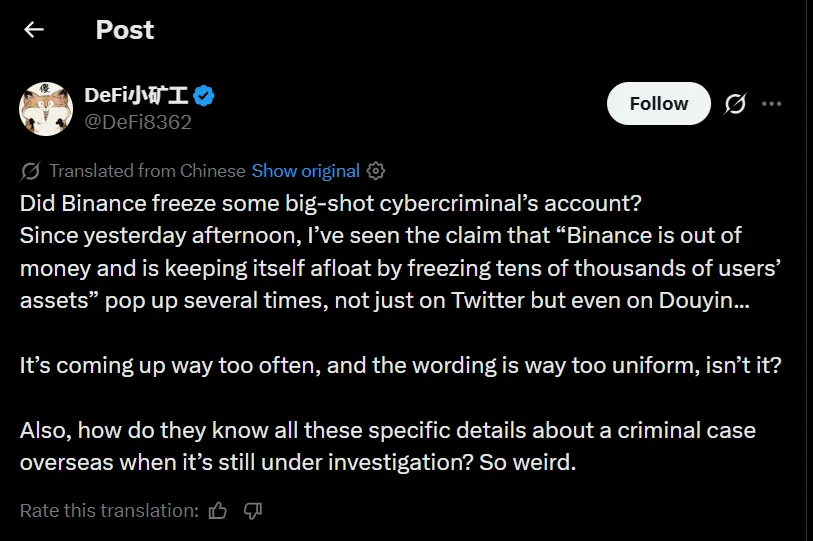
Notably, the user conceded that they noticed a suspicious level of coordination in the posts’ frequency and their wording.
He Yi presented three points in her response to the post, noting that when a court orders a financial firm to freeze funds, the firm has few options but to comply. In the post, she noted that by the time the order reaches a firm, the matter has already entered litigation, and the evidence supporting the order is solid.
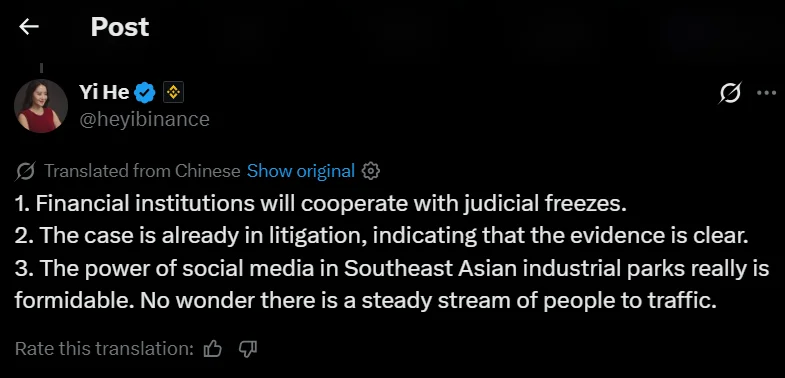
The Binance co-founder also called out what she perceived as the influence of the Southeast Asia scam compounds she linked the freeze orders to, noting that the same influence that lets them coordinate such social media smear campaigns is the same reason they continue to see a steady stream of people to traffic.
Binance shows evidence of strong reserves
The social media rumors are one thing; the on-chain data of Binance’s reserves are another. Reports citing Defillama data noted that Binance’s tracked assets fell nearly 12% to $128.3 billion by November 2 from about $144.9 billion on October 29.
Most of the pressure on the exchange’s reserves was due to falling crypto prices and withdrawals after the exchange returned on November 1 after the $6.3 billion theft it suffered in late October.
Binance reported about 2.1% in net outflows from its $171 billion in assets. Former chief Changpeng Zhao (CZ) wrote that 98% of users chose to stay, and the exchange committed to publishing a zero-knowledge proof of reserves showing customer balances are backed.
The Myanmar and Cambodia explanation vs. the hack liquidity crunch rumor
Friday’s comments extend a warning He Yi posted on November 8, when she told Chinese-speaking users not to send Binance funds tied to questionable situations, including earnings from a Myanmar business, debts collected in Cambodia, discounted stablecoins bought from friends, or coins forwarded by relatives.
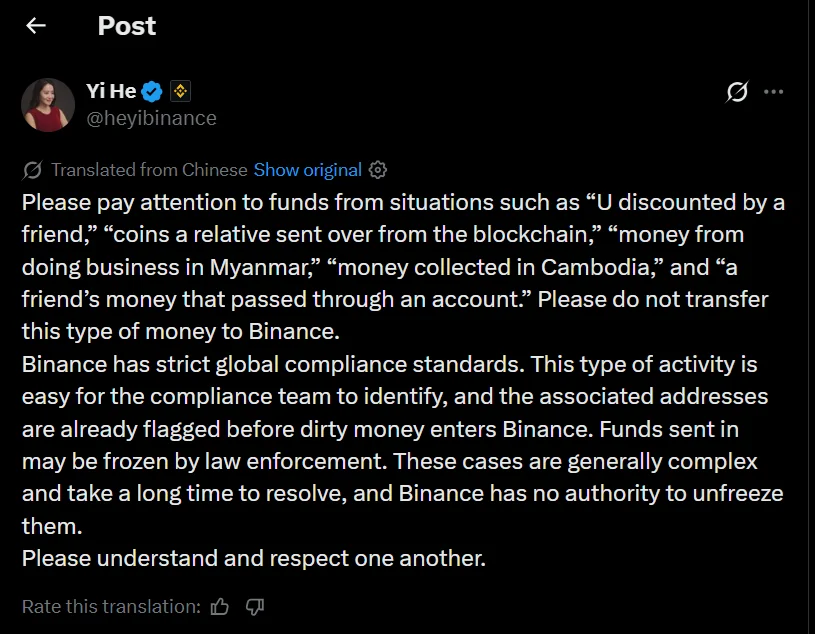
She said Binance’s compliance systems can flag risky addresses before a deposit lands, and that freezes ordered by authorities can drag on because the exchange cannot release assets under an official order on its own.
Both countries feature in fraud investigations. A September 2026 FinCEN review examined $12.7 billion in activity tied to Southeast Asian investment scams. In April, the US Justice Department announced charges over a fraud compound in Myanmar and said it had restrained about $700 million in crypto.
The timing is what gives the rumor its oxygen. The October 29 breach was the largest crypto theft on record. Cryptopolitan put the total stolen at $6.43 billion, a theft the FBI attributed on October 31 to North Korea’s TraderTraitor group, with Elliptic estimating $2.85 billion frozen by November 6.
Insolvency talk has dogged the exchange before; a community withdrawal push in February failed to drain it, as Cryptopolitan reported. Against that backdrop, any frozen balance reads to some users as a symptom of distress.
If you're reading this, you’re already ahead. Stay there with our newsletter.
FAQs
Why is Binance freezing some user accounts?
He Yi said the freezes are law-enforcement orders on funds tied to Southeast Asian scam compounds, not evidence that the exchange is short of cash.
How big was the Binance hack?
Cryptopolitan reported the October 29 breach drained about $6.43 billion, which the FBI attributed on October 31 to North Korea's TraderTraitor group, making it the largest crypto theft on record.
What did He Yi warn users about on November 8?
She told Chinese-speaking users not to deposit funds from suspect sources such as discounted USDT, coins sent by relatives, Myanmar business earnings or payments collected in Cambodia, warning that the related addresses may already be flagged.
Disclaimer. The information provided is not trading advice. Cryptopolitan.com holds no liability for any investments made based on the information provided on this page. We strongly recommend independent research and/or consultation with a qualified professional before making any investment decisions.

Hannah Collymore
Hannah is a writer and editor with nearly a decade of blog writing and event reporting experience in the crypto space. At Cryptopolitan, Hannah contributes to the news page, reporting and analyzing the latest developments in DeFi, RWA, crypto regulation, AI and frontier tech industries. She graduated from Arcadia university with a degree in Business Administration.









