🔥 Trade with Pros on Discord → 21 Days Free (No Card)JOIN FREE

LIVE

Gold crashes to $5,100 as Bitcoin tumbles back to $80,000

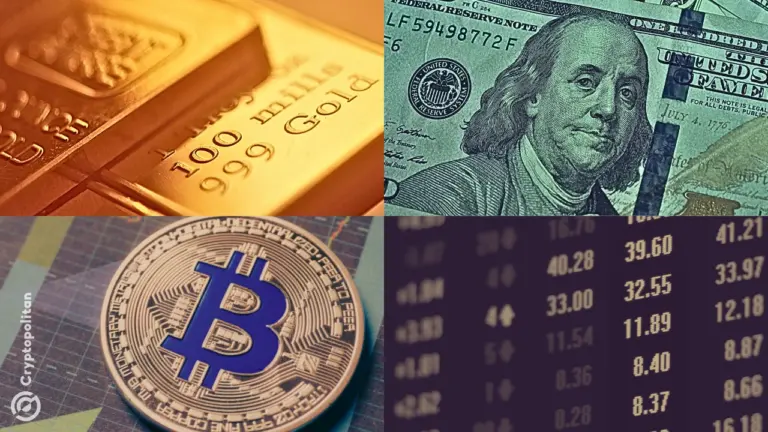
Gold crashes below $5,000 in shocking reversal as Bitcoin tumbles back to $80,000

  • Gold futures plunged $300 in two hours, slicing through $5,200 and then $5,000, now trading near $4,936. Volatility has hit levels last seen during 2008’s financial crisis.

  • Silver collapsed 16% overnight, briefly falling under $100 an ounce, before recovering to around $103.81.

  • Bitcoin fell 6.25% to $80,477, dragging major altcoins with it. Ethereum is down 7.2%, Solana dropped 7.09%, HYPE plunged 8.54%, and DOGE lost 6.47%.

See also  Bitcoin surges to $92,500 as rebound continues with US stocks

Live Reporting

17:35Miran backs Warsh, says inflation is “fake” and more cuts are needed

Stephen Miran says he’s not worried about inflation, and he’s not worried about Kevin Warsh either. On Friday, the outgoing Fed governor told Bloomberg that President Donald Trump’s nominee to lead the central bank is well equipped for the role.

“He’s been there before, he knows how the place operates,” Miran said. “He knows the key players and he has their respect.”

Miran said he expects Warsh to be able to win over other members of the Fed’s monetary policy committee and push through his ideas.

“He’ll be able to marshal the arguments and the evidence,” Miran said, pointing to Warsh’s past experience inside the Fed during the global financial crisis.

As for the economy, Miran made clear he still believes interest rates need to be cut much further, though he now supports a slower pace of 25 basis points per meeting after recent progress.

He also pushed back against concerns that inflation is still too hot. Speaking earlier on CNBC, Miran said the gap between current inflation and the 2% target is mostly noise caused by quirks in how housing costs and portfolio management fees are calculated.

“It’s not real inflation, it’s fake inflation,” he said. Adjusting for those inputs, core inflation excluding housing is already down to 2.2%, which Miran says is close enough to target.

17:04Hassett backs Warsh Fed pick, says he’s staying at White House

Kevin Hassett is staying put. Speaking Friday after President Donald Trump tapped Kevin Warsh to be the next Federal Reserve chair, Hassett said he’s happy with the decision and has no interest in leaving his current post as head of the National Economic Council.

“I’ve got my dream job,” Hassett told CNBC’s Squawk on the Street. “President Trump made a great choice, and I’m really thrilled and humbled by all the kind things he said about me.”

Trump posted a message on Truth Social praising Hassett’s work at the White House, writing, “Kevin is indescribably good… if you can’t do better, don’t try to fix it!” The president added that he didn’t want to lose Hassett and that the NEC director is doing “an outstanding job.”

Hassett said the White House is now fully behind Warsh’s nomination and will push for a swift confirmation. “Every single resource we have is behind him,” Hassett said. “We really want to get Kevin confirmed as soon as possible so the Fed can start moving in the right direction.”

If the Senate confirms him, Warsh will officially replace Governor Stephen Miran, whose term ends Saturday, but won’t take over as Fed chair until May, when Jerome Powell’s term expires.

16:57China posts record $1.8 trillion deficit as social spending surges

China logged a record 12.7 trillion yuan deficit last year, equal to about $1.8 trillion, as social welfare spending grew 9.5%, the fastest pace since 2017.

This is a huge change in China’s fiscal policy, with broad government expenditure up nearly 4% year-on-year even as total spending came in 5% below initial budget targets.

According to data from China’s Ministry of Finance released Friday, Beijing spent about 40 trillion yuan in 2025 under its two main budgets. The deficit spike wasn’t due to stimulus alone.

A large share of the outlays went to refinance local government off-balance-sheet debt, limiting what was left for new investment.

Roughly 3.4 trillion yuan from new special local government bonds was used to pay off so-called hidden debt, far more than planned.

That effectively drained liquidity away from infrastructure or industrial programs, the kind that typically boost GDP growth, and channeled it into plugging financial holes.

The pattern contrasts with China’s last major overspend in 2018, during the first round of trade war measures under U.S. President Donald Trump.

This time, the spending shift is being driven by domestic priorities, including cash handouts to families as part of efforts to raise birth rates.

On the revenue side, individual income tax receipts rose 11.5%, the fastest jump since 2021, as Chinese authorities tightened enforcement, especially around undisclosed overseas assets and previously untaxed income sources.

Several tax breaks were also scrapped last year, helping offset weaker corporate or trade-related revenue streams.

16:43Fed's Bostic urges patience on rate cuts, says inflation still too hot

Atlanta Fed President Raphael Bostic said Friday it’s not time to cut rates again, pushing back against calls for more easing.

“We should be waiting, and be more patient,” Raphael told CNBC, adding that inflation is still too high and the Fed needs to stay somewhat restrictive.

The comments came just days after the Fed voted to hold its policy rate at 3.5%–3.75%, pausing after three cuts in late 2025. Fed Chair Jerome Powell had said the decision was broadly supported, citing a recent stabilization in the unemployment rate as a reason for caution.

Bostic agreed with that. “I do feel like that downside risk, that a catastrophe is going to happen in employment, is much further away from us than it was even a month ago,” he said. “That gives me some confidence that we can be patient.”

His message landed just hours after President Donald Trump confirmed he’ll nominate Kevin Warsh to replace Powell as Fed chair when his term ends in May.

Raphael said he doesn’t know Warsh well but has heard “he’s quite thoughtful” and someone “you can really engage with.”

Friday’s meeting was also Raphael’s final one as a voting policymaker. He’s retiring at the end of February after serving at the Atlanta Fed since 2017.

16:09Waller once again warns Fed is underestimating labor risk

Christopher Waller doesn’t think the U.S. economy is strong enough to keep rates where they are. On Friday, the Fed governor publicly dissented from this week’s policy decision, saying the central bank should have cut interest rates by 25 basis points instead of holding steady at 3.5% to 3.75%.

Waller said the labor market is weakening, and that data revisions expected in the coming weeks will likely show zero payroll growth in 2025. He pointed to a rise in the unemployment rate, slower hiring, and companies already planning layoffs in 2026.

“I’ve heard in multiple outreach meetings of planned layoffs in 2026,” Waller said in a written statement. “This indicates to me that there is considerable doubt about future employment growth.”

His dissent highlights a split inside the Fed. Most policymakers are signaling patience, especially after Q4 GDP came in stronger than expected and inflation has slowed. But Waller says monetary policy is still too tight and needs to be loosened now to prevent a bigger downturn.

15:57Silver collapses 16% before bouncing; gold slides to $4,937

Silver broke first. In the early hours, spot silver crashed 16%, briefly falling under $100 an ounce before rebounding.

As of press time, it’s now trading at $103.81, still down 10.6% on the day. That’s the steepest single-day drop in over a year. February silver futures on the NYMEX also got hammered, down 10%.

Gold followed close behind. Spot gold lost 5.7% to hit $4,936, after earlier sinking as much as 7%. Front-month gold futures dropped 3.4% in New York trading. That puts gold just above yesterday’s session lows, and brings the total drawdown since Wednesday to nearly $600 an ounce.

This sell-off didn’t stay in metals. Platinum dropped over 10%, and palladium fell nearly 8%. The shock is spreading across assets tied to precious metals, hitting stocks too.

Fresnillo, the largest silver miner in the world, lost 4% in London by mid-session. Endeavour Silver was down 9% in U.S. premarket, while Coeur Mining slid 8%. On the ETF side, ProShares Ultra Silver was last seen 22% lower, while the iShares Silver Trust ETF fell 11.2%.

This comes right after a historic run. In 2025, silver jumped 150% and gold climbed 65%. Those rallies extended into early 2026, with silver up another 45% year-to-date and gold up 19%. But after today’s selloff, those year-to-date gains are under threat.

15:35Crypto stocks split as miners sink and trading platforms hold up

Crypto-linked stocks were all over the place as the broader market stayed under pressure. The S&P 500 fell 0.3%, the Nasdaq lost 0.5%, and the Dow dropped 177 points, down 0.4%, setting a rough backdrop for anything tied to risk.

Among the big names, MercadoLibre fell 2.31% to $2,166.82, while Coinbase slipped 0.95% to $197.28 and PayPal dropped 1.18% to $52.48.

Circle fell 3.69% to $65.06, and Galaxy Digital lost 3.94% to $28.78. Robinhood stood out, rising 2.16% to $103.42, one of the few green spots among crypto-related equities.

Bitcoin-heavy firms leaned weak. Strategy was flat at $143.20, barely holding on after a tough year, while Block slid 1.74% to $61.13.

IREN dropped 5.9%, Cipher Mining fell 5.42%, Riot Platforms lost 5.42%, and TeraWulf sank 6.4%. Hut 8 slid 4.96%, Core Scientific fell 1.59%, and CleanSpark dropped 1.79% as miners tracked Bitcoin’s move back toward $80,000.

Smaller miners and crypto plays stayed under pressure too. Bitmine fell 3.73%, Bitfarms slipped 0.82%, Bit Digital dropped 2.61%, and Canaan lost 1.27%.

MARA fell 1.17%, while Argo Blockchain slid 3.24%. Liquidity was thin across many of the microcaps, with several names barely trading.

A few stocks managed to buck the trend. GameStop jumped 4.3%, Nexon collapsed 11.31%, and Kulr fell 6.17%, showing just how scattered price action has become.

05:18Gold snaps lower as crypto sells off and U.S. futures turn red

Gold got hit fast. Futures dropped $300 an ounce in two hours, slicing straight through $5,200 and landing near $5,100. The speed of the fall matters.

Gold volatility is now back at 2008 levels, which tells you this is not a calm pullback. This is forced selling showing up in size.

Crypto followed the same script. Bitcoin slid 6.25% to $80,477, with spot volume at $58.53 billion and total market cap sitting at $1.65 trillion.

Derivatives activity jumped, with $110.52 billion traded and $770.71 million in liquidations rolling through. The pressure did not stop there.

Ethereum fell 7.20% to $2,736, with $34.41 billion in spot volume and $416.44 million wiped out in liquidations. Solana dropped 7.09% to $114, XRP fell 6.87% to $1.74, and BNB slid 5.80% to $845. HYPE took the hardest hit, down 8.54% to $28.99, while DOGE slipped 6.47% to $0.114.

U.S. equity futures were already rolling over as this played out. S&P 500 futures fell 0.3%, Nasdaq 100 futures lost 0.3%, and Dow futures dropped 139 points, also 0.3%, after stocks logged a second straight losing session. Risk is getting sold everywhere at once, and the tape is moving fast.

What to know

Gold plunged below $5,000, silver briefly broke $100, and Bitcoin dropped to $80,000.

Editor's choice

Loading Editor's Choice articles...

- The Crypto newsletter that keeps you ahead -

Markets move fast.

We move faster.

Subscribe to Cryptopolitan Daily and get timely, sharp, and relevant crypto insights straight to your inbox.

Join now and
never miss a move.

Get in. Get the facts.
Get ahead.

Subscribe to CryptoPolitan