


LATEST NEWS



Best crypto insights delivered straight to your inbox.

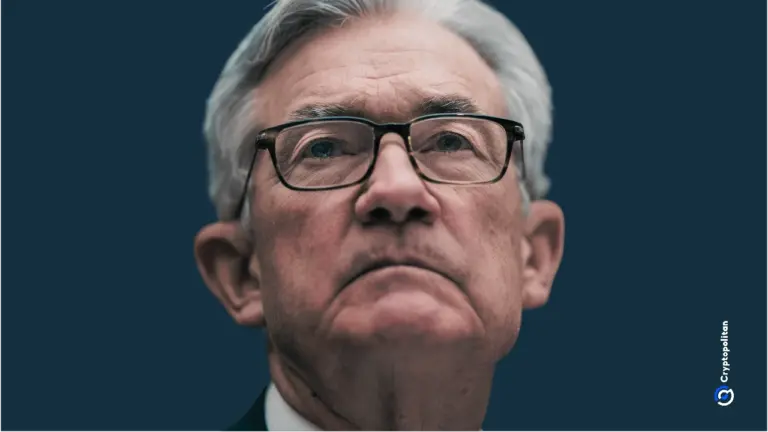

The Federal Reserve just lowered its target range by 25 basis points to 3.75%–4.00%, marking its second consecutive cut this year. In a statement, the FOMC said economic activity is growing “at a moderate pace,” though job gains have clearly slowed, and unemployment has ticked up, even if it’s still relatively low.
Live Reporting
The dollar ripped higher on Wednesday after Powell’s blunt message to markets: don’t assume we’re cutting again in December. The Fed Chair pushed back hard on investor expectations, warning that officials are still far from a consensus on what comes next.
“Markets should not assume another interest rate cut will happen at the end of the year,” Powell said, adding that the committee is grappling with sharply divided views on the path forward.
The effect on currency markets was immediate. The dollar index jumped 0.63%, hitting 99.28, while the euro dropped 0.56% to $1.1585.
Rate-cut bets got a haircut too. The odds of a December cut fell to 62%, down from around 85% just earlier in the day, a full 23-point collapse triggered by Powell’s change in tone.
This post is updated LIVE.
The pressure’s rising on banks, and Powell knows it. Asked about growing losses in subprime lending, especially auto loans, Powell confirmed what the market’s been whispering for weeks: defaults are climbing, and some banks are already taking hits.
“You’ve seen rising defaults in subprime credit for some time now,” he said. “Now you’ve seen a number of subprime auto lenders taking significant losses, and some of those losses are showing up on bank balance sheets.”
Still, Powell said the issue looks contained… for now.
“I don’t see at this point a broader credit issue… it doesn’t seem to have very broad application across financial institutions.”
But the Fed isn’t brushing it off. Powell made it clear this is on their radar:
“We’re going to be monitoring this quite carefully and making sure that that is the case.”
This post is updated LIVE.
Powell just acknowledged the economic split that’s becoming impossible to ignore: the rich are still spending, the rest are not.
Asked about the stress hitting lower-income households, Powell pointed to what he’s hearing from corporate America:
“If you listen to the earnings calls… many of them are saying there’s a bifurcated economy. Consumers at the lower end are struggling, buying less, and shifting to lower-cost products… while at the top, people are spending.”
He said there’s “much, much anecdotal data” supporting that divide, and the Fed is taking it seriously. That comment aligns with earlier parts of the press conference, where Powell flagged downside risks to employment and signs that labor demand is softening.
He also circled back to tariff-driven inflation, repeating that the base case is still that it’s a one-time level shift, not a structural trend.
“We’ve been very focused for all of this year at making sure that that’s the case.”
This post is updated LIVE.
Powell just got hit with a politically loaded question: What’s the timeline for reappointing the 12 regional Reserve Bank presidents, whose terms expire in February? His answer was short and surgical.
“It’s a process that we go through under the law… every five years… We’re in the middle of that process, and we’re going to complete it in a timely way. That’s really all I can say.”
He didn’t elaborate, and didn’t need to. Behind the scenes, Trump’s team is reportedly weighing a pressure campaign to shape those appointments.
The goal: install Fed voices more aligned with his economic agenda and critical of Powell’s leadership.
So far, Powell’s response is institutional, procedural, and guarded, but the stakes are huge. The selection process is largely handled by the Fed’s Board of Governors and local Reserve Bank boards, but any attempt by the administration to sway those picks would set up a rare public clash over central bank independence.
This post is updated LIVE.
Powell just gave the clearest number yet on how much Trump’s tariffs are inflating prices, and it’s not small.
“Inflation away from tariffs is actually not so far from our 2% goal,” Powell told reporters. He said estimates vary, but pegged the tariff-driven impact at around five to six tenths of a percentage point.
That means if headline inflation is sitting at 2.8%, without the import taxes in play, it would be closer to 2.3% or 2.4%, brushing right up against the Fed’s long-term target.
This is the first time Powell has attached real numbers to the tariff effect, and it sharpens the dilemma: core inflation might be tamed, but trade policy is keeping the headline elevated.
And if that distortion fades, the Fed might be staring down an economy that’s already within range of its inflation goal, but only on paper.
This post is updated LIVE.
Asked directly how the government shutdown’s data blackout might affect the Fed’s December decision, Powell didn’t pretend to know. “It’s really hard to say. December’s meeting is six weeks away. We just don’t know what we’re going to get.”
But he did explain how the Fed’s still trying to piece things together. Powell said the committee is leaning on state-level unemployment claims and the Fed’s own Beige Book, the anecdotal economic survey compiled from its 12 districts, to stay in touch with reality.
“We’ll have a picture of what’s going on… not a detailed feel of things,” he admitted, “but if there were a significant or a material change in the economy… I think we’d pick that up through this.”
He also hinted that too much uncertainty alone could be enough to pause. “If there is a very high level of uncertainty, then… that could be an argument in favor of caution about moving,” Powell said.
This post is updated LIVE.
U.S. stocks flipped into the red on Wednesday after the Fed Chair threw serious doubt on any further rate cuts this year. Just hours after hitting fresh intraday all-time highs, the Dow sank 189 points (–0.4%), the S&P 500 slid 0.4%, and the Nasdaq dipped 0.1%.
Crypto felt it even harder. Bitcoin, which had soared earlier this week on soft-landing optimism, crashed $2,000 within minutes of the Fed press conference. It’s now trading at $109,600, down 5% over the past 24 hours, erasing almost all the gains from its recent rally.
Traders had priced in a December cut as a done deal. Powell ripped that narrative to pieces live on mic.
This post is updated LIVE.
Markets just flinched. Traders are quickly pulling back bets on a third straight cut in December, slashing the odds to 69% from 91% earlier, after Powell’s press conference took a sharp turn away from certainty.
Powell said it loud and clear: “A further reduction in the policy rate at the December meeting is not a foregone conclusion. Far from it.” That one line, plus his reminder that “policy is not on a pre-set course,” was enough to hit the brakes on Wall Street’s December rate-cut rally.
And then came the zinger. Powell confirmed what many suspected but hadn’t heard aloud:
“At this meeting, there were strongly differing views about how to proceed in December.”
Asked directly whether he was worried about traders jumping ahead of the Fed, Powell doubled down: no one’s made any decision yet.
“At a time when we have tension between our two goals, we have, you know, strong views across the committee… the takeaway from that is that we haven’t made a decision about December.”
When reporters pressed him further on those internal disagreements, Powell pointed to divergent forecasts and different levels of risk aversion among committee members.
This post is updated LIVE.
Jerome Powell just stepped up to the mic, and the first thing he did was acknowledge the elephant in the room; the government shutdown.
Powell told reporters that, yes, key federal data is missing, but available public and private-sector reports suggest “not much has changed” in the Fed’s outlook since September.
He said the shutdown is “weighing on economic activity” for now, but claimed those effects should reverse once it ends. Translation: temporary pain, but not enough to change policy direction.
On jobs, Powell said: “Labor demand has clearly softened.” He flagged that hiring and layoffs are still low, but job growth has slowed sharply, likely due to weaker immigration and labor participation.
But he didn’t stop there: Powell admitted that “downside risks to employment have arisen in recent months.” And then the Fed chair said:
“Higher tariffs are pushing up prices in some categories of goods, resulting in higher overall inflation. A reasonable base case is that the effects on inflation will be relatively short-lived, a one-time shift in the price level. But it is also possible that the inflationary effects could instead be more persistent, and that is a risk to be assessed and managed.”
This post is updated LIVE.
Within minutes of the Fed’s rate cut, Wall Street kept charging higher. The Nasdaq jumped 0.5%, the S&P 500 nudged up 0.1%, and the Dow climbed 96 points, or 0.2%, enough for all three major U.S. indexes to clock new intraday records.
The rally shows investors had already locked this move in, and maybe hoped for more.
Meanwhile, the bond market surged. The 10-year Treasury yield jumped 3.5 basis points, pushing it to 4.018%, while the more rate-sensitive 2-year yield climbed 3 bps to 3.524%.
Why the spike? Two reasons. First, the Fed also announced it’ll restart limited Treasury purchases. Second, traders are still betting hard on more cuts ahead. October’s cut didn’t cool those bets. If anything, it sharpened them.
Even though short-term interest-rate futures dipped slightly post-announcement, the broader positioning still shows markets expect a third straight 25 bps cut in December, with another in March. So while Powell didn’t promise anything, Wall Street’s already penciling it in.
This post is updated LIVE.
It’s official: the Fed’s two-year-long balance sheet runoff ends December 1. With that, the central bank closes the chapter on a massive unwind that began back in 2022, when inflation was surging and the Fed was scrambling to pull liquidity out of the system.
Since then, the Fed has slashed more than $2 trillion off its balance sheet, mostly Treasuries and mortgage-backed securities, bringing the total size down to under $6.6 trillion, its lowest since 2020.
That balance sheet had ballooned after COVID hit. With the benchmark rate near zero, Powell’s Fed had gone on a trillion-dollar bond buying spree to keep credit flowing and the economy alive
Now, three years later, that emergency playbook is officially closed, but at a time when the economy’s still fighting inflation, job growth is slowing, and rate cuts are back in play.
This post is updated LIVE.
The Fed just pulled the trigger. For the second time this year, Jerome Powell and the FOMC voted to cut interest rates by 25 basis points, pushing the new target range down to 3.75% to 4.00%.
The decision wasn’t a surprise — Wall Street saw it coming — but the Fed’s statement makes one thing clear: they’re still nervous.
According to the Committee, economic growth is “moderate,” but job gains have slowed, and unemployment has inched up. Inflation? It’s still too high, even though it’s not spiraling.
And with the government still shut down and data limited, the Fed basically admitted it’s steering with one eye closed. They warned that “uncertainty remains elevated,” and said the risk to jobs has gotten worse in recent months.
The vote wasn’t unanimous. Stephen Miran wanted a deeper cut (50 bps) while Jeffrey Schmid didn’t want any cut at all.
Everyone else backed the 25 bps move. Powell and his crew also said they’re ending the runoff of their bond holdings on December 1, putting a pause on the balance sheet tightening.
They didn’t commit to more cuts, but they didn’t rule them out either. Instead, they’ll keep watching “incoming data” and “the balance of risks.” In short, this was a cautious cut, not a pivot. They’re playing it safe, keeping their options open, and trying not to crash the economy while inflation’s still sticky.
This post is updated LIVE.

With Washington still paralyzed by a government shutdown, the Fed is heading into today’s interest rate decision flying blind.
Key data’s missing. And when Jerome Powell faces reporters this afternoon, don’t expect much clarity. Analysts are already bracing for a toned-down, tight-lipped Powell.
Wall Street, meanwhile, is almost 100% certain of what’s coming. Markets have already locked in a 25 bps cut, with 99.9% certainty, according to CME’s FedWatch.
No one’s betting on 50. Literally no one. And just a 0.1% chance remains for a hold. Doves on the committee reportedly pushed for something bigger, but they’re likely to be outvoted.
Inflation’s still stuck around 3%, but that’s nowhere near the inflation spiral folks feared when Trump’s tariffs were first rolled out. Still, the president couldn’t resist lobbing grenades at the Fed again
Speaking Wednesday in Gyeongju, South Korea, Trump called Powell “Jerome ‘Too Late’ Powell,” drawing laughs from a room full of APEC CEOs.
He also claimed the U.S. economy will hit 4% growth in Q1 2026, despite economists warning that his new import taxes are likely to slow things down, not speed things up.
This post is updated LIVE.
JUST IN
- The Federal Reserve just cut rates by 25 basis points; it’s the second straight reduction this year.
- The new target range is now 3.75% to 4.00% — exactly what markets priced in, and exactly what Powell gave them.
TABLE OF CONTENT
Share this article

MORE … NEWS









DEEP CRYPTO
CRASH COURSE
- Which cryptocurrencies can make you money
- How to boost your security with a wallet (and which ones are actually worth using)
- Little-known investment strategies that the pros use
- How to get started investing in crypto (which exchanges to use, the best crypto to buy etc)