






China, South Korea lead as East Asia’s $1.2T crypto economy defies regulatory strain

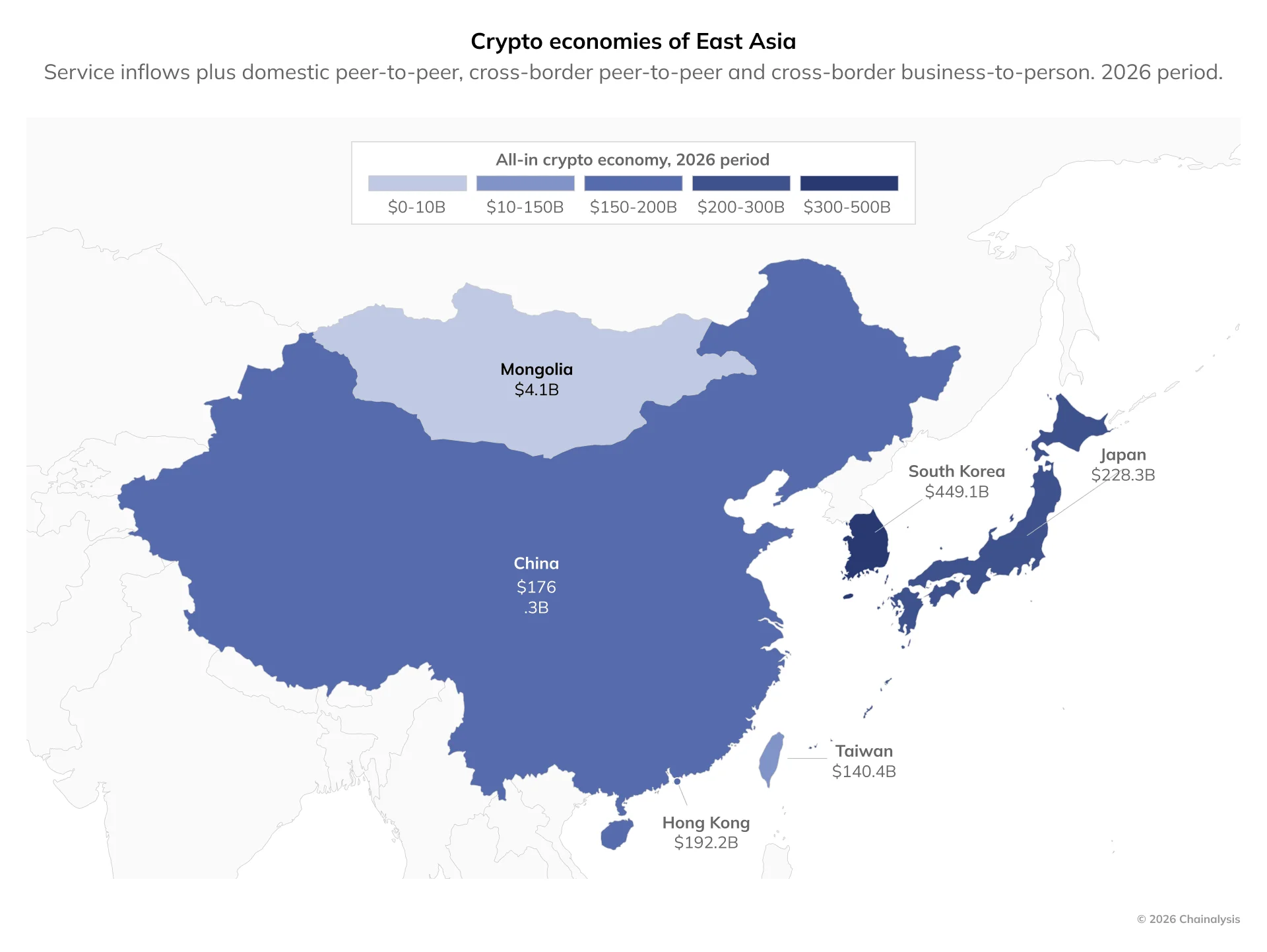
- Chainalysis puts East Asia’s crypto economy at roughly $1.2 trillion across South Korea, Japan, Hong Kong, China and Taiwan.
- The report found that in market after market, the rules and the actual usage have split.
- Banned China saw P2P stablecoin wallets grow 43x, Hong Kong licensed stablecoins it cannot yet trade, tax-free South Korea leaned into AI tokens, and heavily taxed Japan saw retail pile onto DEXs.
East Asia’s five largest markets now hold a crypto economy worth roughly $1.2 trillion.
In several East Asian markets, the rules on paper describe a very different market than the one people are actually using due to the fact that crypto is a licensed business in some capitals and a banned activity in others.
Do the crypto rules and trading across East Asia match?
A Chainalysis report published today shows a gap in the existing crypto regulations across East Asia and the way trading is being run in real life. The report states that the gap is widest in mainland China, where trading has been outlawed for years. Chainalysis still puts the Chinese crypto economy at a minimum of $176.3 billion despite the ban.
The clearest sign of the divergence is that the count of distinct wallets sending peer-to-peer stablecoin transfers inside China rose 43 times between the first quarter of 2024 and the second quarter of 2026, Chainalysis found. Over its reporting window of July 2025 to June 2026, the firm tracked $104.1 billion moving through 18.1 million self-custodied stablecoin transfers.
Chainalysis also measured a turnover rate of 33.2 times a year, which is more than triple the global figure of 9.3. The firm says that the figure means users are treating stablecoins less like a store of value and more like operating cash.
Domestic P2P transfers made up 59.1% of China’s total crypto activity, about 3.5 times their share a year earlier, with one month, March 2026, adding $4.9 billion on its own.
Can stablecoins be traded in Hong Kong?
Hong Kong’s $192.2 billion crypto market is the most institutional in the region. About 16% of money flowing into services went to institutional platforms, nearly three times the share of any neighbor.
Most of that 16% (85% of it), went to custody providers, prime brokers, and market makers. Hong Kong also took in almost $24 billion in business-to-business flows, and institutional platform receipts grew 87% in a year, the fastest in East Asia.
The Hong Kong Monetary Authority (HKMA) gave HSBC and Anchorpoint, a venture backed by Standard Chartered, HKT and Animoca Brands the first two stablecoin issuer licenses on April 10, 2026. Cryptopolitan reported that the two were chosen from 36 applicants under an ordinance that took effect in August 2025.
However, neither firm has anywhere to trade its coin because Hong Kong is yet to prepare a venue, trading pair or start date.
The bill meant to license virtual-asset trading platforms is only due to be reviewed later this year. A February notice from the People’s Bank of China and seven other agencies also banned unauthorized yuan-pegged coins both at home and abroad.
How is South Korea’s crypto market performing?
South Korea is the regional leader at $449.1 billion, up 12.3% on the period, due to a 16.3% growth in its exchange sector and an additional $51.1 billion in exchange-related flows. The market is overwhelmingly retail, and Chainalysis said those retail traders tilted harder toward AI-linked tokens than any other category.
Retail traders are watching a 22% tax, which includes a 20% national tax plus a 2% local charge for gains above 2.5 million won, that is currently set to take effect on January 1, 2027.
The tax has been delayed repeatedly, and independent lawmaker Han Dong-hoon is attempting to delay it for two more years. His argument is that authorities cannot yet track trading once assets leave domestic exchanges. A petition also demanding a delay has received the 50,000 signatures needed for parliamentary review.
In Japan’s crypto market, valued at $228.3 billion, decentralized exchanges accounted for 34.5% of service activity. The figure represents the highest DEX share of any established market in the region dominated by centralized exchanges.
Chainalysis found that DEX usage has more than tripled since 2022. Meanwhile, 65.7% of swaps were between $10 and $1,000.
Crypto gains are currently taxed as miscellaneous income at rates reaching about 55%, and this is to stay the same until the law reclassifying crypto as a financial product under the Financial Instruments and Exchange Act takes effect in fiscal 2027. Even then, as Cryptopolitan reported, the lower 20% flat rate only applies from January 1, 2028.
If you're reading this, you’re already ahead. Stay there with our newsletter.
FAQs
How much did China's peer-to-peer stablecoin use grow despite the crypto ban?
The number of unique wallets sending P2P stablecoin transfers in China grew 43-fold between the first quarter of 2024 and the second quarter of 2026, with $104.1 billion moving across 18.1 million transfers, according to Chainalysis.
Which country has East Asia's largest crypto economy?
South Korea, at $449.1 billion, up 12.3% period over period, ahead of Japan ($228.3 billion), Hong Kong ($192.2 billion), China ($176.3 billion) and Taiwan ($140.4 billion), per Chainalysis.
When is South Korea's crypto tax scheduled to take effect?
A 22% tax on crypto gains (a 20% national rate plus 2% local, above a 2.5-million-won deduction) is set for January 1, 2027, though lawmaker Han Dong-hoon is calling for another two-year delay.
Disclaimer. The information provided is not trading advice. Cryptopolitan.com holds no liability for any investments made based on the information provided on this page. We strongly recommend independent research and/or consultation with a qualified professional before making any investment decisions.

Hannah Collymore
Hannah is a writer and editor with nearly a decade of blog writing and event reporting experience in the crypto space. At Cryptopolitan, Hannah contributes to the news page, reporting and analyzing the latest developments in DeFi, RWA, crypto regulation, AI and frontier tech industries. She graduated from Arcadia university with a degree in Business Administration.









