







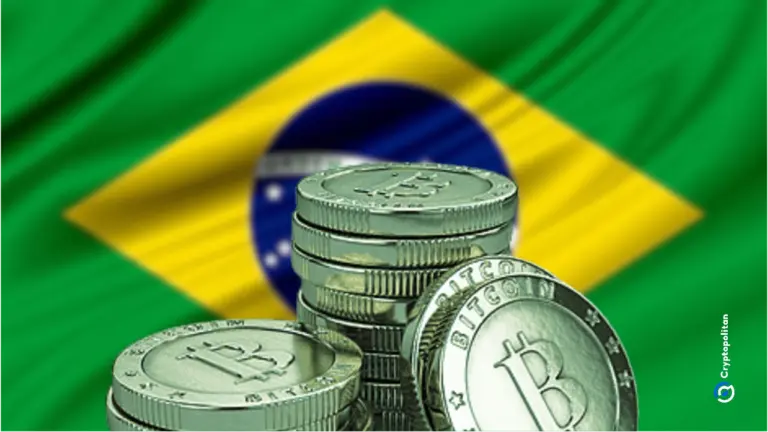
- Brazil’s Finance Ministry is considering extending the financial transaction tax (IOF) to cryptocurrency transactions for international payments
- Currently, crypto transactions are not subject to IOF under the “Virtual Assets Act,” although investors pay income tax on profits exceeding a monthly exemption.
- The regulatory vacuum around stablecoins raises concerns over money laundering.
According to an exclusive report from Reuters on Tuesday, the Brazilian Finance Ministry is considering applying the country’s current financial transaction tax, or IOF, to certain cross-border transfers involving stablecoins and crypto tokens.
According to law No. 14,478 of 21 December 2022, named the “Virtual Assets Act,” crypto transactions are not subject to IOF, although investors must pay income tax on gains above a monthly exemption threshold.
Crypto tax meant to close regulatory blanks, Brazilian officials say
The anonymous sources claimed that the proposed tax rule change could close a regulatory loophole, although it comes with the potential to boost public revenue. Brazil has been under pressure to meet fiscal targets, so adding taxes to crypto transactions is a new revenue stream and an attractive prospect.
Stablecoins, which are digital assets tied to traditional currencies like the US dollar, have helped Brazil’s crypto sector develop greatly. The federal tax administration says that in the first half of 2025, crypto transactions in Latin America’s biggest economy reached 227 billion reais ($42.8 billion). This is a 20% rise from the first half of 2024.
Of that total, two-thirds involved USDT, the dollar-backed stablecoin issued by Tether, while Bitcoin accounted for just 11% of trading activity. The government believes stablecoins are used primarily for payments rather than investment, which is likely to create avenues for money laundering in the midst of the regulatory vacuum.
The central bank’s new regulatory framework that took effect in February classifies the purchase, sale, or exchange of stablecoins as foreign-exchange transactions. This designation also covers international payments, card transaction settlements, transfers through electronic methods, and movements to or from self-custody wallets.
“The new measures prevent regulatory arbitrage and ensure stablecoins are subject to the same oversight as conventional FX channels,” a government official told Reuters.
New laws expand transactions reporting requirements
The tax authority recently broadened reporting rules for crypto transactions to include foreign service providers operating in Brazil. A Federal Police official mentioned that the more visible these flows are, the easier it will be for Brazil to enforce other import-related taxes.
“If you import machinery or inputs, declare 20% officially, and send the remaining 80% via USDT without paying customs duties, IOF is the least of your problems,” the source said. The government may be losing more than $30 billion annually from imports settled with crypto to avoid taxation, according to the federal police.
Cryptopolitan reported in June that Brazil eliminated tax exemptions for crypto gains, introducing a flat 17.5% tax on profits for individuals under provisional measure MP 1303.
Previously, investors could sell up to R$35,000 (roughly $6,300) per month without incurring taxes.
The new flat-tax system means smaller investors could face higher liabilities, while large holders may see lower bills, according to local news outlet Portal do Bitcoin. The tax applies to assets held domestically or abroad, including in self-custody wallets. Crypto holders can offset losses, but only within a rolling five-quarter window, with stricter rules scheduled to be applied in 2026.
Brazil is LATAM’s crypto activity hotbed
Brazil is the leading crypto market in Latin America and ranks fifth worldwide in Chainalysis’ Global Crypto Adoption Index for 2025, up from 10th in 2024.
Between July 2024 and June 2025, the country received $318.8 billion in crypto, nearly one-third of all Latin American activity during that period.
Gabriel Galipolo, head of Brazil’s central bank, told Reuters in February that around 90% of crypto flow in the country is linked to dollar-backed stablecoins.
Last week, the central bank unveiled new rules requiring local digital asset firms, including intermediaries, custodians, and brokers, to obtain authorization from it before operating.
Don’t just read crypto news. Understand it. Subscribe to our newsletter. It's free.
Disclaimer. The information provided is not trading advice. Cryptopolitan.com holds no liability for any investments made based on the information provided on this page. We strongly recommend independent research and/or consultation with a qualified professional before making any investment decisions.

Florence Muchai
Florence has been covering for the past 6 years crypto, gaming, tech, and AI news. Her Computer Studies at Meru University of Science and Technology and Disaster Management and International Diplomacy at MMUST amply equip her with language, observation and technical skills. Florence has worked at VAP Group and as an editor for several crypto media houses.









