








- The Bitcoin Policy Institute is urging Congress and regulators to scrutinize MSCI’s power over broad-market indexes.
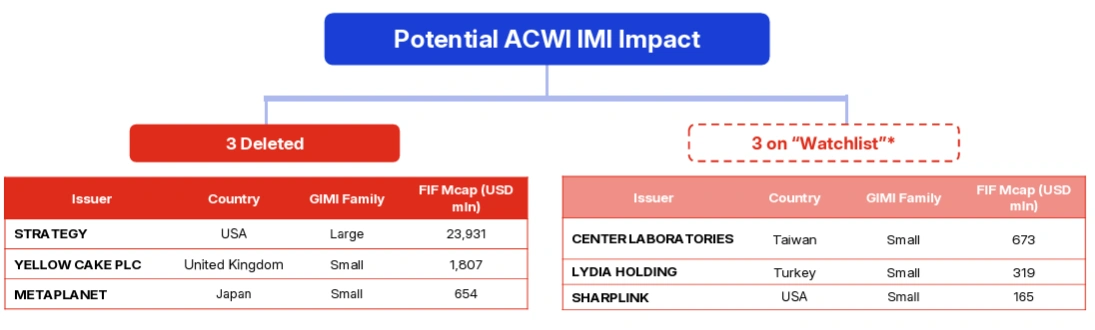
- The probe call came after the firm proposed a screen that would delete Strategy, Metaplanet and place Sharplink on a watchlist.
- 54% of U.S. long-term fund assets track benchmarks from just three providers, and a single exclusion forces index funds to sell.
The Bitcoin Policy Institute (BPI) has invoked the option of a Congressional probe into MSCI and its listing standards for public companies after the index provider revived a proposal that would have cut corporate digital asset treasury firms Strategy and Metaplanet and placed Sharplink on a delisting watchlist.
Inclusion in the index provider’s stock market indexes is a direct route to trillions of dollars in American retirement savings. The Bitcoin think tank is now arguing that MSCI is wielding undue power to exclude Strategy and other asset-heavy firms from capital flows.
Why firms don’t want to be dropped from MSCI
Conner Brown’s September 30 BPI paper lands on the same day as the public comment window on MSCI’s proposal closed, with a decision due on October 16.
Brown argued that when someone buys a “passive” index fund, a private company’s committee, not the fund manager, decides what counts as “the market.” However, three firms, MSCI, S&P Dow Jones Indices and FTSE Russell, set the benchmarks that 54% of all long-term fund assets in the United States follow.
$21 trillion is benchmarked to MSCI’s indexes alone.

Brown is calling out that scale as a problem. Index providers, by adding or cutting a single company, force every fund tracking the benchmark to rebalance, which trickles down to individual stocks gaining or losing financial bases without any fund managers or investors involved in those decisions.
The BPI document contends that index providers wear a passive label while making active decisions, with little oversight, as they are not currently regulated as investment advisers.
MSCI’s neutrality faces scrutiny
MSCI has insisted over the years that it is a neutral entity, telling the SEC in 2022 that it “expresses no opinion or view as to whether any market, company, strategy or investment is good or bad.” In 2024, it told congressional investigators that an index “is simply a mathematical calculation” that “does not, and cannot, channel investments.”
Brown pointed to the September 2025 MSCI proposal to remove any company holding at least half its assets in Bitcoin or other digital assets as proof that MSCI makes discretionary decisions.
After pushback, MSCI shelved that plan in January 2026, announcing that it would drop the digital-asset-treasury exclusion criteria, but it would open a broader consultation on “non-operating companies” instead.
That broader consultation arrived in August 2026, laying out a methodology that, when applied to the ACWI IMI index using May 2026 data, cut Strategy, UK uranium holder Yellow Cake and Japan’s Metaplanet.
Three more, including Ethereum treasury firm SharpLink, would land on a public watchlist, as Cryptopolitan reported.
Brown made the same point that Strategy made in its refusal of MSCI’s “operating assets” category, arguing that it is not defined under U.S. GAAP or IFRS.
Strategy called the proposal “misguided” and a “pretext for targeting Digital Asset Treasury Companies,” while arguing the hit is minor because MSCI GIMI-linked funds hold only about 3.1% of its shares.
The paper also pointed to metadata from the public PDF for the August 2026 consultation as “concrete evidence of continuity and potentially shared purpose between the two consultations” and “warrants asking whether its broader language carried forward the earlier intentional effort to remove those companies.”
Why BPI is asking for Congress action
Brown is calling on Congress to scrutinize what it describes as discretionary exclusions, citing the historical precedent set when lawmakers once examined MSCI’s index decisions.
A 2023 House select committee investigation faulted MSCI and BlackRock over investments in blacklisted Chinese firms.
A follow-up report in 2024 claimed MSCI indexes channeled $3.7 billion into Chinese entities accused of human rights abuses and military ties.
Brown’s remedy is a presumption of inclusion for lawful, liquid, investable equities in broad-market benchmarks, with any values-based screens moved to clearly labeled opt-in indexes.
MSCI says the comment period closed September 30, with results expected on or before October 16 and any changes folded into the November 2026 index review. It stresses that no change is guaranteed.
The smartest crypto minds already read our newsletter. Want in? Join them.
FAQs
Who is asking Congress to look at MSCI, and why?
The Bitcoin Policy Institute, through a paper by Conner Brown published September 30, 2026, argues that private index providers make unaccountable decisions over trillions in savings and that MSCI's proposed exclusion rule shows why lawmakers and regulators should impose transparency and a presumption of inclusion for lawful, investable companies.
Which companies would MSCI's proposed screen remove?
Applied to May 2026 data, MSCI's five-ratio "non-operating company" screen would delete Strategy (23.9billionfloat-adjustedvalue),UKuraniumholderYellowCake(1.8 billion) and Japan's Metaplanet ($654 million) from its ACWI IMI index, with SharpLink and two others placed on a watchlist.
When will MSCI decide on the proposal?
MSCI's public comment period closed September 30, 2026, and the firm expects to announce results on or before October 16, with any resulting changes applied at the November 2026 Index Review, though it says no change is guaranteed.
Disclaimer. The information provided is not trading advice. Cryptopolitan.com holds no liability for any investments made based on the information provided on this page. We strongly recommend independent research and/or consultation with a qualified professional before making any investment decisions.

Hannah Collymore
Hannah is a writer and editor with nearly a decade of blog writing and event reporting experience in the crypto space. At Cryptopolitan, Hannah contributes to the news page, reporting and analyzing the latest developments in DeFi, RWA, crypto regulation, AI and frontier tech industries. She graduated from Arcadia university with a degree in Business Administration.









