






South Korea’s president leads national response to North Korea cyber threat after Binance hack

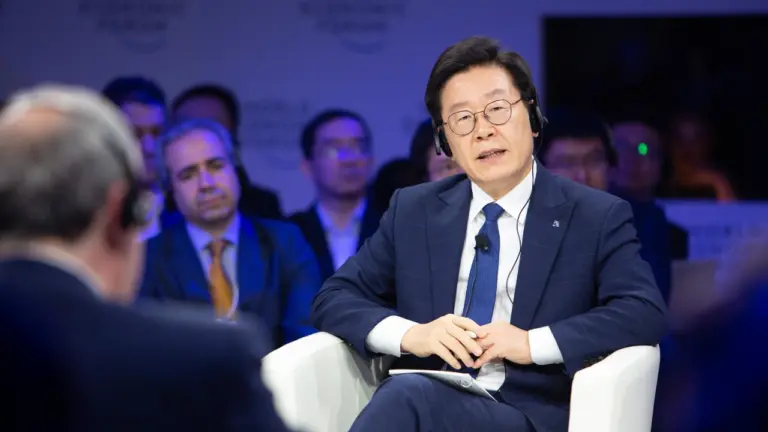
Lee Jae-Myung at the World Economic Forum - Annual Meeting of the New Champions in Tianjin, People's Republic of China 2018. (Copyright by World Economic Forum / Sikarin Thanachaiary)
- President Lee Jae Myung has asked his cabinet to review building a government-wide cybersecurity agency after the $6.3 billion Binance theft.
- South Korean exchanges, financial firms and public institutions have already been hit by a wave of breaches.
- Seoul is trying to move away from after-the-fact cleanup toward a centralized, preventive security structure.
South Korea’s president wants one strong agency to lead the country’s fight against hackers.
Following a huge crypto theft at Binance and several attacks on Korean financial firms, President Lee Jae Myung has asked officials to study the idea of building an agency.
What did South Korea’s president ask for?
At a cabinet meeting at the Blue House, President Lee Jae Myung said that the current system of completing security checks and fixing problems after an attack happens is not working well enough.
He asked officials to “actively consider forming a powerful and effective cybersecurity ‘tsar’ body” that would lead and organize security work that is now spread across many government offices.
Lee also said the country should consider a task force that includes both government and private companies. He pointed out that AI is making hacking smarter and more common, so the goal is to stop attacks before they happen.
He mentioned that the finance, energy and information networks are key areas that need stronger protection.
Officials must still decide what the security agency would look like and which powers it would take over from other offices.
Why is South Korea worried about cybersecurity now?
The main trigger for the request is the October 29 Binance theft, where a hacker took about $6.3 billion from the exchange’s online “hot” wallets across ten blockchains, most of it in about 20 minutes. TRM says it is the largest crypto theft ever, about four times the $1.5 billion Bybit hack in February 2025.
The FBI blamed North Korea on October 31, and TRM linked the attack to a North Korean hacking unit called TraderTraitor.
Cryptopolitan reported that North Korea has so far denied the attribution, with Kim Yo Jong, the sister of leader Kim Jong Un, calling the claim “absurd rhetoric and nothing new.”
Beyond the Binance hack, several Korean financial firms have been hacked recently, including Mirae Asset Global Investments, crypto exchange Bithumb and Daishin Securities (KRX: 003540). Some of these attacks exposed customer data.
South Korea’s spy agency, the National Intelligence Service, has started emergency security checks at more than 2,100 ministries, local governments and public offices.
Cryptopolitan also reported that the Financial Services Commission called in staff from five Korean crypto exchanges, including Upbit, Bithumb, Coinone, DigitalX and Gopax, to check how ready they are following the Binance hack.
Under Korean law, exchanges must keep at least 80% of customer crypto in offline “cold” wallets. The Binance money was stolen from hot wallets, which are connected to the internet.
Korean crypto users may have less protection than Binance users because a bill on paying back users after hacks, the Digital Asset Basic Act, has not passed yet.
Meanwhile, Binance has restored services, covering the losses from the incident. Binance has said it funded about 95% of the stolen amount from its own reserves.
The smartest crypto minds already read our newsletter. Want in? Join them.
FAQs
How much was stolen from Binance and who is blamed?
TRM Labs traced about $6.36 billion out of Binance wallets across ten blockchains on October 29, and the FBI attributed the attack to North Korea's TraderTraitor group on October 31.
What did President Lee actually propose?
Lee instructed officials to review creating a powerful government-wide cybersecurity body, described as a "czar" agency, to coordinate security functions currently spread across different agencies, and raised the idea of a joint public-private task force.
How has North Korea responded to the accusation?
In a November 2 statement carried by KCNA, Kim Yo Jong called the FBI's attribution "an absurd rhetoric and nothing new" and described it as a grave political provocation against the DPRK.
Disclaimer. The information provided is not trading advice. Cryptopolitan.com holds no liability for any investments made based on the information provided on this page. We strongly recommend independent research and/or consultation with a qualified professional before making any investment decisions.

Hannah Collymore
Hannah is a writer and editor with nearly a decade of blog writing and event reporting experience in the crypto space. At Cryptopolitan, Hannah contributes to the news page, reporting and analyzing the latest developments in DeFi, RWA, crypto regulation, AI and frontier tech industries. She graduated from Arcadia university with a degree in Business Administration.









