







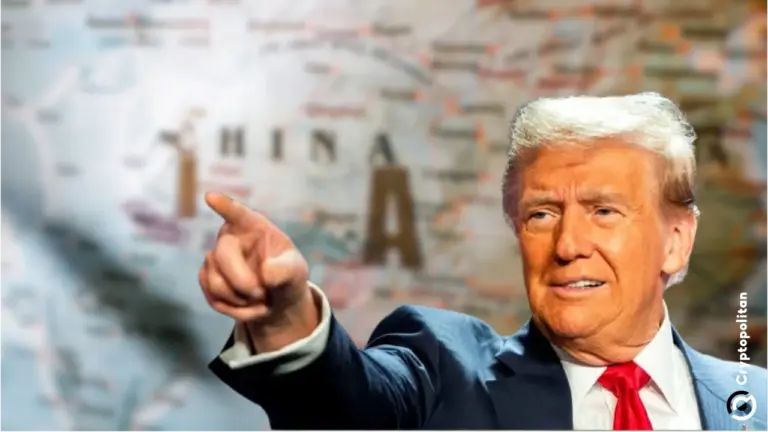
- The Trump administration is drafting a rule to stop Chinese companies from renting American AI chips through data centers abroad.
- Commerce’s Bureau for Industry and Security could circulate the draft to AI companies as early as September.
- Moonshot AI was accused of tapping GB300 systems in Thailand after releasing Kimi K3.
The Trump administration is preparing a rule that would stop Chinese companies from renting American AI chips through data centers in other countries.
This is a channel that the current US export controls do not cover currently.
Who is writing the rule and when will it land?
The Commerce Department’s Bureau of Industry and Security (BIS) is the office that has been working on the draft. BIS is also the office in charge of chip export licensing.
People close to the matter say that the rule could get circulated to AI companies and other stakeholders as early as September.
Should the rule advance, it would replace the Biden-era AI Diffusion Rule, a framework that capped sales of advanced chips to certain countries.
BIS scrapped that rule in 2025, saying it would have “stifled American innovation and saddled companies with burdensome new regulatory requirements.”
Why physical export controls miss the problem
While Washington’s export controls can block Nvidia’s top processors from shipping into China, it cannot stop a developer in Shanghai from paying to run workloads on those same chips sitting in a server rack abroad.
Moonshot AI was accused of tapping GB300 systems in Thailand after it released its Kimi K3 model. Analysts say that the AI company did not do anything illegal, as it does not hold the hardware.
Cassia King, a senior researcher on the Compute Policy team at the Institute for AI Policy and Strategy, stated that existing US policy “controls physical AI chips,” she said. “It does not cover remote access to those chips.”
The White House, for its part, said that the administration “has implemented the most rigorous export control regime in modern history.”
How big the workaround has become
In November 2025, it was reported that Shanghai startup INF Tech was training AI on roughly 2,300 leading-edge Blackwell chips housed in an Indonesian data center, according to the Carnegie Endowment for International Peace.
Indosat, the Indonesian telecom that bought the servers for about $100 million, said INF Tech only rents processing power and never touches the hardware.
Carnegie’s research also discovered that there were other firms doing the same. Alibaba and ByteDance have reportedly used Nvidia chips in Southeast Asian facilities to train their latest large language models.
Tencent struck a $1.2 billion deal last December for access to 15,000 B200 chips through a Japanese cloud provider. At least eleven state-linked Chinese entities have sought restricted US technology this way. The regional data center market that hosts much of this compute is projected to top $30 billion by 2030.
The legislative track running in parallel
The US Congress is also working to create legislation that covers the areas that the existing export controls do not cover.
The revised Remote Access Security Act (RASA) has again cleared the House with bipartisan backing.
The bill would redefine “exports” to cover remote compute access. In turn, it would force cloud providers to verify that their customers are not restricted parties.
The decision to widen what falls under export controls is not welcomed by everyone. Oren Etzioni, founding CEO of the Allen Institute for Artificial Intelligence, is one of them, as he wrote in an op-ed that if RASA passes, foreign customers who currently buy American cloud compute “may instead begin patronizing China,” costing the US both revenue and long-term influence in the AI race.
If you're reading this, you’re already ahead. Stay there with our newsletter.
FAQs
What loophole is the Trump administration trying to close?
Current US export rules control who buys and physically holds an AI chip, but they do not restrict Chinese companies from renting that chip's computing power remotely through data centers in other countries.
When could the new rule take effect?
The Bureau of Industry and Security could submit the draft to AI companies and other stakeholders as early as September, though it remains a proposal and not yet an enforced regulation.
How have Chinese firms accessed Nvidia chips despite the ban?
Carnegie reported that Shanghai's INF Tech trained AI on about 2,300 Blackwell chips in an Indonesian data center, while Alibaba, ByteDance, and Tencent have rented Nvidia compute through facilities in Southeast Asia and Japan.
Disclaimer. The information provided is not trading advice. Cryptopolitan.com holds no liability for any investments made based on the information provided on this page. We strongly recommend independent research and/or consultation with a qualified professional before making any investment decisions.

Hannah Collymore
Hannah is a writer and editor with nearly a decade of blog writing and event reporting experience in the crypto space. At Cryptopolitan, Hannah contributes to the news page, reporting and analyzing the latest developments in DeFi, RWA, crypto regulation, AI and frontier tech industries. She graduated from Arcadia university with a degree in Business Administration.









