







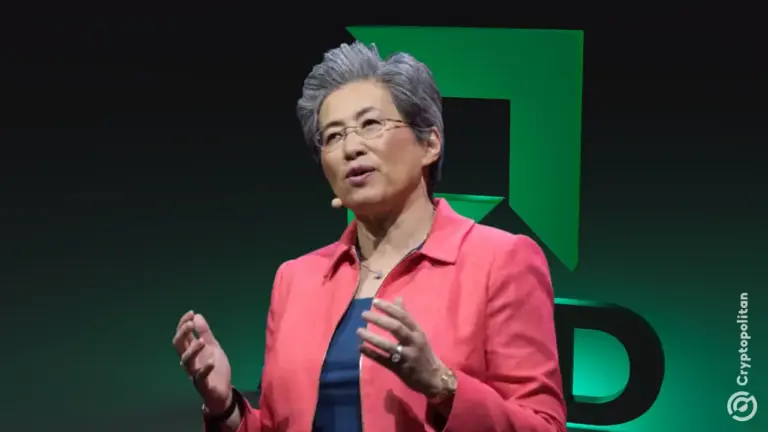
- AMD CEO Lisa Su said in Seoul on Wednesday that the company is still exploring a foundry partnership with Samsung Electronics, on top of the HBM4 memory supply deal the two signed in March.
- AMD needs far more high-bandwidth memory for accelerators like the 432GB MI455X at a time when supply is tight, while a manufacturing win would help revive Samsung’s loss-making foundry.
- The deal is far from settled as AMD still manufactures its advanced chips at TSMC and has warned about the risks involved in qualifying a new manufacturer.
Advanced Micro Devices (AMD) is still considering a foundry partnership with Samsung Electronics, CEO Lisa Su said in Seoul on Wednesday, as the chipmaker works to secure the memory supply needed for its next generation of AI accelerators.
Su met with Jun Young-hyun, Samsung’s vice chairman and head of its Device Solutions division, at the company’s Seocho office in Seoul’s Gangnam district on Wednesday. It was their first meeting in about seven months, following their previous meeting in March. AMD senior vice presidents Jack Huynh and Joseph Macri were also in attendance.
Su kept the agenda on ground non-specific when reporters asked her for details, saying the conversation would focus on AMD’s wider partnership with Samsung. She also noted that AMD has multiple partners within the Korean electronics giant. When asked if she would also meet Samsung Executive Chairman Jay Y. Lee, Su declined to elaborate, replying, “Too much information,” the Seoul Economic Daily reported. Earlier that day, she met SK hynix President Kwak Noh-jung, marking their first meeting in Korea, according to Businesskorea.
HBM4 is why AMD keeps coming back to Korea
The pull for AMD towards Korea is memory, and specifically high-bandwidth memory. AMD’s newest AI accelerator, the Instinct MI455X, carries 432GB of sixth-generation HBM (HBM4), a 50% increase on the 288GB of HBM3E in the earlier MI355X, CHOSUNBIZ reported.
Su said memory supply remains “very tight,” with the chipmaker working with customers to use memory more efficiently while pushing suppliers to increase output as quickly as possible.
AMD had placed Samsung as its preferred HBM4 supplier for the MI455X accelerator back in March, and Su told reporters at an “AMD Gamer Day” event in Seoul that shipments of the MI455 and the Helios system, both built on the HBM4 memory, had already started.
Su also highlighted how much AMD depends on South Korean suppliers. She said the Korean supply chain is a major part of AMD’s operations, with Samsung and SK hynix playing a central role in the company’s data-center ambitions.
Foundry question amid TSMC reliance
AMD currently relies on Taiwan’s TSMC to manufacture its advanced CPUs and GPUs, including the MI455X, which is built using a TSMC process. Adding a second manufacturer would require AMD to repeat the qualification process, including checks on yields, performance and delivery timelines.
AMD also warned in its latest annual report that moving some production to a new foundry could delay product launches or potentially hurt yields.
The companies’ March memorandum still left room for a more extensive partnership. Along with HBM4 and next-generation DDR5 supplies, the two sides agreed to explore producing future chips through Samsung’s foundry, with Samsung also offering its advanced packaging capabilities.
The foundry question has continued to remain a sticking point though, with one senior semiconductor-industry figure telling CHOSUNBIZ that AMD “sees too much risk in entrusting Samsung Electronics with foundry,” suggesting the current talks are largely focused on closing the gap between the two sides.
Landing actual AMD chip orders could accelerate a turnaround in Samsung’s loss-making contract manufacturing business, the Seoul Economic Daily reported. Su stopped short of confirming any new foundry deal but left the door open. She said Samsung Electronics remains an important partner across several areas and that AMD continues to look for opportunities to work together. She also stressed the need for a broad supply chain that can be planned three to five years ahead.
If you're reading this, you’re already ahead. Stay there with our newsletter.
Disclaimer. The information provided is not trading advice. Cryptopolitan.com holds no liability for any investments made based on the information provided on this page. We strongly recommend independent research and/or consultation with a qualified professional before making any investment decisions.

Opeyemi Olanrewaju
Opeyemi specializes in creating and refining high-quality content focused on cryptocurrency, global financial markets and the economy. He graduated from the University of Ibadan with an MBBS degree. He has worked as Editor-in-Chief for his College’s editorial publication and previously at CFA. For over six years, he has helped safeguard uniqueness as news editor at Cryptopolitan.









