






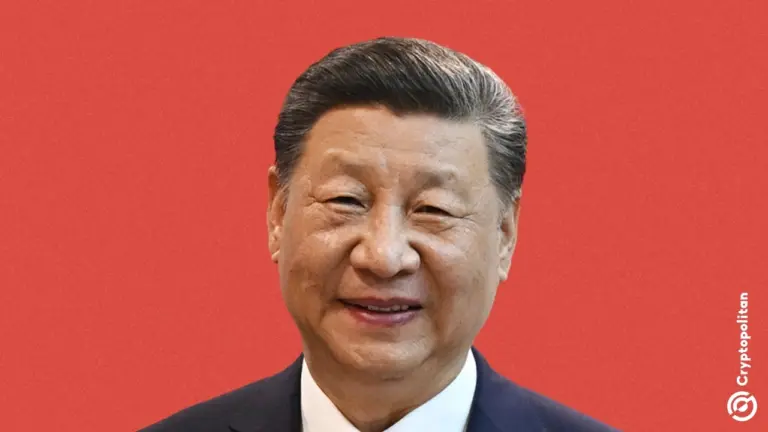
- Jinping urged the U.S. to keep AI talks open while both countries compete.
- He said AI should stay under human control and be used for public benefit.
- Trump said both sides should continue cooperation on AI after the state dinner.
Chinese President Xi Jinping told a room packed with US technology leaders that Washington and Beijing can keep competing in AI while still working together on how the technology is controlled.
Donald Trump hosted Jinping for a state dinner that put AI right in the middle of the evening. Recent warnings about AI creating risks on a global scale have pushed the technology far beyond Silicon Valley. It is now part of national security, trade policy, industrial strategy and diplomacy.
Nvidia (NASDAQ: NVDA) CEO Jensen Huang attended with his wife, Lori Huang. SpaceX CEO Elon Musk, AMD (NASDAQ: AMD) CEO Lisa Su and Apple (NASDAQ: AAPL) CEO Tim Cook were there too.
The room also included OpenAI CEO Sam Altman, OpenAI President Greg Brockman, Google (NASDAQ: GOOGL) co-founder Sergey Brin, and Microsoft (NASDAQ: MSFT) CEO Satya Nadella.
Jensen, Elon, Lisa, Tim, Sam, Greg, Sergey, and Satya found themselves seated around a dinner table while politics intruded on discussions related directly to the technologies their respective firms create, finance, manufacture, or distribute.
Jinping urges Washington to maintain AI negotiations amid rivalry between the two nations
According to China’s report of events, Jinping emphasized that competition did not preclude cooperation. According to Beijing, Jinping stated that “there may be competition,” but there may also be “even more” cooperation. He then went further, saying:
“The two sides can continue their dialogue on AI, exchange views on its risks and benefits, and jointly prevent the misuse and abuse of AI. AI must be kept under human control. A people-centered approach should be upheld, and AI should be developed for the positive and for good, so that AI will serve the progress of humanity.”
China’s summary said Trump also backed more communication between both governments. It quoted him as saying Washington and Beijing should “maintain dialogue and strengthen cooperation on AI.”
When the summit was announced, the U.S. government had yet to release its official response.
Beijing made significant strides towards closing the technological gap it had fallen behind on over decades.
While China had been developing artificial intelligence as one of its strategic priorities since at least 2013, Chinese companies rarely followed similar strategies as their counterparts in the United States.
Open-weight AI models formed the core of their efforts. Open-weight systems enable users to download and locally host the weights powering each AI, allowing modification to meet particular needs. This approach differs dramatically from closed-weight solutions developed in the United States, which usually offer customers limited access through a product interface or API while keeping the weights under lock and key.
Many popular Chinese AI models are available publicly. For instance, Moonshot AI’s Kimi K3 found success because of its ability to function close to the capabilities of frontier technologies while retaining full openness.
Trump later posted his own take on Truth Social.
“Very productive meeting with President Xi for both the U.S.A. and China. Tremendous things will be happening,” Trump wrote.
He also said Jinping appeared comfortable with replacing the term artificial intelligence with “SUPER INTELLIGENCE.”
“Like almost everyone else, he seemed to like calling the poorly and inaccurately named Artificial Intelligence to a far more accurate and important name, SUPER INTELLIGENCE. That would be ‘SUPER!’ Everyone last night agreed, also,” Trump wrote.
Washington pressures countries to choose its AI bloc as Beijing builds a rival network
The US is preparing letters warning numerous nations that joining America’s AI alliance means leaving Beijing’s rival coalition. According to documents seen by Reuters, State Department officials have drafted letters to the 35 countries that signed the US AI Opportunity Statement back in June.
Those nations form Pax Silica, an American-founded AI framework launched last year. This was done to ensure access to infrastructure powering modern AI technology, such as semiconductors, model supply chains, and critical minerals. Around two dozen nations belong to this group. They include Japan, Australia, South Korea, and Kazakhstan, important due to its resource deposits.
Here lies the crux of the dilemma: Kazakhstan is part of China’s competing AI coalition as well.
Jinping created China’s rival structure in July. Called the World Artificial Intelligence Cooperation Organization, it gives Beijing another platform for international AI cooperation while promoting the country’s open-weight approach.
Kazakhstan is currently the only country identified as belonging to both camps.
“To be part of everything is to be part of nothing. Signature of the Pax Silica Declaration is not merely a membership subscription, but a commitment,” the document says.
It also tells participating governments to “choose deliberately” when deciding which AI structures they join. The draft says membership in Pax Silica “cannot be held alongside membership in duplicative initiatives whose expectations conflict with our own.”
Don’t just read crypto news. Understand it. Subscribe to our newsletter. It's free.

Jai Hamid
Jai Hamid has been covering crypto, stock markets, technology, the global economy, and the geopolitical events that affect markets for the past 6 years. She has worked with blockchain-focused publications including AMB Crypto, Coin Edition, and CryptoTale on market analyses, major companies, regulation, and macroeconomic trends. She has attended London School of Journalism and thrice shared crypto market insights on one of Africa’s top TV networks.









