






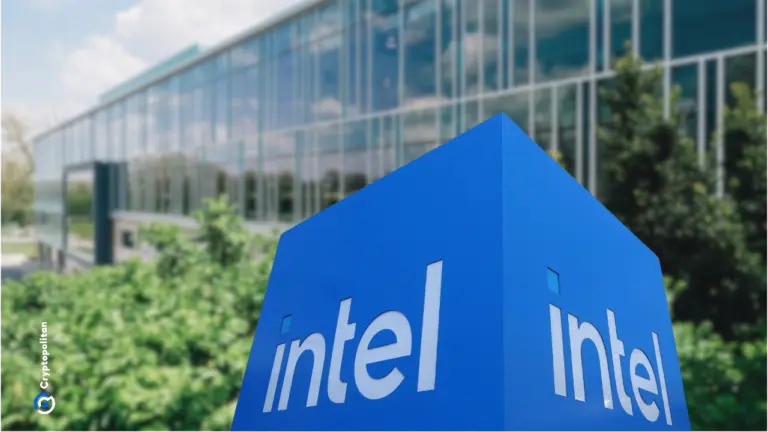
- The Trump administration is considering investing in Intel using CHIPS Act funds.
- Analyst Gil Luria says government involvement is needed to protect national security and strengthen U.S. chip production.
- Intel’s funding and development have drawn scrutiny, prompting calls for closer government oversight.
On Friday, August 15, Gil Luria, the head of Technology Research, pointed out the urgency of the government’s intelligence participation in Intel’s operations to enhance national security. His comments followed news that the Trump administration is considering investing in the tech giant.
In an interview, Luria noted that while they generally oppose government control over private companies, the current circumstances leave little choice—arguing that direct government participation is now essential to safeguard the nation’s security.
Washington’s plan to invest in Intel sparked endless controversy among individuals
On Thursday, August 14, a reliable source reported that Trump’s administration is eyeing Intel to invest significantly in the tech ecosystem. Individuals received the news with mixed reactions.
Some criticized the US government’s plan, stating that since the chip maker is a struggling tech company, its intention to invest in the firm is mainly about taking full control of its operation amid the AI boom era. Others have pointed out that the US government’s involvement in the tech firm’s operations has a significant advantage. They cite the recent market data showing a 7% gain in $INTC as evidence that government involvement could boost the company’s prospects.
Considering the steep competition surrounding semiconductor manufacturers and the ongoing concerns raised about national security, the debates concerning Intel’s fate are heating up among investors. They tend to consider the tech firm’s future productive capacity and the political backing put in place to support Intel’s slow-paced development.
When asked to comment on the topic of discussion, Intel decided not to respond.
Aside from national security concerns, Luria highlighted the advantages of this investment. For Luria, this investment is a game-changer for Intel’s development. Additionally, it will solidify its position as a global chip supplier to the US, reducing the country’s dependence on its rivals such as Taiwan Semiconductor Manufacturing Company (TSMC) and Samsung.
He based his argument on US President Donald Trump’s earlier claims to increase the production of chips and advanced technology in the country.
Still, it remains uncertain how Trump’s administration will affect Intel’s operations and the criteria they will apply while investing. What has been disclosed is that the officials will use funds from the CHIPS Act to make the investment.
What has been disclosed is that the officials will use funds from the CHIPS Act to invest.
Intel funding under scrutiny as analysts call for government oversight
Under the CHIPS Act, the Department of Commerce provided Intel $7.9 billion and an additional $3 billion to support the Pentagon’s Secure Enclave program.
Concerning this donation, Luria commented that this was among the chances Intel had to develop, but it did not succeed. The analyst called on the government’s intelligence to step in to curb this. According to him, Trump’s administration will give Intel unfair benefits, and if this takes place, the administration will be eligible to own a share of the business.
To demonstrate the intense nature of the situation, Lip-Bu Tan, the CEO of Intel, met with Trump at the White House on Monday, August 11, days after the US president asked the chief executive officer to step down, alleging that he had formed strong connections with China.
Luria echoed recent remarks by OpenAI CEO Sam Altman and Meta CEO Mark Zuckerberg, who stressed the need for government involvement in the tech sector, particularly in light of concerns that superintelligent AI could trigger a new era of nuclear arms proliferation.
The analyst did not stop at this point; he further emphasized that they cannot sit back and watch someone else make shell casings for their nuclear arsenals. Hence, he urged that the relevant authorities should be called on to take the correct measures.
If you're reading this, you’re already ahead. Stay there with our newsletter.

Nellius Irene
Nellius is a Business Management and IT graduate with five years of experience in the cryptocurrency industry. She is also a graduate of Bitcoin Dada. Nellius has contributed to leading media publications, including BanklessTimes, Cryptobasic, and Riseup Media.









