






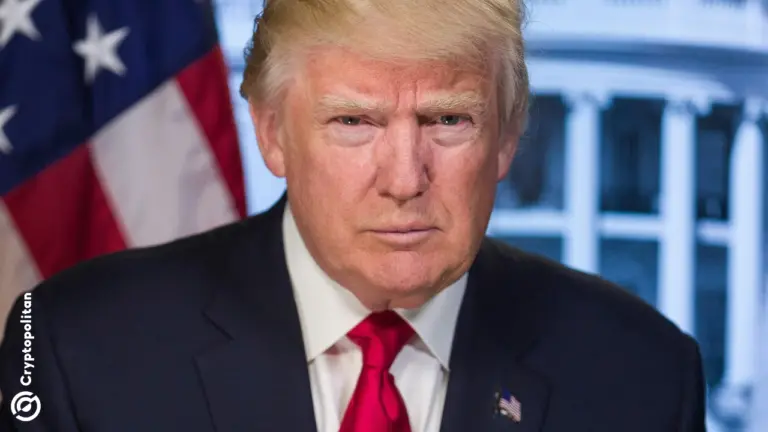
- Trump on Sunday dismissed AI-risk warnings as “very negative forces.”
- He reaffirmed that the U.S. should prioritize speed to stay ahead of China.
- Senators, on the other hand, are progressing towards an AI safety bill to address concerns regarding the development of increasingly capable AI systems.
On Sunday, U.S. President Donald Trump played down the rising alarm bells about artificial intelligence and said that the exaggerated concerns could hamper America’s race against China as worldwide AI investments are expected to cross the $1 trillion mark this year.
While speaking at his golf club in Doonbeg, Ireland, Trump took the side of the “go faster” argument in the ongoing debate that is currently taking place in Washington and the AI sector. The key issue for the market, however, is whether speed strengthens America’s position in the race or leads to the emergence of new safety, financial, and fragmentation risks in the global AI industry.
‘Whoever wins AI wins’
Trump was asked if he believes AI needs less aggressive development or stricter regulation. He agreed with the possibility of regulations but expressed that he believes the people warning about the repercussions of AI coming is unwarranted.
“Whoever wins AI wins.” — Donald Trump
His statements correlate with the AI Action Plan launched by the White House in July 2025, where more than 90 federal actions were proposed to facilitate further innovation, growth of infrastructure, and the strengthening of the position of the U.S in the AI race.
A Congress that isn’t buying the all-clear
While Trump is quite confident, others in Capitol Hill do not share his sense of assurance. House Democratic leader Hakeem Jeffries has asserted that the lawmakers must “act urgently” regarding AI risks and has taken on AI risks as the priority issue of the House Democratic Party.
House Speaker Mike Johnson is more careful, but he does not call for inactivity. He is in favor of “some guardrails, some safety measures” and warns that if America loses its lead in AI to China, it will result in another national-security problem for the country. He considers AI to be one of the most important things to deal with for Congress.
Senators, on the other hand, are progressing towards taking concrete actions. Senators Amy Klobuchar, Ted Cruz, and John Thune are working on an AI safety bill in a bipartisan manner after Jacob Coxon, the former researcher at Anthropic, voiced his concerns regarding the development of increasingly capable AI systems.
Under the proposed bill, frontier AI developers could face a legal “duty of care”, and the government will acquire the right to ban the release of unsafe models, making safety regulations more enforceable and less dependent on voluntary industry pledges.
The U.S. would certainly not be acting alone in terms of regulation. The EU AI Act governs the use of the general-purpose AI models and has began in August 2, 2025. According to the Act, any model with a training power exceeding 10^25 FLOP is considered likely to cause systemic risk and become subject to extra requirements, such as informing the Commission, mitigating risks, reporting incidents, and ensuring cybersecurity.
The International AI Safety Report 2026, launched by Yoshua Bengio with the help of over 30 countries and international institutions, proves how much global scope the governance issue has.
The money says $1 trillion, the economists say fragile
According to Goldman Sachs, it is predicted that by 2026, there will be global investments in artificial intelligence amounting to around $1 trillion, out of which nearly $581 billion will be made in the United States. It added that cumulative spending since the beginning of 2022 will come up to approximately $1.8 trillion by the end of the year.
However, information from the BIS from July reveals a different story. Namely, their model states that spending on AI is expected to be at least 1.5 times higher than the socially acceptable level, going up to three times more than the norm if demand decreases. Debt and circular financing can also put pressure on companies if the revenue from AI does not meet expectations.

So, the danger here is not merely ‘too much AI’ or ‘too much regulation’. According to BCG, the discrepancy in approaches between the U.S. and China has already resulted in the division of the world into separate AI contexts.
In case of regulatory, financial, and technology differentiation, the situation described by Trump as a winner-take-all race will transform into a situation in which businesses will have to bear costs associated with both overinvestment and fragmentation.
Don’t just read crypto news. Understand it. Subscribe to our newsletter. It's free.
FAQs
What did Trump say about AI critics?
Speaking to reporters at his golf course in Ireland on Sunday, Trump likened people raising concerns about AI to "very negative forces" bringing up scenarios that "won't happen," and said he wants the U.S. to stay the industry leader over China, according to Reuters.
How much money is going into AI in 2026?
Goldman Sachs Research forecasts global AI investment will exceed $1 trillion in 2026, including about $581 billion in the United States, with cumulative spending since 2022 reaching roughly $1.8 trillion by the end of the year.
What are U.S. senators proposing on AI safety?
According to the IAPP, Senators Klobuchar, Cruz and Thune are drafting a bipartisan bill, prompted by the resignation of Anthropic researcher Jacob Coxon, that would create enforceable safety obligations for the biggest AI developers and could be introduced within days.
Disclaimer. The information provided is not trading advice. Cryptopolitan.com holds no liability for any investments made based on the information provided on this page. We strongly recommend independent research and/or consultation with a qualified professional before making any investment decisions.

Ibiam Wayas
Ibiam Wayas has covered the crypto news beat since 2019. He studied Computer Science at National Open University of Nigeria. His work has appeared on various crypto news platforms, including Coinfomania, Crypto News Australia, and AltcoinBuzz. Drawing on his background in Computer Science, he now focuses on crypto, robotics, and longevity news.









