





Nvidia CEO Jensen Huang says China will beat the U.S. in AI race, raising geopolitical stakes

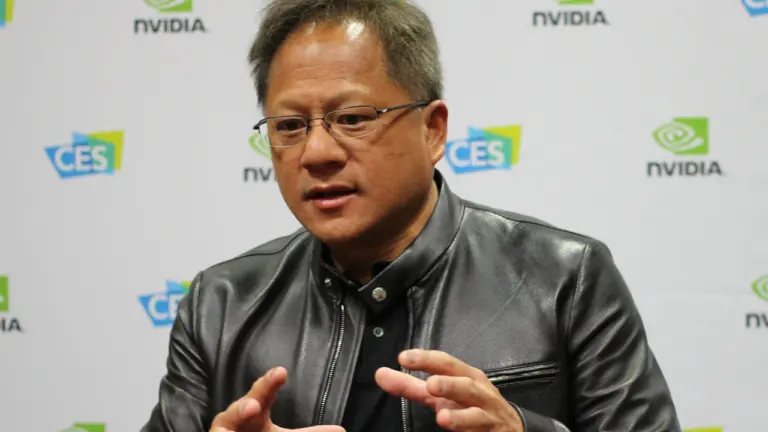
Photo by Maurizio Pesce via Flickr
- Jensen Huang said China is positioned to beat the U.S. in the AI race due to cheaper energy and fewer regulations.
- The U.S. is keeping export bans on Nvidia’s most advanced Blackwell chips following Trump’s talks with Xi.
- China is supporting its tech companies with power subsidies to run large AI systems despite less efficient domestic chips.
Nvidia chief executive Jensen Huang said China is positioned to overtake the United States in artificial intelligence development, telling the Financial Times that “China is going to win the AI race.”
The remarks came after U.S. President Donald Trump and Chinese President Xi Jinping held talks last week, where the White House chose to keep existing export bans on the most advanced Nvidia chips.
Jensen said the U.S. is slowing itself down with heavy caution and fractured rules, while China is lowering costs and accelerating growth.
Jensen said the West, including the U.S. and the UK, is being held back by what he described as “cynicism.” He said developing stronger AI systems requires bold investment and collaboration, not hesitation.
Jensen pointed to how different U.S. states are creating separate AI restrictions, saying this could lead to “50 new regulations,” while China is moving in the opposite direction by backing companies with major subsidies.
Energy subsidies help China scale AI infrastructure
Jensen said China’s approach allows its tech companies to run large-scale AI systems at a lower cost. He said, “Power is free,” referring to local government energy subsidies. Several large data centers operated by ByteDance, Alibaba, and Tencent have received increased power incentives, according to reporting cited in the Financial Times.
The subsidies were expanded after these firms said that switching to domestic chips from Huawei and Cambricon increased electricity usage and raised operating costs. Those chips are less energy efficient than Nvidia hardware, meaning they require more power to run the same tasks.
Even with the efficiency gap, Jensen has said before that U.S. AI companies are not far ahead of their Chinese counterparts. He has urged Washington to allow chip sales to China so that the global ecosystem continues to rely on U.S. platforms.
But Trump has taken the opposite stance. After meeting Xi, Trump said on CBS, “The most advanced, we will not let anybody have them other than the United States.” He said China can work with Nvidia, but not when it comes to Blackwell-level systems.
Trump had previously suggested that Nvidia may regain partial access to the Chinese market with a modified Blackwell chip. He said in August, “It’s possible I’d make a deal” on a version that was “enhanced in a negative way.”
But no deal is in place. The U.S. has not issued the regulations needed to enable those controlled sales.
Nvidia builds government ties while U.S. concerns grow
Last week, Nvidia held a developer conference in Washington DC, a move that showed the company is working to strengthen relationships in government. Around the same time, Nvidia’s market valuation reached $5 trillion for the first time.
The rise followed Trump saying he intended to speak with Xi about Blackwell during a visit to South Korea. Later, Trump said the discussion did not happen.
Nvidia and AMD have agreed to pay the U.S. government 15% of revenue from AI chips designed specifically for the Chinese market. But the regulatory conditions for those sales remain incomplete, meaning companies cannot move forward.
Meanwhile, U.S. concern about China’s AI progress has increased since the release of the DeepSeek language model in January. DeepSeek is from a small Chinese lab, but it drew attention in Silicon Valley because of its complexity.
The release led to debate about whether better-funded labs, including OpenAI and Anthropic, can maintain a technological advantage.
The reaction inside U.S. AI circles showed that China is developing systems faster than many expected, with fewer obstacles in its way.
If you're reading this, you’re already ahead. Stay there with our newsletter.

Jai Hamid
Jai Hamid has been covering crypto, stock markets, technology, the global economy, and the geopolitical events that affect markets for the past 6 years. She has worked with blockchain-focused publications including AMB Crypto, Coin Edition, and CryptoTale on market analyses, major companies, regulation, and macroeconomic trends. She has attended London School of Journalism and thrice shared crypto market insights on one of Africa’s top TV networks.









