







- CXMT sued the U.S. Department of Defense to challenge its designation as a “Chinese military company.”
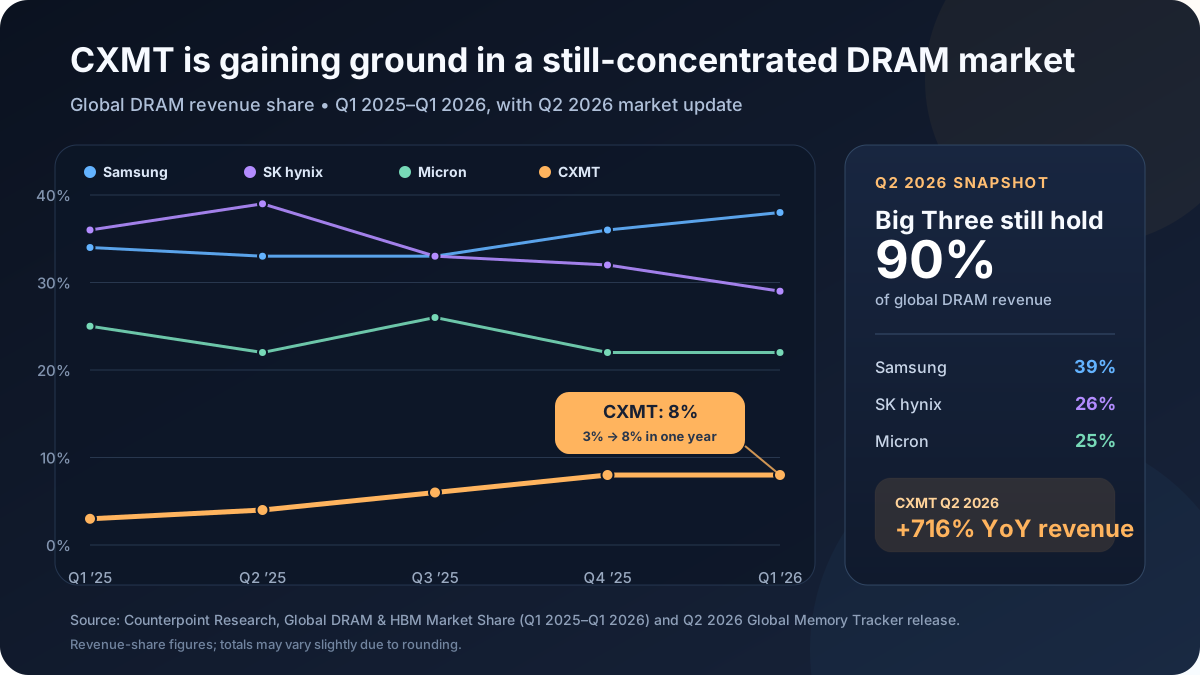
- AI demand is intensifying the DRAM shortage, with Samsung, SK hynix and Micron controlling about 90% of the market.
- CXMT is rapidly expanding, with DRAM revenue reportedly up 716% year over year and its share of global bit shipments approaching 9%.
China’s biggest memory-chip maker is challenging a U.S. military label just as the AI industry is scrambling for more of the memory it produces. ChangXin Memory Technologies (CXMT) filed suit against the U.S. Defense Department on Friday, seeking to overturn its designation as a “Chinese military company,” according to Reuters.
The situation is significantly more than just CXMT’s standing. DRAM, or the short-term memory that plays a critical role in AI servers, data centers, mobile phones and PCs, is scarce and big brands like Samsung, SK hynix and Micron have failed to meet demand despite their strong positions. CXMT is actually the only real fourth player in the market. The question of whether Washington will be able to limit its operations will affect the speed at which global memory markets will meet demand.
Why a fourth DRAM maker suddenly matters
Counterpoint Research has reported that Samsung, SK hynix and Micron still control 90% of the global DRAM market revenue in Q2 2026. Samsung takes the lead with a 39% market share, while SK hynix follows with a 26% share, and Micron holds 25%.
The demand for AI has made the market even more concentrated. Counterpoint anticipates that the price of conventional DRAM will continue to rise because agentic AI and AI servers will use more and more capacity.
CXMT has been quick to fill this gap. Counterpoint has stated that CXMT is the fastest-growing major DRAM supplier for the quarter, with revenues growing by 716% compared to last year. Cryptopolitan has reported that CXMT now represents almost 9% of total global DRAM bit shipments.
Its financial growth is equally impressive. The revenue in the first six months amounted to 150.31 billion yuan, or approximately $22.4 billion, which is up 874%, and net profit amounted to 77.61 billion yuan compared to a loss in the previous year as reported by Quartz after reviewing the company’s financial results.
CXMT denies military ties as it challenges Pentagon listing
The Pentagon’s Section 1260H List is not equivalent to the Department of Commerce’s Entity List. While the designation of a military company has significant ramifications regarding federal contracts, another section of the FY 2023 National Defense Authorization Act prohibits federal agencies from using any goods that use semiconductors of CXMT starting from December 2027.
While it is of great reputational and business significance, U.S. companies may still purchase CXMT chips.
This distinction is key to the ongoing lawsuit. CXMT stated that the Pentagon’s decision is arbitrary, baseless, and procedurally flawed. The company filed the lawsuit in the U.S. District Court for the District of Columbia.
“CXMT is not affiliated with the Chinese military.”— CXMT, in its federal lawsuit, as reported by Reuters
The company said its DRAM is designed and sold for civilian and commercial customers.
“None of these determinations is supported by the factual record, by applicable law, or by reasoned decision-making.”— CXMT, in its federal lawsuit, as reported by Reuters
The lawsuit lists Secretary of Defense Peter Hegseth, Deputy Secretary Steve Feinberg, and Chief of Industrial Base Policy Michael Cadenazzi as defendants. The Department of Defense stated, in a statement to Reuters, that it cannot comment on ongoing lawsuits or litigation in progress.
The Apple test hanging over the case
This conflict has arisen as Apple deliberates about acquiring CXMT memory. Cryptopolitan published an article in June regarding Apple’s plans to secure approval from the White House and the Department of Commerce for such acquisitions, as a rapid rise in AI memory prices caused the prices of some iPads and MacBooks to increase up to 20%.
A bipartisan group of senators from both parties has called on Apple to reject CXMT and Yangtze Memory, saying that acceptance from one of the most demanding component customers could lead to adoption across the industry.
Another even more severe restriction is being kept in reserve. CXMT, Deep Seek and over one hundred more companies were cleared through a multilateral regulatory body for possible inclusion on the Commerce Entity List. The list has not been updated since October 2025, with the Trump administration preferring to keep matters from getting out of hand with Beijing.
For now, CXMT is fighting the restriction already in force while the harsher one remains on hold.
A path other Chinese firms have walked
CXMT was not the first Chinese firm that challenged the Pentagon’s roster. In June, Alibaba took legal action for being listed on the list; Xiaomi had effectively triumphed through a lawsuit in the US and was taken off the list in 2021.
CXMT further noted that the Pentagon had momentarily issued a notification in February indicating that CXMT was no longer on the list, but that the notice was withdrawn later that day, followed by re-adding CXMT to the list without sufficient justification.
This historical precedent provides CXMT with a legal precedent. However, as demand for AI-driven memory increases, the result may be important not just for CXMT, but for the global DRAM market as well.
The smartest crypto minds already read our newsletter. Want in? Join them.
FAQs
Why did CXMT sue the U.S. Defense Department?
CXMT is asking a federal court to overturn its designation as a "Chinese military company," calling the decision "arbitrary" and unsupported by evidence, and arguing it violated the firm's due-process rights, according to Reuters' report of the complaint.
How big is CXMT in the global memory market?
CXMT is the world's fourth-largest DRAM maker behind Samsung, SK Hynix and Micron, holding roughly 9% of global DRAM bit shipments per Cryptopolitan, after first-half revenue jumped 874% to about $22.4 billion as reported by Quartz.
Does the Pentagon designation stop U.S. companies from buying CXMT chips?
Not directly. The Section 1260H military-company label can trigger federal contracting curbs and a 2027 government-procurement phaseout, but the separate Commerce Department Entity List, which would require export licenses, has not been updated since October 2025, according to Reuters.
Disclaimer. The information provided is not trading advice. Cryptopolitan.com holds no liability for any investments made based on the information provided on this page. We strongly recommend independent research and/or consultation with a qualified professional before making any investment decisions.

Ashish Kumar
Ashish Kumar is a crypto and financial journalist with eight years of newsroom experience. He covers what’s happening with crypto markets, regulation, DeFi, and exchange ecosystems. He has worked with Coingape, Todayq, and Newsroompost. Ashish holds a PGDP in English Journalism from the IIMC. He has also interviewed industry figures including Arthur Hayes, Yat Siu, Austin Federa, and more.









