








- The Cardano Foundation launched CIP-0113 to let issuers build KYC, sanctions, freeze and seize rules directly into stablecoins, funds and bonds.
- The rules are enforced by the ledger on every transfer, allowing issuers to move or freeze tokens without consent.
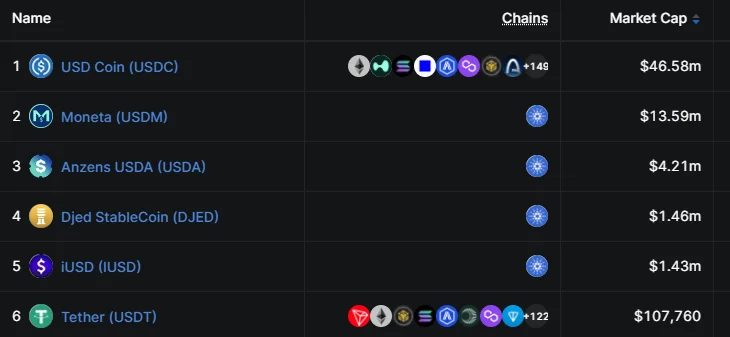
- Cardano’s entire stablecoin market is only about $67 million.
The Cardano Foundation is getting ready for a future where issuers of regulated tokens can freeze or seize stablecoins, funds and bonds issued on the blockchain, as confirmed by the compliance toolkit.
Per Cardano, the toolkit that went live on mainnet on Wednesday will allow issuers to screen recipients and also block sanctioned wallets on the network. The entire stablecoin market, which is the sector that uses the function most often, is relatively small on Cardano, at roughly $67 million.
According to the Swiss-based nonprofit that stewards the network’s development, the CIP-0113 Cardano improvement proposal it announced at the TOKEN2049 conference went live without requiring a hard fork.
Can tokens be frozen on Cardano now?
The CIP-0113 that went live on Cardano is a compliance tool being pitched as a compliance logic that follows tokens everywhere, and every time, checking that tokens continue to meet the rules by issuers.
Issuers can set parameters, including identity and AML checks, screening for sanctions, transfer restrictions, and freeze-and-seize controls from pre-built rule sets, called modules. They can also write their own rules and can swap them out as regulations shift without touching the underlying standard.
How it works in real life is that, whether it is a transfer, mint or burn, the Cardano ledger will first check that the transaction meets the issuer’s rules before approving it. Transactions that don’t meet the issuer’s standards are rejected.
In cases where tokens are restricted, those bars are limited to just one app; they follow them across wallets and services.
Cardano Foundation’s chief executive, Frederik Gregaard, said: “The rules have to travel with the asset and be enforced every time it moves.”
The global powers that CIP-0113 hands to token issuers also come with a headache. For example, if the issuers’ rules allow it, it can claw back tokens from a user’s wallet without their consent. That feature is specifically why the technical specification warns lending services to double-check that the issuers of the tokens they accept as collateral don’t have those powers.
Notably, the “Freeze & Seize” feature is an optional regulatory compliance feature according to the GitHub repository for the Aiken implementation.
Cardano’s stablecoin market is relatively tiny compared to the competition
Relative to Ethereum, Solana, and XRP Ledger, which already have their own versions of transfer controls, Cardano stablecoin market is relatively small, counted at roughly $67.5 million per DeFiLlama data.
Cardano arrived at the Coinbase x402 payment standard relatively late, only adding ADA support in September, as Cryptopolitan reported.
CIP-0113 is Cardano’s answer to the Bank for International Settlements (BIS) and International Monetary Fund (IMF)’s call to add programmability, the ability to hard-code compliance into an asset, as a priority requirement for the growing tokenized finance market.
The Swiss Capital Markets and Technology Association gave the thumbs up on CIP-113 Programmable Asset Tokens, saying it recognizes it as a smart contract equivalent to its CMTAT framework, usable for certifying compliance of ledger-based equity securities under Swiss standards.
The work is older than this week’s headline. The implementation builds on an earlier reference design, CIP-143, originally developed by Phil DiSarro and the IOG team and since migrated to the Aiken language.
Back in January 2025, Cardano founder Charles Hoskinson had taken an interest in the proposal, framing freeze-and-seize as a tool for non-adversarial uses too, such as asset recalls, identity updates and dividend payments. The Foundation says a dedicated securities module for regulated instruments is still in development.
If you're reading this, you’re already ahead. Stay there with our newsletter.
FAQs
What is CIP-0113?
It is a Cardano improvement proposal, now live on mainnet, that lets issuers of stablecoins, tokenized funds, bonds and other regulated assets build compliance rules such as KYC, AML, sanctions screening and freeze-and-seize directly into native Cardano tokens, with the ledger enforcing them on every transfer, mint or burn.
Can an issuer freeze or move my tokens without permission?
Yes, depending on the rules attached to a given token. An authorized party can move holdings without the holder's consent, and the specification warns lending services to check those powers before accepting such a token as collateral.
How large is Cardano's stablecoin market?
Small. DeFiLlama puts the total market capitalization of stablecoins on Cardano at roughly $67.5 million, led by about $46.6 million of USDC and $13.6 million of Moneta's USDM.
Disclaimer. The information provided is not trading advice. Cryptopolitan.com holds no liability for any investments made based on the information provided on this page. We strongly recommend independent research and/or consultation with a qualified professional before making any investment decisions.

Hannah Collymore
Hannah is a writer and editor with nearly a decade of blog writing and event reporting experience in the crypto space. At Cryptopolitan, Hannah contributes to the news page, reporting and analyzing the latest developments in DeFi, RWA, crypto regulation, AI and frontier tech industries. She graduated from Arcadia university with a degree in Business Administration.









