






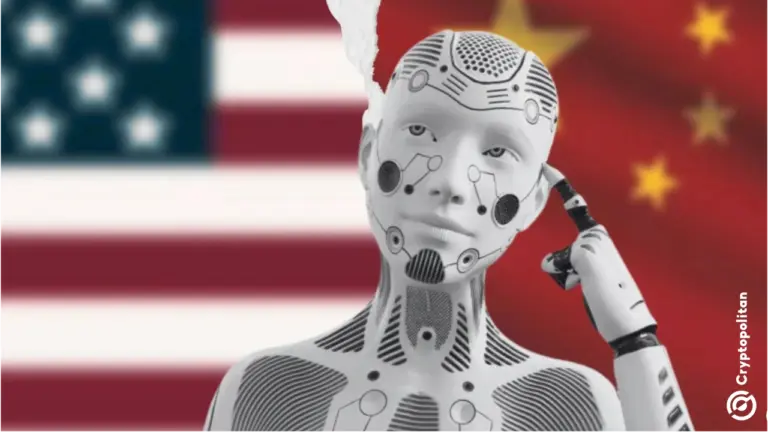
- China leads the US in everyday AI use, but adoption is quietly killing white-collar jobs.
- The Pentagon added Alibaba, Baidu, and BYD to its military-linked companies list, deepening US-China tech tensions.
- OpenAI banned China-linked accounts using ChatGPT to covertly shape American opinion.
China’s AI boom is reaching millions of people, but it is also cutting jobs and fueling tensions with the United States.
China has pulled ahead of the United States in putting AI tools into everyday use, according to tech industry leaders and investors gathered in Shenzhen this week.
But those same voices are sounding alarms about stretched valuations among Chinese companies, even as they praise the country’s progress on the ground.
China’s AI boom comes at a cost to workers
Chi Zhang, general manager of Alibaba Cloud Intelligence Group’s banking division, made the remarks on Thursday at the 2026 HKEX Future Tech Summit in Shenzhen.
He credited China’s current economic situation and its large pool of engineers and entrepreneurs for giving the country a strong platform for bringing AI goods to real consumers.
But the benefits are not without discomfort.
AI is subtly altering how businesses recruit and manage employees in Chinese offices and boardrooms.
Teams are changing, fewer graduates are being hired, and some positions are being abruptly eliminated.
Workers and contractors claim that AI is now taking over duties that were previously performed by humans.
Businesses are prioritizing cost-cutting and efficiency over retaining huge personnel. That presents a challenging question: can China continue to advance AI while maintaining job stability?
Unlike earlier waves of automation that mainly replaced factory work, AI is now taking over tasks once handled by analysts, writers, assistants, and other office workers.
For businesses facing intense competition and thin margins, it is often the cheaper option.
However, it has become more and more difficult to overlook the effect on employees.
US pressure and online influence campaigns add to the friction
At the same time that AI applications are spreading through Chinese workplaces, the country’s biggest technology firms are coming under renewed pressure from the United States.
This month, the US Department of Defense added Alibaba Group Holding, Baidu, and electric-vehicle maker BYD to its so-called “1260H” list, a roster of companies the Pentagon says have ties to China’s military.
The updated list now names 188 firms.
The move came only weeks after a summit between Presidents Donald Trump and Xi Jinping in Beijing, which failed to cool the rivalry between the two countries over technology.
While placement on the list does not immediately block normal business activity, it puts US investors on notice and could signal coming restrictions or even efforts to delist the companies from American exchanges.
The Pentagon’s move comes after a 2021 congressional order aimed at countering China’s “military-civil fusion” strategy.
The strategy is designed to blur the lines between China’s civilian technology industry and its military operations.
According to a report released by the US Department of State in August 2025, China uses this approach to gain access to foreign technology through investments, academic partnerships, joint ventures, and by recruiting skilled talent from overseas.
The rivalry between the two countries has now moved beyond trade and investment and is showing up in online spaces as well.
Two sets of ChatGPT accounts that OpenAI claims originated in China and were being used to conduct influence efforts aimed at American audiences have been shut down.
The first group was dubbed the “Data Center Bandwagon” promotion by the corporation.
That operation produced social media posts and images arguing that the building of data centers in the United States was driving up electricity bills for regular families.
The second campaign focused on criticizing US tariffs, portraying them as an attempt by Washington to gain an edge in the global technology race.
Interestingly, the prompts used to generate the content explicitly told the AI not to mention China’s leader, Xi Jinping.
Instead, only President Trump was supposed to appear in the posts.
OpenAI said the effort was notable because it specifically targeted discussions around its platform and major US data center projects.
According to the company, it appeared to be an attempt by foreign actors to influence the debate over America’s technological future while hiding both their identity and their motives.
If you're reading this, you’re already ahead. Stay there with our newsletter.

Hania Humayun
Hania joined Cryptopolitan with a long history of analyzing finance, economic trends, and prediction markets. She covered topics in emerging technology, AI, and fintech. Hania’s experiences as a licensed architect have added verve and precision to newswriting. She graduated from the National College of Arts in Lahore with an Architecture degree,









