






Starlink Alternatives in 2026: The Best Satellite Internet Provider Compared

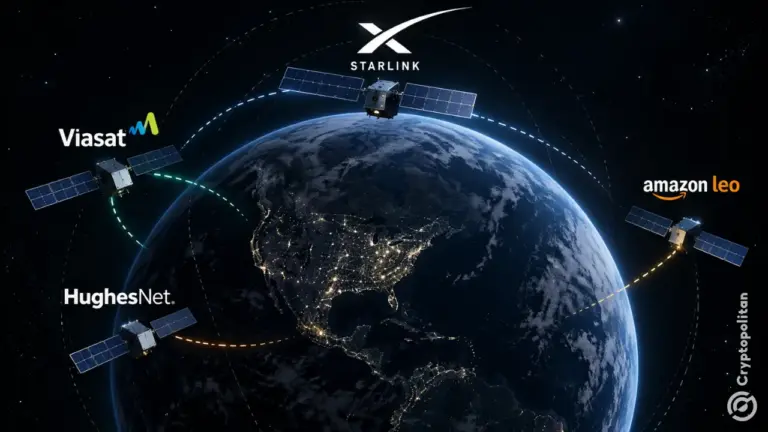
- Starlink alternatives include Viasat, HughesNet, Amazon Leo, EarthLink and T-Mobile 5G Home Internet.
- T-Mobile offers lower latency and unlimited data where its 5G network has enough capacity.
- Viasat and HughesNet provide wider rural coverage but suffer from much higher GEO satellite latency.
The satellite internet market completely changed when Starlink arrived. Cryptopolitan has been actively covering the progress of SpaceX and Starlink – from the company’s Pentagon contracts to serious network failures and geopolitical endeavors.
Previously, people in rural areas lacked both fiber and cable internet infrastructure. While Starlink offers big advantages such as internet connectivity without fiber cable, a consumer may still have reasons to choose other companies over Starlink
In this guide, we have thoroughly compared different satellite internet providers and pitched them as an alternative to Starlink.
Quick Comparison
| Provider | Orbit type | Monthly cost | Equipment cost | Data policy | Availability | Best for |
| Viasat | GEO satellite | Essentials: $39.99 → $69.99; Unleashed: $69.99 → $99.99 after 3 months | $15/mo lease or $250 Lifetime Lease | 150 GB High-Speed on Essentials; Unleashed unlimited with congestion deprioritization | Address-dependent | Rural homes that can tolerate GEO latency |
| HughesNet | GEO; Fusion adds terrestrial wireless | Lite/Select/Elite/Fusion: $39.99–$94.99 intro pricing | $9.99–$19.99/mo lease + $99 setup | 100 GB Priority on Lite/Select; 200 GB on Elite/Fusion, then Standard Data | Broad coverage; Fusion in select areas | Rural coverage; Fusion where lower latency is available |
| Amazon Leo | LEO satellite | Not yet published | Not yet published | Not yet published | Not broadly orderable for U.S. homes | Upcoming LEO alternative |
| EarthLink Satellite | GEO, powered by Viasat | From $59.95/mo | $14.95/mo + $79.95 handling + $79.95 installation | Up to 300 GB depending on plan; speeds may drop after FAP threshold | Address-dependent; marketed in all 50 states | Buyers who prefer EarthLink billing/support |
| T-Mobile 5G Home Internet | Fixed wireless | Rely/Amplified/All-In: $50/$60/$70 with AutoPay | Gateway included + $35 connection charge | Unlimited; lower priority during congestion, with further deprioritization after 1.2 TB | Address- and capacity-dependent | Homes with good 5G capacity and lower-latency needs |
| Regional WISPs & fiber | Fiber / fixed wireless | Varies | Varies | Varies | Local and address-specific | First option to check before satellite |
| Starlink | LEO satellite | Residential 100/200/Max: from $55/$85/$130 | Varies by address and offer | Unlimited; network management applies | Broad U.S. coverage; capacity varies by address | Low-latency satellite for rural homes |
Why People Look for a Starlink Alternative
Price and the equipment cost
Our final price analysis considered various factors involved in Starlink plans. First off, there are monthly subscriptions, which make up the core part of each package. For example, Starlink Residential 100 starts at $55 per month in the U.S. Nonetheless, this isn’t the whole story – apart from the monthly subscription, hardware plays an important role, which varies immensely between different households. Sometimes, people can get discounts on installation or complete bundles for free.
Other satellite providers also practice separate equipment pricing. Such companies as Viasat and HughesNet have separate sections on their web pages dedicated exclusively to the equipment price. Even for T-Mobile, one would have to pay extra charges despite the gateway provided with the kit due to some connection-related fees. As far as we understand the matter, the first-year cost is much more relevant than the average monthly cost, given equipment prices.
Regional availability and limitations of bandwidth
Area mapping appears highly convenient when it comes to picking satellite internet services. It is so because a service like Starlink Residential covers virtually all of the territory of the United States. It means nothing in terms of the availability of the services for every customer. There are limitations of the local network capacity that either restrict availability or charge customers extra.
The same applies to the offer made by T-Mobile. However, there are different reasons behind it. Users can use mobile 5G internet anywhere they like. There still might be a chance that your location does not fall under its coverage area. Why? Because the local tower does not provide such an opportunity. The situation with Amazon Leo is somewhat different since the residential service of the company cannot yet be ordered in the U.S.
Outages and reliability
Starlink has also had large service disruptions. In July 2025, users across several U.S. cities and other parts of the world reported losing service during a major outage.
However, this does not imply Starlink’s unreliability exclusively. Geostationary orbit satellites, fixed wireless networks, and even fiber optic cables can experience failure as well, but due to separate factors.
Satellite coverage should not be taken as uninterrupted connectivity for clients. Clients utilizing the internet link for work purposes would benefit from redundancy planning.
Privacy and terms-of-service changes
Privacy has become another reason some users look at alternatives. In January 2026, Starlink changed its privacy policy to allow some personal information to be used or shared for AI training unless the customer opts out.
Starlink subsequently clarified that individual browsing history is not shared with AI models. Enterprise customers are automatically opted out of data sharing for AI training, while government-account data is not used for AI training.
Nothing impacts bandwidth or reach. But if there are worries around what happens with the account info, then this represents another factor to mull over.
How We Compared the Services in this Guide
Satellite internet options can look fairly similar on the surface. Once equipment, data rules and actual availability are added, not so much. We compared each option using six factors that matter most for a fixed home or business.
Availability
First thing, the provider has to actually serve the address. We looked at address-level availability and local capacity instead of treating broad coverage maps as proof that every plan can be ordered.
True first-year cost
The monthly price alone does not tell much. Known first-year bases are about $972 for Viasat Essentials, $708 for HughesNet Lite, and $635 for T-Mobile Rely, before taxes or address-specific charges.
Latency class
A big advertised download number can look useful. It still does not tell the full story. GEO satellite connections have much higher latency than LEO satellites or terrestrial fixed wireless, which can affect gaming, video calls, VPNs, and remote desktop use.
Data policy
“Unlimited” is another word that needs some checking. It does not mean exactly the same thing with every provider. We checked for hard caps, Priority Data allowances, Standard Data, and deprioritization after a usage threshold.
Contract and exit terms
Some services are month-to-month, while others can require a 12- or 24-month commitment. We also checked early termination fees and equipment-return requirements.
What is it actually good for
One score would not work for every household anyway. A GEO plan can still make sense at a remote property, while a local fiber or fixed wireless connection may be the better option where it is available.
The Alternatives
Viasat

For Viasat, the use case is fairly simple. It remains one of the main GEO alternatives to Starlink and mostly makes sense where a good terrestrial broadband option simply is not there. Its biggest difference from Starlink is latency. Independent Ookla data from Q1 2025 put Viasat at about 49 Mbps median download speed and roughly 684 ms median latency.
Viasat currently sells two main residential plans in the U.S. Essentials starts at $39.99 per month for the first three months and then rises to $69.99. Unleashed starts at $69.99 and then moves to $99.99 after three months. Equipment is another $15 per month, although a $250 Lifetime Lease is available in some areas.
Essentials includes 150 GB of High-Speed Data before moving to Standard Data. Unleashed has unlimited High-Speed Data, but Viasat’s legal policy ties roughly 360 GB over 30 days to the usage level covering about 70% of residential customers. Around 850 GB corresponds to the top 5%, where congestion slowdowns can become much more severe.
For rural users, the broad availability is probably the clearest advantage, especially where cable or fiber has never reached. The biggest drawback is GEO latency, which makes Viasat much less attractive for competitive gaming, remote desktop work, and other applications where response time matters.
HughesNet

HughesNet satellite service reaches the contiguous U.S., Alaska, and Puerto Rico, where there is a clear view of the southern sky. In the general U.S. residential lineup, HughesNet offers Lite, Select, Elite, and Fusion. Lite, Select, and Elite are GEO satellite plans, while Fusion combines satellite with terrestrial wireless to reduce latency. Regional plan availability can vary.
The initial subscription price of the Lite package will amount to $39.99/mo with a 12-month commitment before increasing to $49.99/mo. The Select plan, it costs $49.99 initially before jumping up to $74.99/mo after the trial period. Similarly, Elite will charge users initially $64.99/mo and then increase to $89.99/mo, whereas Fusion begins at $94.99/mo, followed by an increase to $119.99/mo at the end of 12 months. These figures come alongside automatic check transfer discounts for customers paying via the ACH method.
Lite and Select each include 100 GB of Priority Data per month, while Elite and Fusion include 200 GB. After the applicable Priority Data allowance is used, customers continue with unlimited Standard Data, although speeds may be slower when the network is busy.
Regarding equipment charges, HughesNet lease pricing ranges from $9.99 to $19.99 per month depending on the plan, with a $99 lease setup fee. Current promotions include standard professional installation at no charge for new customers who lease the equipment.
One major drawback of standard HughesNet plans stems from high geostationary latency, which independent Ookla speed tests measured at a median of roughly 683 ms.
Amazon Leo

Amazon Leo is still an upcoming LEO competitor. Before the rename, it was Project Kuiper. Cryptopolitan covered the constellation’s buildout when SpaceX launched 24 Project Kuiper satellites, and Amazon says fixed service will begin rolling out across initial latitude bands later in 2026.
For consumers, there is one obvious problem right now: the service still cannot be broadly ordered in the U.S. Amazon has not published a normal consumer price, equipment cost, data policy, or contract structure that can be compared directly with Starlink, Viasat, or HughesNet.
Amazon has three terminal families announced so far. Leo Nano is rated for up to 100 Mbps, Leo Pro for up to 400 Mbps, and the enterprise-focused Leo Ultra for up to 1 Gbps download and 400 Mbps upload. These are company claims based on preliminary testing, not measured residential performance.
There is also a rollout caveat. Amazon had already sought more time for the July 30, 2026 FCC milestone, which required 1,616 satellites to be deployed and operational. The FCC granted a limited waiver in June, allowing deployment to continue while keeping the final 2029 deadline in place.
So for now, Amazon Leo belongs more on the watch list. It is not yet a replacement that most people can simply order.
EarthLink
EarthLink stands out from other satellite internet providers due to its business model. It uses the satellite infrastructure created by Viasat, offering only retail-level satellite internet packages. EarthLink is responsible for customer relationships and invoicing.
The difference between EarthLink and Viasat affects the way in which EarthLink should be assessed against the competition. Wholesale pricing options allow EarthLink to create distinct offers, setting up individual prices and plans. We’ll use these terms when evaluating satellite internet performance.
EarthLink’s satellite internet plans start around $49.95 to $59.95 per month for introductory tiers. Equipment rental is listed at $14.95 per month, with a $79.95 processing and handling fee alongside a $79.95 standard installation charge.
Satellite data caps offered by EarthLink extend between 15 GB and 300 GB. Following the exceedance of any selected Fair Access Policy limits, customers’ internet connections stay active. However, users might experience decreased speeds without losing connectivity or paying for extra gigabytes of traffic.
The actual value of purchasing EarthLink services lies in getting access to Viasat-based GEO satellites through yet another retail partner. However, all the inherent characteristics of GEOs – significant latencies and susceptibility to weather conditions – remain unchanged.
T-Mobile 5G Home Internet
T-Mobile is the option that does not involve satellites; instead, it leverages fixed wireless connectivity. Specifically, the T-Mobile 5G cellular network supplies fixed internet to residences. This means that there is no need for satellite dishes, and the latency level should be substantially lower compared to GEO satellite connectivity as long as the regional network has sufficient capacity.
The pricing levels are $50 per month with AutoPay, $60 per month for the Amplified plan, and a $70 monthly rate for the All-In package. The provider offers lower prices at $35, $45, and $55 per month, but they only apply to subscribers with qualified T-Mobile voice postpaid lines. The gateway is included, although a $35 device connection charge still applies.
The users get unlimited data connectivity without any cap limitations. Network prioritization remains a key component as well. Home Internet traffic already receives lower priority than many mobile users during congestion, while customers using more than 1.2 TB in a billing cycle are prioritized last until the next billing cycle.
The performance metrics exceed GEO satellite connectivity in case the link works fine. According to Ookla reports, T-Mobile achieved a median download speed of 222.72 Mbps, a median upload speed of 18.12 Mbps, and 46 ms latency in the Q2 2026 period.
The availability becomes significantly more complicated. Even if a particular area enjoys 5G phone connectivity by T-Mobile, it might still be impossible to subscribe to Home Internet due to tower capacity issues.
Regional WISPs and fiber
However, regional providers tend to be extremely hard to identify. They do not appear in national broadband offerings, which most people would be reading. The FCC has identified over 2,000 firms that report availability of residential fixed broadband, and all of them operate in limited geographic areas.
This becomes an issue especially in rural areas. There may be a local wireless internet service provider who covers certain communities or stretches of road using terrestrial fixed wireless, while another service provider may have stopped right next to one building and covered the other. National pricing or speed information is not helpful here. It boils down to whichever firm provides services at that particular location.
First, I would use the FCC National Broadband Map by entering the exact address and filtering for fiber and fixed wireless, then check the provider’s Broadband Facts label.
However, the map may also be out of date due to recent construction. The most current version of the public map is based on availability information for the month of December 2025. Therefore, recent construction done in 2026 may not be shown on the map. State broadband offices and WISP directories in your area will be able to help you find other alternatives.
Starlink
In comparison, Starlink is the LEO satellite baseline. Starlink is already widely available and boasts significantly lower latency than GEO companies. Current residential options for the United States include Residential 100 for $55 per month, Residential 200 for $85, and Residential Max for $130.
When it comes to hardware, things get a bit complicated for Starlink. Currently, Starlink offers no upfront costs for hardware in certain regions, $10 monthly rent in certain markets, and a variety of purchasing and free kit options based on your location. High-demand regions can incur an additional Demand Surcharge once.
The amount of residential data is unlimited – yet congestion is not going away because of it. Residential 100 and 200 may suffer more during network congestion, while Max will receive maximum priority within the Residential class.
According to independent Ookla data, at the end of 2025, the median Starlink download speed was more than 100 Mbps in all states except Alaska, with significantly lower latency compared to GEO satellites. The only requirement remains the view of the sky.
In the case of rural households that have no high-quality terrestrial broadband connections, Starlink is still the better buy now with respect to lower latency. However, there is another alternative that might make more sense in some cases.
Satellite Internet for Business
For business use, the comparison changes a little. A consumer plan may be fast enough for email and browsing but still lack an SLA, faster repair, public or static IP options, or higher and sometimes symmetrical upload capacity for certain workloads. Businesses may also need a second connection for failover when the primary line goes down.
Starlink has one of the clearer business offerings. Its Local Priority plans start at $55 per month for 50 GB of Priority Data and go up to $530 for 2 TB. Eligible Priority plans include a 99.9% uptime SLA, with a 20% credit on recurring line and data fees if the service falls below the commitment. Starlink also offers publicly routable IPv4, although the address is dynamically assigned rather than static.
Both Viasat and HughesNet provide business satellite services with special assistance for businesses and other features. Viasat has a $49.99 backup service as well as a static IP on selected plans for $10 monthly. HughesNet provides 24/7 business support; a static IP can also be added by certain customers.
Another fixed wireless Internet option is T-Mobile Business Internet. It has month-to-month plans, 24/7 business support and a static IP available as an upgrade on certain business routers, although the default plan lacks an uptime SLA.
It all depends on what kind of operation is being run. A small business using cloud applications needs something else compared to another business that requires 100% uptime, large uploads, remote access or an additional connection that will work in case of an outage.
What Nobody Tells You Before You Sign Up
Monthly pricing is usually the easiest number to find. There are no annual contracts in effect on T-Mobile’s side. Starlink operates on a monthly subscription basis. Yet, free equipment promotions might carry the obligation to stay within the company’s services for twelve or twenty-four months, along with associated charges in case of early departure.
There is also an “unlimited” data allowance, which seems like an easy term until you understand all its nuances. For example, HughesNet provides subscribers with a fixed quota of Priority Data before they switch to the Standard Data plan. In addition, while having no strict limit of usage on a monthly level, Viasat Unleashed might give less prioritization rights to the heavy users when the network experiences bottlenecks.
Starlink Residential provides limitless internet as well, although the problem persists in terms of traffic control. Satellite latency is where geostationary orbit services show one of their biggest limitations. Independent testing shows that the median values for Viasat and HughesNet average at 680 ms, while FCC defines ‘low-latency’ as 100 ms or less. This kind of lag can particularly affect competitive gaming, remote desktop work, VPN use, and interactive video calls even when the advertised download speed is high.
Severe weather can affect satellite service as well. The installation process itself requires taking care of various installation aspects, such as mount location (rooftop mounting, pole mounting, wiring), which may incur additional fees.
Additionally, consider the early exit penalty from your plan contract, along with equipment return costs, cancellation fees, Starlink commitment fees, or change fees before making the move.
Final Verdict: It Really Depends on Where You Live
There is no single Starlink alternative that works better in all cases. The choice depends on particular addresses. To begin with, it is necessary to examine whether fiber optic services or regional WISP networks are available locally. T-Mobile 5G Home Internet needs to be taken into account where it is possible, since it provides considerably lower latency compared to GEO satellites and doesn’t involve a satellite dish.
If it is not the case, then Starlink will remain the low-latency satellite internet solution for many rural homes. Solutions like Viasat or HughesNet will perform better when geographic coverage is of greater importance than latency. EarthLink is also an additional retail way to access Viasat satellite internet solutions. Amazon Leo residential solution cannot yet be ordered everywhere in the U.S.
Price does not tell the whole story when deciding what works better. Exact address validation leads directly into comparing the full-year cost, equipment specifications, latency speed, data limitations, and contracts associated with each satellite internet service provider alternative.
If the connection needs to move with an RV or van rather than stay at one property, see our Best Internet for RV & Van Life guide.
FAQs
What is the best alternative to Starlink?
There isn’t one particular satellite internet vendor that will be objectively superior in all possible cases. Geographical variations make such claims irrelevant. If capacity is high enough locally, T-Mobile 5G Home Internet becomes a suitable option, particularly when users wish to avoid satellites altogether and receive lower latency internet connection without using satellite dishes.
Amazon’s planned Leo satellite constellation is expected to emerge as competition, although currently orders cannot be placed yet for residences throughout the United States. For sites with limited access to traditional broadband, GEO options like Viasat and HughesNet are available.
Is there a cheaper alternative to Starlink?
The cheapest satellite internet plan on the first bill may not stay cheapest over a full year. Some alternatives have lower starting monthly prices than Starlink, but the cheaper plan can come with other costs or limits. Viasat Essentials and HughesNet Lite both start below Starlink
The trade-off is different for each service. GEO plans have much higher latency and may use Priority Data or congestion rules. Equipment rental, setup, and installation can also raise the first-year cost. The monthly rate alone is not enough to decide which option is actually cheaper.
What’s the difference between LEO and GEO satellite internet?
For most users, latency is the difference they will notice first. GEO satellites orbit much farther from Earth, so the signal takes longer to travel. Independent measurements for Viasat and HughesNet were around 680 ms, while Starlink’s LEO network operates at much lower latency.
The FCC defines low-latency fixed broadband as 100 ms or less. That difference matters most for interactive uses such as gaming, video calls, VPNs, and remote desktop work. GEO can still handle browsing and streaming, but it feels much slower when a fast response is required.
Can I get satellite internet for gaming?
Yes, although not every satellite connection works equally well for it. The best satellite internet for gaming generally needs lower latency — usually a LEO connection. GEO services such as Viasat and standard HughesNet plans have very high latency, which makes fast multiplayer games a poor fit even when download speed is adequate.
Starlink is much more realistic for gaming because its LEO network has much lower latency. HughesNet Fusion is another option in select areas because it combines satellite with terrestrial wireless for latency-sensitive traffic. Casual or turn-based games are less demanding than competitive multiplayer.
Is satellite internet good enough for working from home?
It can be. A lot depends on what the person actually does from home. Email, web apps, and buffered video can work over satellite, while video calls, remote desktop, and some VPN connections are more sensitive to latency.
Starlink is generally better suited to interactive work because of its lower LEO latency. Viasat and standard HughesNet plans can still support home-office use, but the delay is more noticeable. HughesNet itself warns that VPNs can significantly reduce speeds, and Fusion is its better option for time-sensitive work where available.
What is the best satellite internet for business?
There is no automatic winner for business use. It depends on what the connection is expected to do. Starlink Priority stands out for businesses that want lower LEO latency, higher network priority, and a published 99.9% uptime SLA.
Viasat and HughesNet also offer business satellite plans with dedicated support and backup options, while T-Mobile Business Internet can be a strong non-satellite choice where 5G capacity is available. Check SLA terms, public or static IP needs, upload requirements, repair support, and failover before choosing a plan.
Disclaimer. The information provided is not trading advice. Cryptopolitan.com holds no liability for any investments made based on the information provided on this page. We strongly recommend independent research and/or consultation with a qualified professional before making any investment decisions.

Hania Humayun
Hania joined Cryptopolitan with a long history of analyzing finance, economic trends, and prediction markets. She covered topics in emerging technology, AI, and fintech. Hania’s experiences as a licensed architect have added verve and precision to newswriting. She graduated from the National College of Arts in Lahore with an Architecture degree,









