




AEREDIUM puts ownerless lending protocol LOVEH on testnet, pays AERX for bugs

- AEREDIUM deployed LOVEH, an ownerless lending protocol with no admin keys or governance, to its testnet.
- It is also paying 10,000 AERX airdrop points for each confirmed bug.
- Because the contracts can never be patched, the security hunt has to happen before any real funds are deposited.
AEREDIUM’s LOVEH, which it describes as an ownerless and immutable lending protocol, has gone live on public testnet. As part of the testnet rollout, the project also announced a campaign to award 10,000 AERX airdrop points for every security flaw confirmed in the protocol’s contracts.
LOVEH is the first consumer-facing DeFi application from AEREDIUM, a project that describes itself as a Layer 1 blockchain for institutional clients.
By design, nobody can pause, patch or upgrade markets once they go live because LOVEH contracts do not have owners, administrative keys or governance structures. Not even the developers who wrote the contracts can change them once they are deployed.
Why is AEREDIUM launching LOVEH?
AEREDIUM is pitching LOVEH as the fixed-gas-fee answer to the price-crash problem that has historically tested the resilience of lending pools. These network fee spikes are typically compounded by borrowers scrambling to add collateral, lenders rushing to withdraw, and liquidators racing to close bad loans.
MakerDAO’s “Black Thursday” episode in 2020 is a classic example of loans getting liquidated for next to nothing because of a fee surge during a market rout.
According to LOVEH documentation, the USD 60-per-megabyte fee for transaction data that the chain charges remains unchanged, even during periods of volatility.
Hence, transfers on the chain cost less than one cent, the same rate users pay on low-activity days as well as on high-volume ones.
Notably, while LOVEH ensures that loans do not get wiped out just because the network got expensive, standard collateral-based liquidation still applies.
Why LOVEH launched without owners, admin keys or governance
LOVEH’s design follows a DeFi philosophy that has seen different iterations over the years. Liquity’s Ethereum lending protocol shipped without governance and no admin keys, according to a 2021 blog post by co-founder Kolten Bergeron. Morpho Blue launched under similar minimalist and immutable conditions.
The LOVEH GitHub repository outlined the five-item checklist for users deploying markets on the chain:
- Token lent
- Collateral accepted
- Price source
- Borrowing limit
- Rate formula
Once deployers meet all five requirements and send markets live on the network, nobody can edit them, not even the contract’s writers.
Lenders earn the interest borrowers pay, minus a 10% protocol fee hard-coded to flow to the AEREDIUM Foundation in the lent token. Also, market failures are non-contagious, so that one market does not affect others.
LOVEH offers 10,000 AERX for each confirmed bug
Due to the product’s immutability, AEREDIUM has gone all out debugging the code before users start trading real dollars on LOVEH contracts. The Foundation is offering 10,000 AERX per confirmed vulnerability, paid as airdrop points under the published program terms.
Users qualify for the 10,000 AERX reward for finding flaws in the category of unauthorized access to funds, trapping lenders’ or borrowers’ money, or breaking a documented rule, such as a market’s books failing to balance or a within-limit loan getting liquidated.
Style complaints, wording and cost gripes earn thanks but no reward.
When different users report the same bug, the earliest documented filing receives the reward.
The pre-launch bug bounty campaign is not novel to LOVEH. Leading DEX Uniswap put up what it called the largest bug bounty in history when it announced a $15.5 million reward pool ahead of its v4 contracts in 2024.
AEREDIUM’s airdrop converts points to AERX at a fixed 10-to-1 rate, according to its airdrop program page.
Rates that start where Ethereum’s USDC pools sit
LOVEH did not invent its pricing from scratch. On deployment day, its rate line was pinned to the average borrowing rate of the three largest USDC lending pools on Ethereum, read straight from those contracts and cross-checked by two independent sources that had to agree.
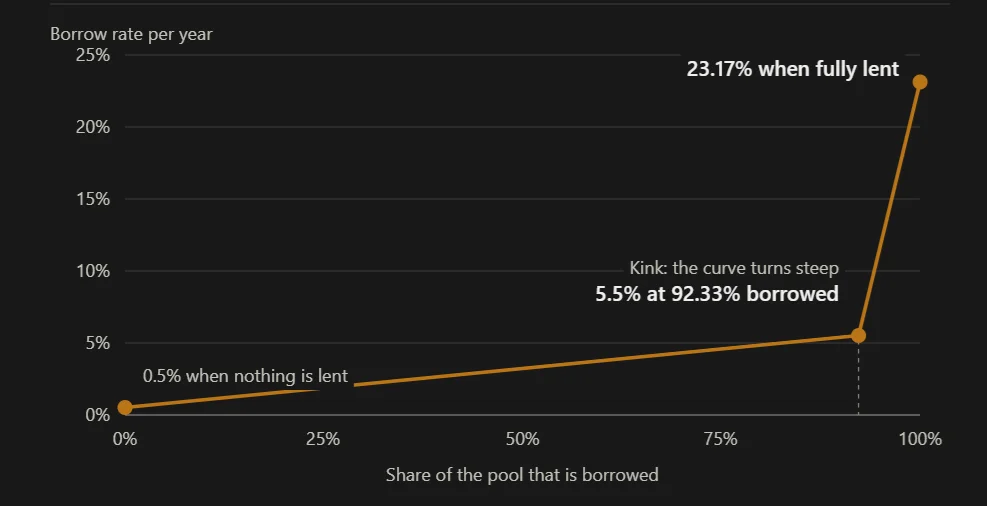
From there, the curve moves with supply and demand. A borrower pays 0.5% a year when nothing is lent out, 5.5% once 92.33% of a pool is borrowed, and 23.17% when the pool is fully lent.
AEREDIUM, whose CEO Albert Dadon has described the firm’s institutional work on payment-agnostic settlement, is now testing whether the same rigid, ownerless model can stand up to a public attack.
If you're reading this, you’re already ahead. Stay there with our newsletter.
FAQs
What is LOVEH?
LOVEH is a lending market on the AEREDIUM blockchain where lenders deposit a coin to earn interest and borrowers take it against locked collateral, with no owner, no administrative key and no governance, according to AEREDIUM's project page and GitHub repository.
How much does AEREDIUM pay for finding a bug, and how do you report one?
The AEREDIUM Foundation pays 10,000 AERX in airdrop points for each confirmed vulnerability that lets someone take funds, traps a user's money or breaks a documented rule; reports are submitted privately through the project's GitHub repository.
Why can't LOVEH be changed after launch?
Its contracts have no owner, no admin key and no governance, so nobody, including the developers who wrote the code, can pause, upgrade or alter a market once it is deployed, which is why AEREDIUM is inviting attacks during the testnet phase.
Disclaimer. The information provided is not trading advice. Cryptopolitan.com holds no liability for any investments made based on the information provided on this page. We strongly recommend independent research and/or consultation with a qualified professional before making any investment decisions.

Hannah Collymore
Hannah is a writer and editor with nearly a decade of blog writing and event reporting experience in the crypto space. At Cryptopolitan, Hannah contributes to the news page, reporting and analyzing the latest developments in DeFi, RWA, crypto regulation, AI and frontier tech industries. She graduated from Arcadia university with a degree in Business Administration.









