





The Top Five Self-Custody Crypto Wallets in 2026: A Critical Comparison Beyond Marketing Claims

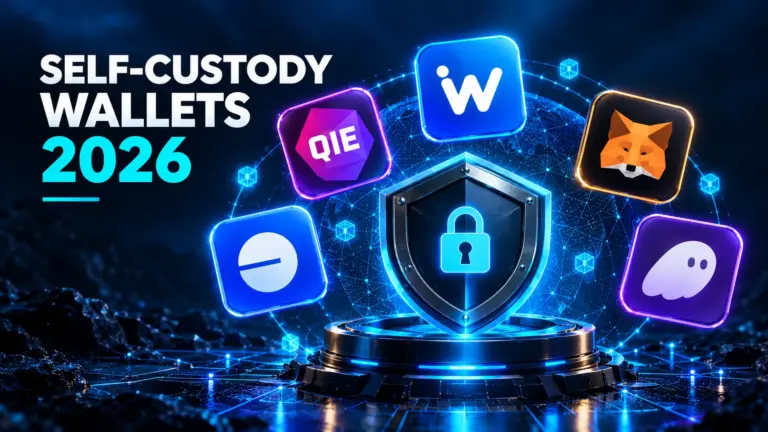
The crypto wallet market has changed substantially. A wallet is no longer simply software that stores a private key and signs transactions. Leading products increasingly compete on security intelligence, multichain support, trading, access to decentralized applications, identity, payments, and the ability to make blockchain technology understandable to ordinary users.
QIE Wallet, for instance, while smaller and younger than MetaMask, has a materially different approach to the wallet problem: combining self-custody with reusable identity, human-readable multichain payment IDs, and real-world payments.
1. MetaMask: Still the Benchmark for Web3 Infrastructure
MetaMask remains one of the most important interfaces between users and decentralized applications. Historically associated with Ethereum and EVM networks, it has expanded considerably. MetaMask now directly supports major networks, including Ethereum, Bitcoin, Solana, Tron, BNB Chain, Base, Arbitrum, Optimism, Polygon, and Avalanche. Its multichain architecture now derives EVM, Bitcoin, and Solana addresses within the same account structure.
Best suited to: DeFi users, developers, experienced Web3 users, and users requiring broad dApp interoperability.
2. Iron Wallet – Crypto wallet with AI Agent Support Capabilities
Iron wallet is a non-custodial crypto wallet that enables users to store, send, receive, and swap cryptocurrencies. It also doubles as a hot wallet for AI agents running locally on your computer.
An AI agent is an autonomous program that uses artificial intelligence to process goals, plan multi-step workflows, and execute actions using external tools and APIs. In this case, Iron wallet enables AI agents running on artificial intelligence applications like Cursor, ChatGPT, or Claude to check wallet balances, send crypto, and swap assets.
The wallet does not store your seed phrase. This means you are solely accountable for your assets. The wallet’s nature prevents it from storing any personal details, ensuring the safety and anonymity of your personal data.
Best suited to: Users working or experimenting with AI agents and regular users concerned about the safety of their data.
3. Phantom: Perhaps the Best Consumer User Experience
Phantom began as a Solana wallet, and that heritage remains important. Its user experience was designed for an environment dominated by consumer applications, NFTs, and high-frequency token trading, rather than for Ethereum’s more technical early DeFi culture.
Phantom now supports Solana, Ethereum, Base, Polygon, Bitcoin, Sui, HyperEVM, and other selected networks.
Best suited to: Solana users, active traders, and consumers who value polished design and strong transaction previews.
4. Base App: The Wallet Is Becoming an On-Chain Social Application
Coinbase’s wallet strategy has changed considerably. What was formerly known as Coinbase Wallet is increasingly being positioned as the Base App, an all-in-one self-custody application that incorporates trading, discovery, content, mini-apps, and communication.
Base’s real advantage is onboarding. The newer experience supports simplified sign-in mechanisms and aims to combine wallets, trading, social interaction, and applications into a single environment.
Best suited to: Users wanting simplified onboarding and an increasingly integrated social, trading, and application experience.
5. QIE Wallet: Smaller, Less Proven — but Attacking a Different Problem
QIE Wallet requires a different type of evaluation.
It cannot credibly claim the maturity, installed base, or battle-testing history of MetaMask or Phantom. Any objective comparison must acknowledge this.
Where it becomes interesting is what the wallet is trying to solve.
QIE Wallet currently supports Bitcoin, Ethereum, BNB Chain, Solana, Tron, Avalanche, Polygon, and Arbitrum, with additional networks planned. Cross-chain swaps are provided through third-party infrastructure, while the wallet remains self-custodial.
Its private-key architecture follows the conventional non-custodial model: keys are generated locally, recovery uses a BIP-39 compatible phrase, and QIE states that it cannot access or recover the user’s private key.
That alone does not differentiate it substantially from established wallets.
The more interesting development is QIE ID.
Instead of asking users to send cryptocurrency to addresses such as:
0x71C7656EC7ab88b098defB751B7401B5f6d8976F
QIE attempts to map multiple blockchain addresses to one human-readable identity, such as:
alex.qie
The same identity can resolve to addresses on Bitcoin, Ethereum/EVM networks, Solana, Tron, and other supported chains.
The second differentiator is QIE Pass, which introduces reusable identity verification without converting the wallet into a custodial product.
Users who choose to complete verification can establish a reusable verified credential. According to QIE’s documentation, the underlying verification is performed through Sumsub infrastructure; QIE does not place the user’s identity documents on-chain or store the underlying KYC documents itself. Instead, the system indicates that verification has been completed.
Best suited to: Users interested in self-custody combined with human-readable multichain payments, reusable identity, and QIE ecosystem services.
Which Wallet Wins?
There is no single intellectually defensible winner across all categories.
For established Web3 interoperability, MetaMask remains difficult to beat.
For AI agent support and privacy, Iron Wallet has the strongest proposition among these five.
For consumer UX and active trading, Phantom remains particularly strong.
For integrated social and application onboarding, Base App is pursuing perhaps the most ambitious mainstream strategy.
For identity-led payments and reputation, QIE Wallet is pursuing the most differentiated model in this group, but it also carries the greatest risk of adoption and maturity.
The next generation of crypto wallets will therefore probably not be won by whichever company supports the most tokens. It will be won by whichever wallet makes ownership, identity, security, and payments disappear into an experience so simple that users no longer need to understand the blockchain beneath it.
That is the standard against which all five should ultimately be judged.
Disclaimer. This is a Corporate Press Release. Readers should do their own due diligence before taking any actions related to the promoted company or any of its affiliates or services. Cryptopolitan.com is not responsible, directly or indirectly, for any damage or loss caused or alleged to be caused by or in connection with the use of or reliance on any content, goods or services mentioned in the press release.
Cryptopolitan Media
A dedicated desk for curated insights and featured updates from our network of global industry partners.









