




- Russian company IT-Imperial staged the country’s first robot wedding at Moscow’s Pushkin Library.
- Humanoid robots Robert and Matilda swapped bracelets and read AI-generated vows in a symbolic, legally meaningless ceremony.
- The event landed on Russia’s Family, Love and Fidelity Day and spread quickly across social media.
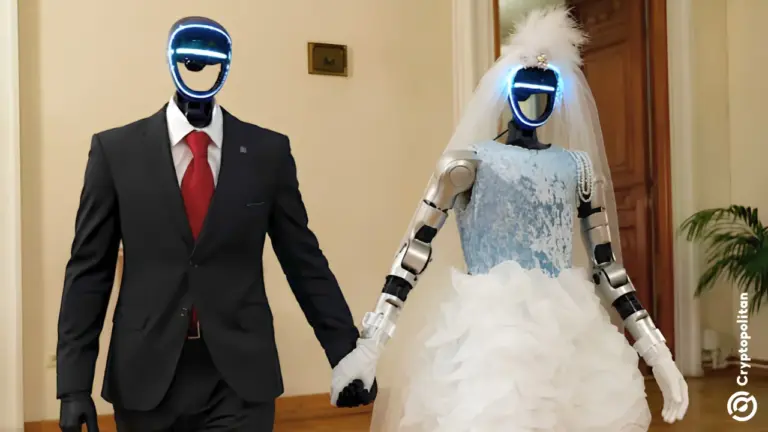
Two humanoid robots exchanged vows created by artificial intelligence at Moscow’s Pushkin Library. Russia’s first robot wedding, according to the organizers, was a staged demonstration intended to raise awareness of the nation’s humanoid robotics efforts.
The two robots, Robert and Matilda, were constructed by the Russian company IT-Imperial. There is no legal marital status for either. The purpose of the event, according to Deputy CEO Anna Bagdasaryan, was to demonstrate the capabilities of humanoid machines and encourage greater public interaction with technology.
The robots operate on open platforms, so anyone can create their own behavioral algorithms, she continued.
Robert plays office worker, Matilda dances as ballerina
Robert was designed to resemble a blogger and office worker. Matilda danced during the event and was dressed like a ballerina. The couple exchanged wedding bracelets for rings. They were carried onto the stage by Dogmatik, a robot dog, and the vows were AI-generated.
The ceremony was planned to take place on Russia’s Family, Love, and Fidelity Day. Prior to their library debut, the two machines made their public debut at the 2026 St. Petersburg International Economic Forum. Additionally, IT-Imperial donated a number of books on automation, robotics, and artificial intelligence to the Pushkin Library.
Images and videos from the event quickly went viral on social media, featuring the robots dancing and interacting with attendees. The event was described by the outlet as symbolic and playful, a tech demonstration with no legal significance. It stated that as robots enter the fields of education, entertainment, and customer service, the wedding reignited the online discussion about how humans and machines will coexist.
Two humanoid robots, Robert and Matilda, became the centre of attention during what organisers described as Russia’s first robotic wedding ceremony, an event designed to showcase advances in humanoid technology rather than blur the line between humans and machines pic.twitter.com/ljegdOFiyS
— Swaraj Srivastava (@SwarajAjad) July 10, 2026
Developers lean on robot theater to sell progress
Nowadays, public robot theater is a common marketing strategy. Researchers in China, the US, and Russia are racing to create more machines that resemble humans. The Moscow wedding was held in the midst of competition, with businesses showcasing their advancements through demonstrations.
A Unitree G1 humanoid was captured on camera kneeling on a sidewalk in the Sichuan province of China, according to a June report from Cryptopolitan. It included a donation plate, a QR code, and an LED sign that said, “no money to recharge,” and it accepted payments via Alipay and WeChat Pay. Nobody took credit for placing it there. A G1 unit kicked a child during a martial arts demonstration in Xinjiang, and another toppled over while attempting to dance, according to separate incidents that Cryptopolitan documented.
In May, Taiwan Semiconductor Manufacturing Company chairman Wei Zhejia declared that Chinese humanoids “jump around, bounce about” and are “just for show.” Industry analysts agreed, stating that the majority of these machines are only used as props for entertainment. Without revealing a commercial timeline, IT-Imperial has now presented Robert and Matilda to two audiences: a public library and an economic forum.
Don’t just read crypto news. Understand it. Subscribe to our newsletter. It's free.
FAQs
Who built the robots Robert and Matilda?
They were developed by the Russian company IT-Imperial.
Was the robot wedding a legally recognized marriage?
No. The ceremony had no legal status and was staged purely as a public technology demonstration.
Where and when did the ceremony take place?
It was held at Moscow's Pushkin Library, timed to coincide with Russia's Family, Love and Fidelity Day.

Randa Moses
Randa Moses is an editor and reporter at Cryptopolitan covering tech, AI, robotics, crypto, scams, and hacks. She has worked in the crypto space since 2017. She held roles at Forward Protocol, AmaZix, and Cryptosomniac. Randa holds a degree in Electrical and Electronics Engineering from the University of Bradford.









