




Polymarket refers midterm bets to CFTC as anonymous offshore wallets dominate election markets

- Polymarket has probed dozens of midterm-related bets and sent at least two to the CFTC.
- Its anonymous offshore platform remains where most election money and manipulation risk sit.
- A small set of wallets controls the bulk of trading volume, which make election markets uniquely exposed just days before the November 3 vote.
Polymarket has investigated dozens of bets tied to the U.S. midterms and referred at least two of those cases to the Commodity Futures Trading Commission (CFTC).
Despite the investigations, Polymarket’s largely unregulated offshore site still allows traders to stay anonymous and pay in crypto.
Can Polymarket’s offshore site be controlled?
Polymarket runs two platforms. One platform demands that users trade with real identities, the U.S. version, while Polymarket International, which has been described by the company’s head of global intelligence and investigations Shana Bautista as its “bigger brother,” is essentially unregulated and lets people trade anonymously with cryptocurrency.
Bautista, a former FBI official who joined the company in June, argued the anonymity is thinner than it looks, saying that despite it, there has never been a case where the authorities “haven’t been able to identify, potentially, who these people are.”
A study commissioned by the Coalition for Prediction Markets and conducted by Rutgers professor Harry Crane estimated Americans wagered as much as $34 billion on offshore prediction markets in the 12 months through April 2026.
As much as 30% of Polymarket’s volume over that period came from U.S. users, even though they are barred from the offshore site.
The Anti-Corruption Data Collective reviewed more than 21,000 midterm markets across Kalshi and Polymarket and found that the top 1% of Polymarket wallets, by congressional trading volume, drove 70% of that volume this cycle.
Dune research pointed out that of 24,930 Polymarket wallets holding midterm positions as of October 18, the median position was $14, yet the top 100 wallets held 56% of all position value.
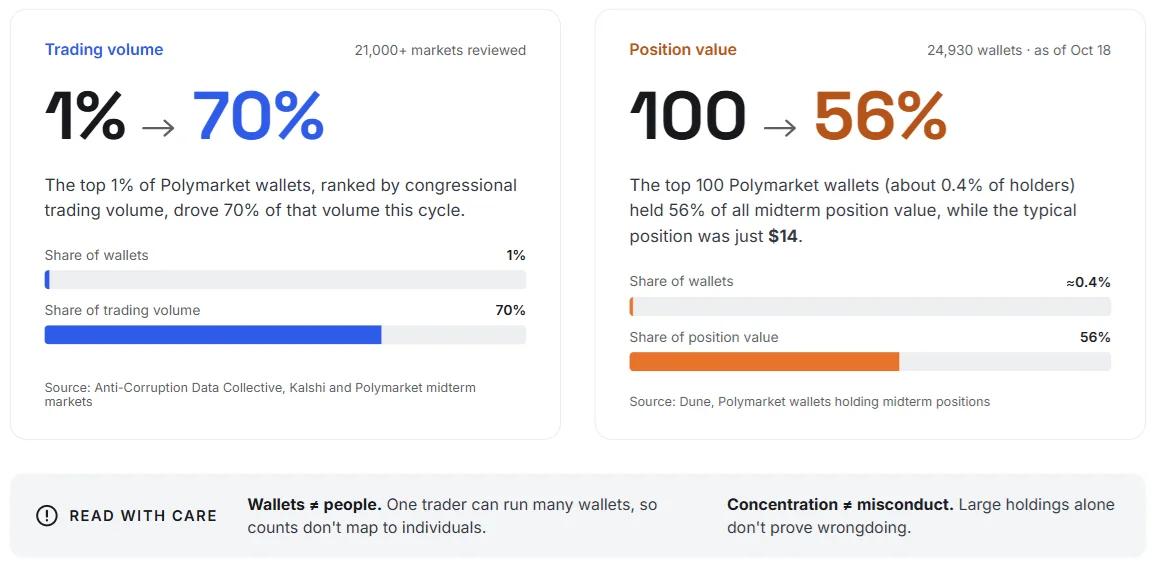
Dune warned that the number of wallets isn’t the same as the number of traders, and that one person or group holding a large share isn’t proof that they are doing something wrong.
How do election markets invite manipulation?
Rajiv Sethi, a Barnard College economics professor who has studied prediction markets for decades, laid out the concern that election bets can have an effect on what is being bet on. He said the markets risk becoming “a self-fulfilling prophecy.”
Bautista said her 16-person team uses a new surveillance system that pulls in huge amounts of data on each user. The data is collated from social media, Federal Election Commission records, crypto firms, banking partners, and statistical models.
When enough warning signs add up, they receive alerts. She said they get hundreds of alerts a day, and if any insider traders attempt to outsmart the system, “we will find you.”
Cryptopolitan has previously reported on the allegations of insider trading that Polymarket faces after the wallets of several whales went dark following outsized bets on U.S. military action in Venezuela.
CFTC Chairman Michael Selig has said that the agency will be on the lookout for manipulation in prediction markets ahead of the midterms.
The CFTC previously ordered former White House teleprompter operator Gabriel Perez to return $107,539.02 and pay a $65,000 penalty, and former Representative George Santos to return $17,569.98 and pay $17,500. In both cases, a three-year trading ban was imposed.
The New York Times found that more than 80 Polymarket users placed suspiciously timed bets, including wagers made before undisclosed U.S. and Israeli operations against Iran, pushing House Oversight Chairman James Comer to open an investigation in May into whether traders use nonpublic information on Polymarket and Kalshi.
Polymarket’s rival, Kalshi, has suspended six 2026 candidates for betting on their own races. Across the industry, more than $1.4 billion has already changed hands on 2026 midterm markets, with Kalshi near $1.1 billion and Polymarket above $340 million.
The smartest crypto minds already read our newsletter. Want in? Join them.
FAQs
How many election bets has Polymarket investigated?
According to its head of global intelligence Shana Bautista, Polymarket has looked into dozens of midterm-related cases, and a person familiar with the probes told NPR at least two have been referred to the CFTC.
How concentrated is Polymarket's election betting?
The Anti-Corruption Data Collective found the top 1% of Polymarket wallets drove 70% of congressional trading volume this cycle, and Dune research showed the top 100 wallets held 56% of midterm position value as of October 18.
How much has been wagered on the 2026 midterms?
More than $1.4 billion has been traded on 2026 midterm prediction markets, with Kalshi near $1.1 billion and Polymarket above $340 million.
Disclaimer. The information provided is not trading advice. Cryptopolitan.com holds no liability for any investments made based on the information provided on this page. We strongly recommend independent research and/or consultation with a qualified professional before making any investment decisions.

Hannah Collymore
Hannah is a writer and editor with nearly a decade of blog writing and event reporting experience in the crypto space. At Cryptopolitan, Hannah contributes to the news page, reporting and analyzing the latest developments in DeFi, RWA, crypto regulation, AI and frontier tech industries. She graduated from Arcadia university with a degree in Business Administration.









