






- Elon Musk answered a chart of AI spending at 3.63% of US GDP, calling Earth’s economy under a trillionth of a K2 economy.
- A Brookings paper by Stijn Van Nieuwerburgh projects $10.3 trillion in US AI investment from 2025 to 2032.
- The paper warns that AI financing is shifting to opaque off-balance-sheet structures.
Elon Musk responded with a one-line quote post on X on Thursday to a chart projecting US AI infrastructure spending at 3.63% of GDP. “An Earth economy is less than a trillionth the size of a K2 economy,” Musk wrote.
Andrew Chen, an investor, posted the chart hours earlier with the caption “Epic.”
Brookings puts the buildout at $10.3 trillion through 2032
The figure is from a Brookings Papers on Economic Activity paper by Stijn Van Nieuwerburgh of Columbia University, “Financing the AI buildout.” AI investment in data center buildings, power systems, networking and specialized chips will average 3.63% of US GDP a year from 2025 to 2032, the paper projects.
That is more than any other spending spree like that in the US. Railroads averaged 2.24% of GDP between 1870 and 1890, compared with 1.13% for the interstate highway drive between 1956 and 1973.
Telecom and fiber averaged 1.1% from 1996 to 2003. Next came canals and electrification at 0.66% and 0.5%.
“The projected buildout would be larger relative to the economy than the major U.S. canal, railroad, electrification, highway, and telecommunications investment booms,” Van Nieuwerburgh writes.
The Brookings version estimates a total AI investment of $10.3 trillion from 2025 to 2032. A March draft of the same paper put it at about $8.2 trillion, or 2.8% of GDP.
Van Nieuwerburgh traces the risk to off-balance-sheet deals
Musk’s “K2” refers to the Kardashev scale, a method to classify civilizations based on the energy they control. A Type II civilization uses close to the entire energy output of its parent star.
Musk’s post didn’t reference the paper or the spending figures. But the analogy does fit a line he has pushed before.

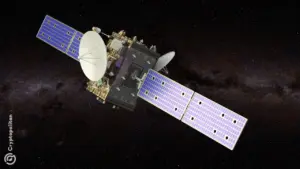
In January, SpaceX pitched a plan to the Federal Communications Commission to launch up to 1 million orbital data center satellites as a first step toward Kardashev II status, Cryptopolitan reported.
And Van Nieuwerburgh warns of a move from transparent on-balance-sheet corporate spending to opaque off-balance-sheet financing through joint ventures, private credit, securitization, special purpose vehicles and lease commitments.
He writes that those structures rely on “uncertain AI demand, rapid technological change, timely access to power and hardware, and the continued credit quality of a small number of [data center] tenants.”
“It would be premature to conclude that AI infrastructure already poses systemic risk comparable to earlier credit booms,” Van Nieuwerburgh writes.
Off-balance-sheet structures remain important “because they may make correlated exposures hard to observe before a downturn,” he adds.
According to Cryptopolitan, the OECD lifted its 2026 global growth forecast to 2.9% on AI infrastructure spending. On Friday, Van Nieuwerburgh will present the paper at Brookings’ fall conference.
If you're reading this, you’re already ahead. Stay there with our newsletter.
FAQs
How much of US GDP is AI infrastructure spending projected to reach?
An average of 3.63% a year from 2025 to 2032, above the railroad boom's 2.24%.
What did Elon Musk mean by a "K2 economy"?
A Kardashev Type II economy, which captures close to the entire energy output of its home star.
What risks does the AI buildout research flag?
Financing is shifting to opaque off-balance-sheet structures, which may make correlated exposures hard to observe before a downturn.
Disclaimer. The information provided is not trading advice. Cryptopolitan.com holds no liability for any investments made based on the information provided on this page. We strongly recommend independent research and/or consultation with a qualified professional before making any investment decisions.

Randa Moses
Randa Moses is an editor and reporter at Cryptopolitan covering tech, AI, robotics, crypto, scams, and hacks. She has worked in the crypto space since 2017. She held roles at Forward Protocol, AmaZix, and Cryptosomniac. Randa holds a degree in Electrical and Electronics Engineering from the University of Bradford.









