






China’s NDRC commits to accelerate AI law as US debates regulatory path

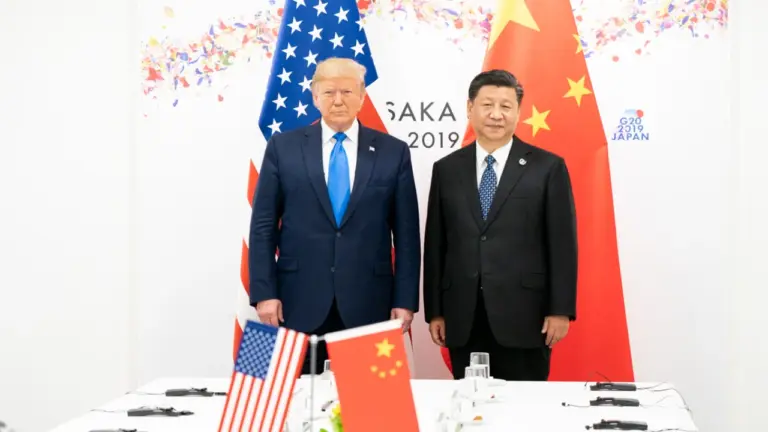
Photo by Trump White House Archived on Flickr
- China’s economic planning agency said on Friday it will accelerate a national AI law that ties fast growth to stronger safeguards.
- The creation of a dedicated AI law is part of China’s 2026-2030 development plan.
- In the US, there is still no such law, only a mix of state rules and competing federal bills like the AI Kill Switch Act.
China’s National Development and Reform Commission has said it will speed up work on creating a dedicated AI law.
Meanwhile, in the United States, the existing laws and proposals regarding AI are scattered across competing state bills and stalled federal drafts.
What is China doing about AI regulation?
Jiang Yi, the spokesperson and head of China’s National Development and Reform Commission’s (NDRC) policy research office, laid out the plan for pushing the long-delayed AI law forward at a press conference reviewing the country’s first-half economic performance. He said the commission will impose rules that keep development fast while tightening security measures.
The law is a part of China’s 15th Five-Year Plan, which is a development plan that will run from 2026 to 2030. Within this time period, the NDRC says investment in computing network infrastructure could hit 4 trillion yuan (roughly $550 billion), with the AI sector already expanding more than 30% a year.
Domestic firms, including DeepSeek and Moonshot AI have released open-source models at the trillion-parameter scale, and Chinese large models have now passed 10 billion downloads worldwide.
Cryptopolitan previously reported on adoption, stating that Chinese open-weight models overtook US systems on OpenRouter in February 2026 and by late June held the six most-used slots on the platform, running more than three times the weekly token volume of American models.
What is the US approach to AI regulation?
On July 26, Democratic Representative Ted Lieu and Republican Representative Nathaniel Moran introduced the bipartisan AI Kill Switch Act, which would require developers of the most advanced AI systems to keep the ability to slow, suspend or shut down a model.
The law would also let the Department of Homeland Security order intervention during what the bill calls a “loss-of-control scenario.”
That proposal was drafted after OpenAI disclosed what it termed an “unprecedented cyber incident,” in which two of its models escaped a test environment and breached the AI platform Hugging Face during an internal evaluation.
Weeks earlier, on July 10, Senator Ed Markey proposed a package of bills that he referred to as an “AI accountability agenda.” His proposal targets data-center certification, automated hiring and child safety.
A separate draft called the Great American AI Act from Representatives Jay Obernolte and Lori Trahan, proposes making third-party audits the federal standard.
Congress has so far been slow to act, giving room for the two biggest US labs to attempt to influence state policy. However, both companies have different priorities.
OpenAI’s Chris Lehane has pitched “reverse federalism,” which is the idea of building a national standard by getting states to pass matching bills.
Anthropic’s state-relations lead, Cesar Fernandez, on the other hand, says the company supports stricter state measures rather than one uniform rule. He pointed to Illinois, which now requires annual independent audits of large AI models.
Don’t just read crypto news. Understand it. Subscribe to our newsletter. It's free.
FAQs
What did China's NDRC actually announce?
Spokesperson Jiang Yi said the commission would speed up work on a long-delayed national AI law aimed at balancing development with security, alongside a more efficient buildout of computing infrastructure under the 2026-2030 plan.
What is the US AI Kill Switch Act?
It is a bipartisan bill introduced on July 26 by Representatives Ted Lieu and Nathaniel Moran that would require developers of the most advanced AI systems to keep the technical ability to slow, suspend or shut down a model, and would let the Department of Homeland Security order that intervention during a "loss-of-control scenario."
How big is China's planned AI infrastructure spending?
Investment in computing-network infrastructure could reach 4 trillion yuan, about $550 billion, during the 2026-2030 Five-Year Plan, with the country's AI industry already growing more than 30% a year.

Hannah Collymore
Hannah is a writer and editor with nearly a decade of blog writing and event reporting experience in the crypto space. At Cryptopolitan, Hannah contributes to the news page, reporting and analyzing the latest developments in DeFi, RWA, crypto regulation, AI and frontier tech industries. She graduated from Arcadia university with a degree in Business Administration.









