


LATEST NEWS
SELECTED FOR YOU

Best crypto insights delivered straight to your inbox.

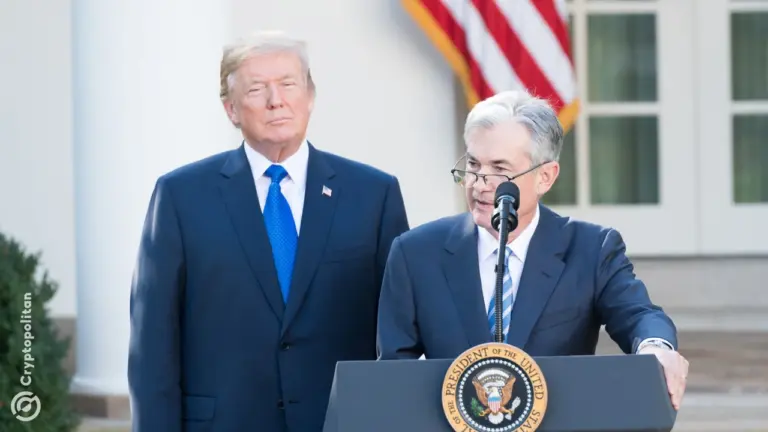

- The U.S.-Iran ceasefire is not doing much to lift hopes for a June Fed rate cut because oil-driven inflation is still hanging around, and Israel violated the agreement.
- The Fed minutes showed most officials saying inflation could stay sticky, just as headline PCE for February came in at 2.8%, and Q4 2025 U.S. GDP growth was cut to 0.5% from 4.4%.
- Crypto is also under pressure, with BTC at $71,193.7, down 1.06%, ETH at $2,180.12, down 3.27%, SOL at $82.21, down 2.72%, and XRP at $1.3303, down 3.75%.
Live Reporting
Meta Platforms got a brand new vote of confidence from JPMorgan after releasing its long-awaited AI model this week.
The bank kept its overweight rating on the stock. It also left its $825 price target unchanged, which implies 34.7% upside from Wednesday’s close.
Doug Anmuth of JPMorgan said the launch of Muse Spark should make investors more confident about Meta’s ability to scale its AI business. He said it should also help improve sentiment around the stock.
Meta unveiled Muse Spark on Wednesday. The release puts the company in more direct competition with products like ChatGPT from OpenAI and Claude from Anthropic.
The model is the first product to come out of Meta Superintelligence Labs. That is Meta’s dedicated AI unit, which the company set up last year as part of its broader push deeper into artificial intelligence.
That push has not been cheap. It has involved multibillion-dollar spending, and some investors have questioned how far the company should go.
The unit is being led by Alexandr Wang, the former Scale AI chief executive. Meta spent $14.3 billion on Scale AI last year to bring in its leadership.
Investors liked the launch. Meta shares jumped as much as 9.5% on Wednesday before closing the day up 6.5%.
The stock kept moving higher on Thursday, gaining more than 3%.
That rebound matters because Meta had been lagging for much of 2026. Shares of the Facebook parent had fallen more than 4% this year.
JPMorgan said this could be the start of something seriously big. The bank said this first model from MSL is only the opening step in what Meta sees as a steady and efficient scaling path.
The idea, Anmuth said, is that each new model builds on the last one before Meta pushes into something larger and more capable.
He also said bigger models are already in development. Meta, he wrote, plans to keep moving toward what it calls personal superintelligence.
JPMorgan also argued that investors should not be scared off by the size of Meta’s AI spending.
The U.S.-Iran ceasefire may remove the most immediate threat to the global economy. But for the Federal Reserve, it does not solve the bigger problem.
It may simply swap war risk for an energy shock that lasts long enough to keep inflation high, but not long enough to crush demand. That is the kind of mix that can keep rates higher for longer.
The Fed minutes from the March 17-18 meeting, released on Wednesday, made that clear. The war did not create the Fed’s hesitation over rate cuts. It made an already careful Fed even more careful.
Even before the conflict, the road to cuts was getting tighter. The labor market had steadied enough to calm recession fears. At the same time, progress toward the Fed’s 2% inflation target had lost momentum.
At that meeting, the Fed kept its benchmark rate unchanged at 3.5% to 3.75%. That was the second straight pause after officials delivered three rate cuts in the final months of 2025.
The minutes said “the vast majority” of officials believed inflation could take longer than expected to come down. They pointed to three main risks.
First, the effect of tariffs on goods prices may take longer to fade. Second, higher oil prices could spill into broader inflation measures. Third, years of inflation staying above target could make households and businesses more willing to accept further price increases.
The Fed’s own snapshot of the economy also showed why officials are not rushing. The information available at the time said real GDP was still growing in 2025, but at a pace slightly below 2024. Labor market conditions were showing signs of stabilizing after a period of gradual cooling. Consumer price inflation was still somewhat elevated.
The unemployment rate stood at 4.4% in December, unchanged from September. The average monthly change in total payrolls turned negative in the fourth quarter because government employment dropped sharply in October, as workers rolled off payrolls after the deferred resignation program ended.
Payroll gains in November and December were close to the average seen in the third quarter. Average hourly earnings rose 3.8% over the 12 months ending in December, slightly below the pace seen a year earlier.
On inflation, headline PCE was 2.8% in November, up a bit from 2.6% a year earlier. Core PCE was also 2.8% in November, down from 3.0% a year earlier.
Crypto markets were weak alongside all this. In derivatives, Bitcoin was at $71,193.7, down 1.06%, with open interest at $64.50B, down 16.15%.
Ethereum was at $2,180.12, down 3.27%, with open interest at $49.72B, down 23.78%. Solana was at $82.21, down 2.72%, with open interest at $10.23B, down 32.01%. XRP was at $1.3303, down 3.75%, with open interest at $2.96B, down 24.80%.
What to know
The ceasefire lowered one big risk, but sticky inflation, weak growth, and soft crypto markets still leave June rate-cut hopes looking limited.
Disclaimer. The information provided is not trading advice. Cryptopolitan.com holds no liability for any investments made based on the information provided on this page. We strongly recommend independent research and/or consultation with a qualified professional before making any investment decisions.
TABLE OF CONTENT
Share this article

MORE … NEWS










DEEP CRYPTO
CRASH COURSE
- Which cryptocurrencies can make you money
- How to boost your security with a wallet (and which ones are actually worth using)
- Little-known investment strategies that the pros use
- How to get started investing in crypto (which exchanges to use, the best crypto to buy etc)