





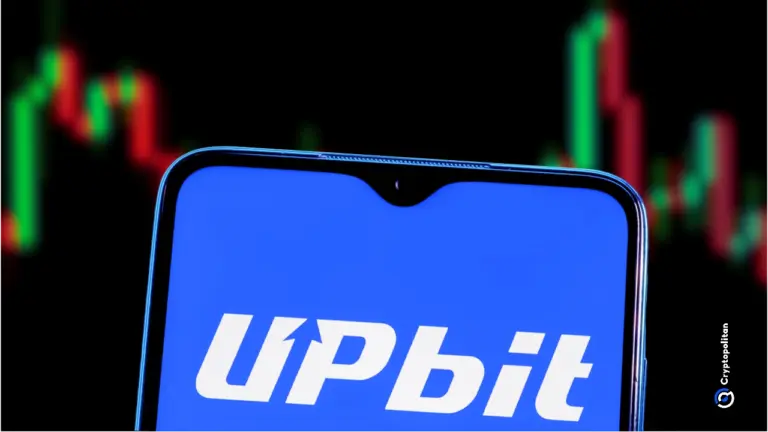
- Upbit is ending BONK trading support on September 7, 2026.
- The exchange said a security incident and disclosure failures behind a July caution flag were never resolved.
- Meanwhile, Bithumb lifted the identical flag on August 7 after judging that the issues had been fixed.
Upbit is ceasing support for trading BONK on Monday, thereby taking away one of the two major South Korean exchanges for the Solana meme coin, while its rival Bithumb goes the other way and supports it.
The end of trading comes as a matter of urgency for traders from Korea, as Upbit is removing the BONK/KRW and BONK/USDT pairs at 15:00 KST on September 7, 2026, which means the cancellation of open orders. Withdrawals for BONK will be available until October 7.
Korean markets carry weight outside of the exchange in question. The Asia Capital Markets Report 2026 by the OECD indicates Korea and India saw the highest absolute inflow of crypto-assets in Asia in the 12 months leading to June 2025.
Two exchanges, one incident, opposite calls
On July 7, Upbit and Bithumb put BONK under the designation of “trading caution.” The concern that led to this designation is mentioned in a notification from Bithumb on July 7: it has to do with a security incident, the cause of which was either unknown or unresolved, as well as whether any significant information has been disclosed in a timely manner.
A month later, the two exchanges parted ways.
On August 7, Bithumb lifted its caution status, claiming that the issues leading to the designation had been resolved, and resumed taking deposits later that day. In contrast, Upbit argued that the grounds for its caution status “have not been resolved” and took steps to halt trading.
This is allowed under Upbit’s market-alert framework. When an issue has been solved, a caution status can be lifted. Otherwise, trading support can be stopped. Bithumb decided to go one way, while Upbit preferred the other.
The hack behind the flag
The incident involved BonkDAO, a treasury managed by the community that is responsible for the BONK ecosystem. An announcement made by BONK via its account on X stated that “$BONK and BonkDAO are two distinct entities,” and added that the attack hit the DAO treasury and did not have an effect on any other BONK operations.
Halborn, a blockchain security company, estimated BonkDAO’s losses to be $20 million. According to their research, the perpetrator of the attack employed a harmful governance proposal to transfer 4.43 trillion BONK out of the treasury. The hacker spent approximately $4.4 million to obtain majority voting rights, winning approximately 99.878% of the votes until the proposal was carried out without any time lock.
While the DAO differs considerably from the wider token ecosystem, that does not mean that review by an exchange is out of the question. Things such as remediation, disclosure, and protection of investors may still play as much of a role in this case as the security of the actual contract.
What the listing rules actually screen for
DAXA’s Best Practices for Listing Virtual Assets applies to both exchanges and assists in maintaining common minimum standards, although maintaining some discretion in judgment. The framework looks at the reliability of issuers, investor protection, safeguards, and regulatory compliance. The framework particularly revolves around any unresolved hacking incidents and any failures to disclose problems that would be important to prospective investors and the value of the asset as a whole.
The concerns regarding BONK are parallel to those that arise as part of the framework. While the rules are the same, determining whether or not a project acted in order to deal with these issues is something that goes to the exchanges’ discretion. This explains why Bithumb gave a green light to BONK while Upbit decided to delist it.
Price and volume climb into the delisting
BONK is experiencing an increase in trading price as its delisting on Upbit approaches. According to CoinMarketCap, BONK was around $0.00000345, about 6.1% higher over 24 hours, with about $134 million in trades and a market cap of about $303 million.
A similar event of BONK’s price increase was observed by Cryptopolitan’s BONK Price-Prediction on September 6, when its price went up by about 4.3% and around $104.6 million in trading.
While it is unclear if this strength is attributed to the positioning before Upbit’s cut-off time, the transferring of trades to other exchanges, or meme coin momentum, there is clarity regarding the timing. The trading activity and prices of BONK are rising as one of South Korea’s largest exchanges is about to halt trading of the coin.
Upbit’s decision is unlikely to determine BONK’s fate beyond South Korea. The token will continue trading on major global exchanges and Solana-based decentralized markets. The bigger question is whether those markets can absorb the liquidity lost from Upbit without widening spreads or weakening market depth. The delisting could also prompt other exchanges to take a closer look at BONK’s security, governance and disclosure risks.
The smartest crypto minds already read our newsletter. Want in? Join them.
FAQs
When does Upbit stop supporting BONK, and until when can users withdraw?
Upbit ends trading support for the BONK/KRW and BONK/USDT pairs at 15:00 KST on September 7, 2026, and supports withdrawals for 30 days after that, through October 7, 2026, per its notice.
Why did Upbit delist BONK while Bithumb kept it listed?
Both exchanges flagged BONK on July 7, 2026 over an unresolved security incident and disclosure shortcomings; Bithumb lifted its caution on August 7 saying the reasons were resolved, while Upbit concluded on the same date that the grounds had not been resolved and terminated support.
What security incident prompted the caution designation?
The trigger was an attack on BonkDAO, which the BONK account described on X as a community-governed treasury distinct from the token itself; a report listed on CoinMarketCap's BONK page put the loss at about $20 million.
Does the Bithumb decision mean BONK is considered safe?
No. Bithumb's decision means that Bithumb determined the grounds for its cautionary designation had been resolved. It does not establish that every exchange must reach the same conclusion.
Does Upbit's delisting mean BONK is being banned in South Korea?
No. The decision concerns Upbit's trading support. It does not by itself prohibit BONK from existing, transferring on Solana, or trading on other exchanges and decentralized markets.
Will BONK still trade after Upbit removes it?
Yes. The delisting removes two Upbit markets, not the token itself. BONK can continue trading on other centralized exchanges and Solana-based decentralized venues.
Could Upbit's exit hurt BONK liquidity?
Potentially. The key issue is whether trading activity migrates to other exchanges or disappears. Losing a major Korean venue can widen spreads and reduce immediately available liquidity even if global 24-hour volume remains substantial.
What should traders watch after the delisting?
Three useful indicators are order-book depth, bid-ask spreads and price differences between exchanges. If volume migrates smoothly, the impact may be limited. If depth deteriorates and spreads widen, the delisting could reveal a deeper liquidity problem.
What changes would BONK need to make to address the governance risk?
Potential safeguards include higher quorum requirements, longer voting periods, limits on newly acquired voting power, execution timelocks, multisig controls and stronger disclosure procedures.
Is the delisting itself evidence that BONK is a fraudulent project?
No. A delisting is an exchange's risk and listing decision. Upbit's stated concerns relate to security incidents and disclosure, not a finding that BONK itself is fraudulent.
Does the delisting make BONK more likely to be delisted elsewhere?
Not automatically. Other exchanges conduct their own reviews and can reach different conclusions, as the divergence between Upbit and Bithumb illustrates.
What is the biggest risk for BONK now?
Beyond price volatility, the bigger issue is whether the project can restore exchange confidence in its security, governance and disclosure processes. The Upbit decision turns those issues into a continuing market-access risk.
Why does Bithumb's reversal matter more than the delisting itself?
Because it creates a useful natural experiment. Upbit says BONK's problems remained serious enough to end trading support, while Bithumb concluded its cautionary concerns had been resolved. The question is no longer simply whether BONK was attacked. It is what level of remediation exchanges require before restoring confidence in a compromised token.
What did Bithumb consider resolved that Upbit still considered material?
Bithumb and Upbit reached different conclusions after reviewing BONK's security and disclosure problems, but neither exchange has publicly explained the precise basis for the divergence.
Disclaimer. The information provided is not trading advice. Cryptopolitan.com holds no liability for any investments made based on the information provided on this page. We strongly recommend independent research and/or consultation with a qualified professional before making any investment decisions.

Ibiam Wayas
Ibiam Wayas has covered the crypto news beat since 2019. He studied Computer Science at National Open University of Nigeria. His work has appeared on various crypto news platforms, including Coinfomania, Crypto News Australia, and AltcoinBuzz. Drawing on his background in Computer Science, he now focuses on crypto, robotics, and longevity news.









