






- The FCA found that 74% of UK adults under 35 believe they can spot AI investment scams, but only 38% would check a firm’s regulatory authorization before investing.
- Reports of suspected AI-enabled fraud rose nearly 400%, from 193 in 2024/25 to 956 in 2025/26.
- The regulator urged investors to verify firms through its Firm Checker tool as AI deepfakes and fake investment promotions become increasingly convincing.
The UK Financial Conduct Authority (FCA) has said that Britain’s youngest investors put more trust in their own radar for artificial intelligence scams than any age group.
Ironically, the report revealed that they are also the most likely group to come across such scams and the least likely to verify a firm before parting with cash.
The regulator’s research is coming at a time of increasing proliferation of cheap, convincing fakes that are now easy to mass-produce.
The same AI tools that young people increasingly lean on for investing help are the ones fraudsters are turning against them.
What is the confidence gap for people under-35 in the UK?
According to the FCA, about 74% of people under 35 reckon they could pick out an AI-generated investment scam. 56% of that demographic say that they have already encountered a promotion that they believe was built with AI in the past year.
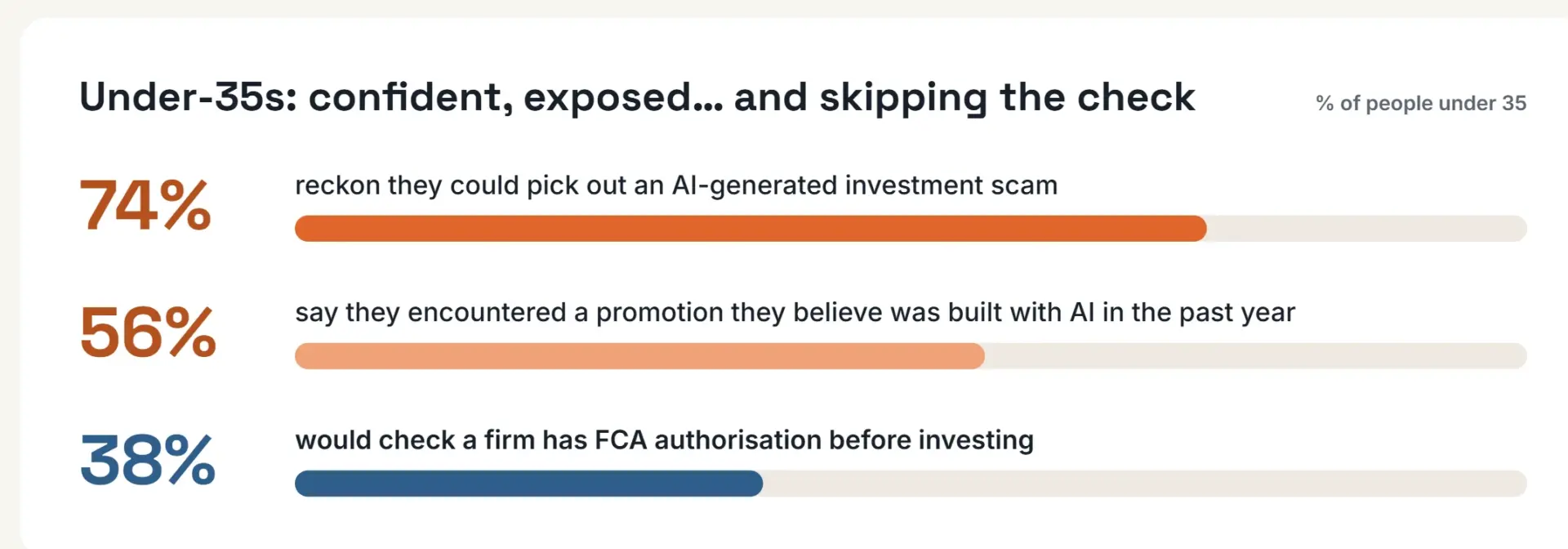
However, the people most exposed to AI-made promotions and most sure of themselves about detecting them are also the ones skipping the one check that flags a fake firm.
This is because only 38% of people under 35 said they would check if a firm had an FCA authorization before investing.
People over the age of 65 were more cautious in that aspect, as 73% of those surveyed said that they will check for the FCA authorization before investing.
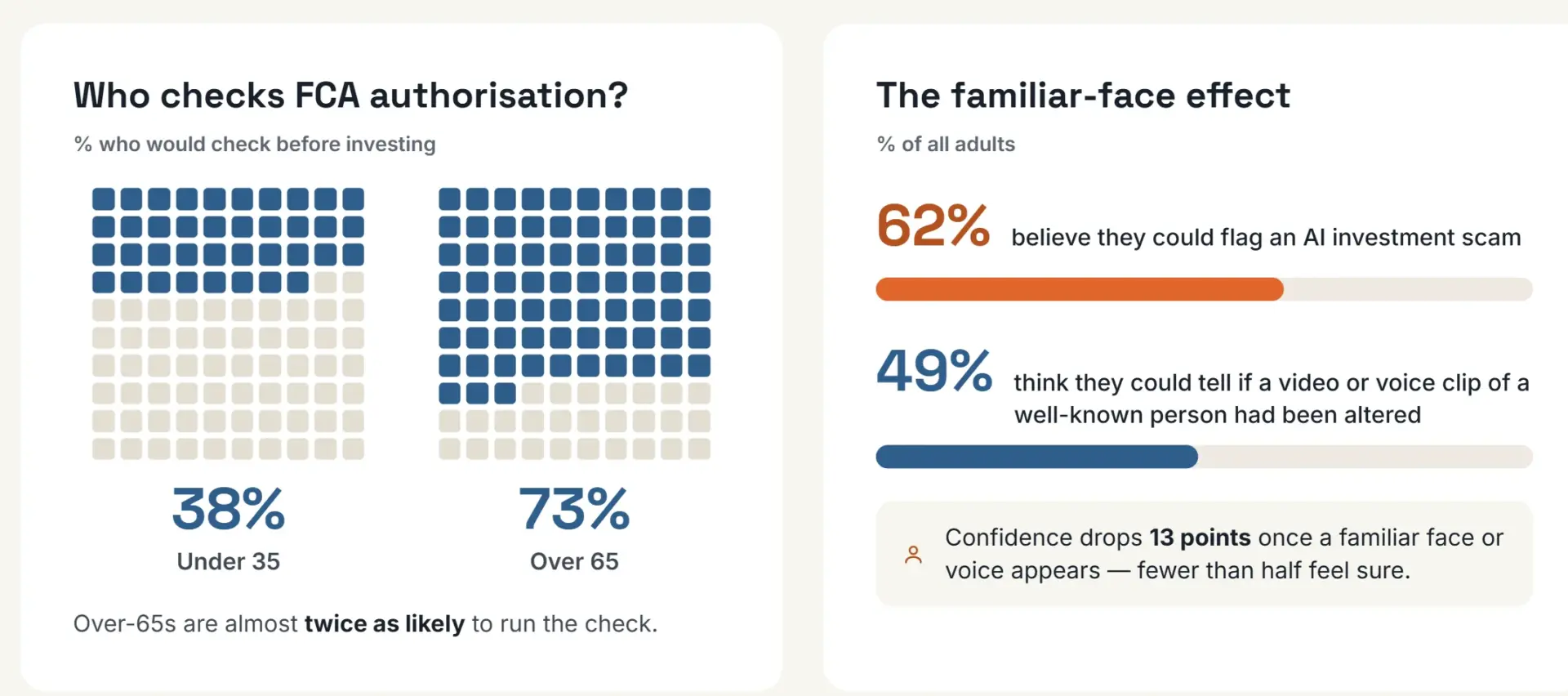
62% of adults believe they could flag an AI investment scam; however, the report also showed how behaviors changed when a familiar face appears, as fewer than half (49%) think they could tell whether a video or voice clip of a well-known person had been altered.
The name that was most cited by people who thought they had seen a fake promotion that fronted a public figure was Martin Lewis.
Reports mentioning AI jumped nearly 400%
There has been a significant rise in the number of fraud reports between 2024 and 2026. According to the FCA, fraud reports to Report Fraud that flagged suspected AI use rose from 193 in 2024/25 to 956 in 2025/26, close to a 400% increase. An average of £28,188 was lost to investment fraud victims over that year.
One in three UK adults (33%) told the FCA they had seen an investment promotion in the past year they believed used AI. The survey, run by Kantar between 20 and 26 October 2026, polled 2,558 people aged 16 and over.
Young investors lean on AI and misread its cover
While the under-35 bracket are the ones who use AI tools the most, the FCA research explained why they also happen to be the soft target of AI-related scams.
Research showed that 56% of 18-to-40-year-olds who own or are weighing investments said they trust AI tools, ahead of TV and radio (47%), the press (46%) and social media influencers (29%).
However, the FCA found 44% wrongly believe AI-generated financial information is regulated, with 38% thinking it is fine to base an investment decision purely on an AI chatbot’s output.
“AI can help you research companies, understand jargon or explore options before you make a decision,” said Lucy Castledine, the FCA’s director of consumer investments. She said that users still need to understand how they are protected and keep exercising their own judgment.
Deepfakes are already moving real money
The threat that the FCA’s research is highlighting is already causing serious challenges in markets.
Coinbase said its automated defenses blocked $4.7 million in transfers this month after scammers used an AI deepfake of Elon Musk to hijack a livestream of a Tesla demo and funnel viewers toward a fake crypto giveaway. Coinbase said that hundreds of users tried to send funds within about two hours.
Courts are also getting up to speed in terms of handling such cases. One of them is the sentencing of David Anthony Sanchez, a 36-year-old from Port St. Lucie, Florida, to 47 months in federal prison.
According to federal prosecutors, Sanchez sent memecoin organizers an AI-cloned recording of streamer N3ON’s voice to fake an endorsement, prying roughly $260,000 in crypto from them.
UK Finance reported that criminals stole £1.28 billion through payment fraud in 2025, with investment fraud being the single largest category of authorized-push-payment. Losses in that category were around £221.5 million, up 40% on the year.
The FCA’s fix is one search
The regulator advised the public to run investment firms through its Firm Checker tool, which lists authorized firms and flags ones it knows are operating without permission.
Sheree Howard, the FCA’s executive director of authorizations, said, “AI makes creating online scams easier and harder for people to identify.” She urged anyone weighing an investment, pension, or loan to check the firm first.
Don’t just read crypto news. Understand it. Subscribe to our newsletter. It's free.
FAQs
How much have AI-related fraud reports risen in the UK?
Reports to Report Fraud that mention suspected use of AI rose from 193 in 2024/25 to 956 in 2025/26, close to a 400% increase, according to the FCA.
Why are under-35s especially at risk from AI scams?
About 74% believe they could spot an AI investment scam and 56% say they have seen one, but only 38% would check whether a firm is FCA-authorised before investing, far below the 73% rate among over-65s.
What does the FCA tell people to do before investing?
The FCA advises using its Firm Checker tool to confirm a firm is authorised for the service it offers and to spot firms known to be operating without authorisation; it estimates the tool has been used more than 1.9 million times since January 2025.
Disclaimer. The information provided is not trading advice. Cryptopolitan.com holds no liability for any investments made based on the information provided on this page. We strongly recommend independent research and/or consultation with a qualified professional before making any investment decisions.

Hannah Collymore
Hannah is a writer and editor with nearly a decade of blog writing and event reporting experience in the crypto space. At Cryptopolitan, Hannah contributes to the news page, reporting and analyzing the latest developments in DeFi, RWA, crypto regulation, AI and frontier tech industries. She graduated from Arcadia university with a degree in Business Administration.