


LATEST NEWS
SELECTED FOR YOU

Best crypto insights delivered straight to your inbox.


-
Elon Musk’s xAI and Nvidia are teaming up to build a 500-megawatt AI factory in Saudi Arabia after Crown Prince Mohammed bin Salman (MBS) said he has committed land, capital, and energy to become “the most AI-enabled nation,” with MBS laying out a vision for deploying tens of millions of robots to boost productivity and rewrite labor economics.
-
Jensen Huang described the project as essential to the shift from “retrieval-based” to generative computing, saying real-time AI demands massive, localized compute power — hence the global push for AI factories.
-
Elon Musk said humanoid robots will be the biggest product in history, bigger than smartphones, and claimed AI and robotics are the only real path to eliminating poverty, not bureaucracy or foreign aid.
Live Reporting
As the packed Kennedy Center hung on every word, Elon Musk and Jensen Huang closed out the U.S.-Saudi investment forum with a mix of real-world breakthroughs and straight-up science fiction, the kind of session where nanobots, trillion-dollar data centers, and orbital AI all felt like parts of the same plan.
Abdullah Alswaha returned to the stage to reveal one last set of stories before the final announcements. He highlighted two Saudi research breakthroughs, both accelerated by the AI tools Elon and Jensen have built.
First: Professor Omar Yaghi, a Saudi-American Nobel Prize winner, used Grok and Nvidia accelerators to create metal-organic frameworks that can pull water from air and trap CO₂.
The second? A nano-robot, just 500 by 1,000 nanometers, built using CRISPR and AI, now being tested to treat sickle cell disease, a concept that sat in research limbo for decades until AI kicked it into gear.
After unveiling their 500 MW AI factory deal with Saudi Arabia, Elon Musk and Jensen Huang turned to a more existential question: what happens to jobs when AI and robots can do everything?
“Work will be optional,” Elon said without hesitation. “It’ll be like playing sports or a video game. If you want to work, you can — but you won’t have to.”
He compared future labor to backyard gardening: “You could go to the store and buy vegetables, or you could grow them yourself. It’s harder, but some people enjoy it. That’s what work will feel like.”
Elon also pointed to a deeper shift. “Money may stop mattering. In the far future, assuming AI and robotics keep advancing, currency becomes irrelevant. There will still be limits with energy and materials, but not money the way we think about it now.”
He recommended reading Iain M. Banks’ Culture novels to imagine that kind of world, a post-scarcity society where wealth, jobs, and status aren’t tied to survival.
Jensen, sipping water and grinning, jumped in: “For the record, currency still matters today. Nvidia’s earnings call is later, by the way.”
Then he got serious. “Jobs aren’t going away, they’re changing. You’ll do more with less effort. What used to be hard becomes easy. And when that happens, you’ll just chase more ideas.”
He said people like him and Elon will probably get busier because of AI. “We’ve got so many things we want to build. AI will make us faster. So we’ll do more.”
Jensen offered a real-world example: radiology. “Everyone thought AI would wipe out radiologists. But the opposite happened. There are now more radiologists being hired, because AI helps them read images faster, study more modalities, and see more patients. AI made them better doctors.”
This post is updated LIVE.
The morning after their private dinner with Trump and MBS, Elon Musk and Jensen Huang took the stage in Washington with Saudi Arabia’s Minister of Communications and IT, Abdullah Alswaha, to launch what they called a “historic alliance” between xAI, Nvidia, and the Kingdom, starting with a 500-megawatt AI compute facility on Saudi soil.
After a booming welcome, Abdullah introduced Elon and Jensen as “two of the greatest visionaries in tech history” and wasted no time setting the stakes. “We helped fuel the industrial age with oil,” he said. “Now, we’re building the infrastructure for the intelligence age; AI factories, EVs, robotics, all of it.”
Elon was up first. He dismissed the word “disruption” and said what xAI and Tesla aim for is “creation.”
He pointed out that before SpaceX, reusable rockets didn’t exist. Before Tesla, “you couldn’t even buy an electric car.” And now, he’s betting on the next frontier: humanoid robotics. “There are no useful humanoid robots today,” Elon said bluntly. “Just gimmicks. Tesla will make the first useful ones.”
The crowd laughed as he brought up the dream of owning a personal C-3PO or R2-D2, but Elon got serious fast. “Humanoid robots will be the biggest product in history. Bigger than cell phones. Everyone will want one — or more.”
His vision goes further. Elon claimed AI and robotics aren’t just gadgets. “They’re the only path to eliminating poverty. Not aid. Not bureaucracy. Just scalable intelligence and machines.”
Abdullah jumped back in, calling Tuesday’s joint announcement between the U.S. and Saudi Arabia “a new strategic layer” in global AI competition. “We’re committing our capital, land, and energy to build AI factories. This is our next oil.”
That’s when Jensen stepped in.
He called Saudi Arabia’s plan to evolve from “AI refineries to AI factories” a global blueprint. “In the past,” Jensen said, “computers were built for retrieval. You typed, it fetched. Now it’s generative — content is built in real time, for you, based on context.”
That shift, he explained, demands massive infrastructure: not just data centers, but real-time inference and training nodes, custom-built for this kind of live, responsive intelligence.
“When you use Grok,” Jensen said, nodding at Elon, “you’re not just reading. You’re triggering computation. Every prompt generates a new result. And that’s why we need AI factories. Everywhere.”
The session ended with a nod back to MBS’s stated ambition to deploy “tens of millions of robots” across industries, from logistics to healthcare to education, to augment the workforce and supercharge productivity.
This post is updated LIVE.
Elon Musk walked back through the gates of the White House on Tuesday night, ending months of tension with President Trump in the most Washington way possible; a gala dinner.
The occasion was of course the lavish evening to honor Mohammed bin Salman, with the East Room packed with billionaires, ballplayers, and power players.
Elon sat alongside names like Tim Cook, David Ellison, Marc Benioff, Bill Ackman, and Nvidia’s Jensen Huang. Even Cristiano Ronaldo showed up, along with heavy-hitters from the GOP like Vice President JD Vance and House Speaker Mike Johnson.
Elon’s presence was loud without saying a word. His fall from grace had been messy, after spending big to help Trump win in 2024 and heading up the now-defunct Department of Government Efficiency, he’d walked out in May over Trump’s ballooning tax cuts. The two hadn’t spoken publicly since.
His political detour had backfired: Tesla took a hit as the brand got wrapped up in Elon’s right-wing image, and investors started worrying he was more into Congress than cars.
He even threatened to start a third party, calling the Democrats and Republicans “a broken duopoly” before going dark.
Tuesday night, though, looked like a reset. Trump wanted him back. Republicans, especially JD Vance, have been quietly working to reel Elon back in.
Tesla board chair Robyn Denholm made it clear on the shareholder vote event a week ago that Elon can dabble in politics all he wants, as long as he hits the numbers tied to his $1 trillion pay package.
This post is updated LIVE.
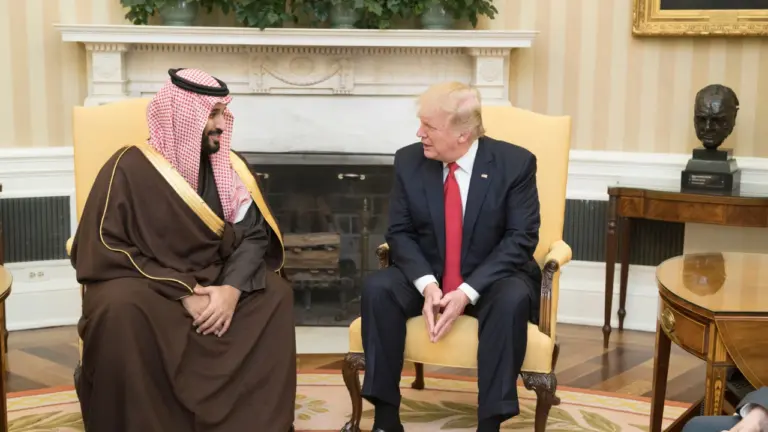
With military jets roaring overhead and the U.S. Marine Band setting the stage, Donald Trump emerged from the White House on Tuesday to greet Crown Prince Mohammed bin Salman (MBS) in a display thick with pageantry, symbolism, and serious money talk.
The two leaders shook hands firmly as cameras rolled, then strolled side-by-side into the White House for what’s shaping up to be a high-stakes bilateral meeting.
Inside, the energy shifted from spectacle to strategy. Trump opened by calling MBS an “extremely respected” man and reminded reporters that the prince has been his “friend for a long time.”
The U.S. president didn’t hold back on praise, even in areas where MBS has faced global criticism. Trump applauded his work on “human rights” and tipped his hat to the crown prince’s father, King Salman, saying he pays him the “greatest respects.”
From there, Trump shifted gears to tout his own administration’s domestic achievements; tariffs, elections, and a booming stock market, before dropping a headline number: $600 billion. That’s how much he said Saudi Arabia plans to invest in the U.S., referencing pledges made during his visit to Riyadh earlier this year.
“That number could go up a little bit higher,” Trump teased, grinning. “We appreciate it very much.”
He emphasized that the money would go toward American companies, factories, Wall Street, and most crucially, jobs. “We have a lot of jobs,” he said, nodding with satisfaction as bin Salman looked on.
This post is updated LIVE.
President Donald Trump on Monday confirmed that he’s giving the green light for Saudi Arabia to buy F-35 stealth fighter jets, a decision that could send shockwaves through Israel’s defense establishment as the U.S. embraces deeper ties with Mohammed bin Salman’s kingdom.
Speaking just hours before a Tuesday sit-down at the White House with MBS, Trump told reporters, “I am planning on doing that. They want to buy them. They’ve been a great ally.”
He credited the Saudis for helping coordinate U.S. missile strikes earlier this year that, in his words, “obliterated” Iran’s nuclear facilities.
The F-35 move is part of a much broader two-day diplomatic swing, one that also includes what Trump hinted will be a formal security agreement between Washington and Riyadh.
He gave no specifics but said the pact is coming, as both sides look to anchor long-term cooperation on military, energy, and tech fronts.
The visit also marks a strategic pivot. On Wednesday, Mohammed bin Salman will co-host a U.S.-Saudi investment forum at the Kennedy Center, but what’s not on the table, at least officially, is any hard push for normalization with Israel.
That file has been shelved as the Gaza war continues to ripple across the region, derailing one of Trump’s cornerstone foreign-policy goals.
This post is updated LIVE.
What to know
xAI and Nvidia are teaming up with the Kingdom of Saudi Arabia to build a massive 500‑megawatt AI facility, beginning with a 50 MW phase.
TABLE OF CONTENT
Share this article

MORE … NEWS










DEEP CRYPTO
CRASH COURSE
- Which cryptocurrencies can make you money
- How to boost your security with a wallet (and which ones are actually worth using)
- Little-known investment strategies that the pros use
- How to get started investing in crypto (which exchanges to use, the best crypto to buy etc)