


LATEST NEWS
Best crypto insights delivered straight to your inbox.
LIVE: Elon Musk’s net worth hits $1.2 trillion as SpaceX stock surges by 30% post-IPO today

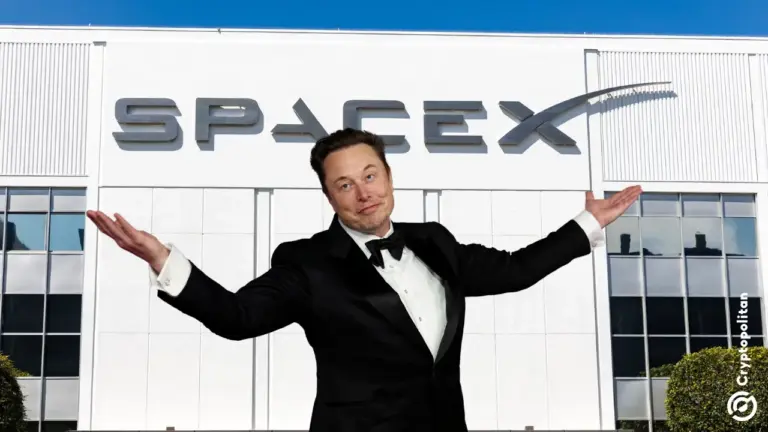

- SpaceX closed its first Nasdaq session up 19% at around $161, valuing the company at $2.1 trillion.
- Elon Musk said SpaceX has been cash-flow positive since around 2015 and needs IPO capital for a major growth phase.
- SpaceX plans include more than 100,000 satellites, space-based AI data centers, and other expansion projects.
Live Reporting
The strongest case for SpaceX’s $1.77 trillion valuation is not its AI plans or satellite network. It is the company’s grip on the launch market.
Wolfe Research began covering the stock on Friday with an outperform rating and a $175 target. The firm said SpaceX’s launch operations sit at the center of the business and help lower costs across its other divisions.
Wolfe analyst Myles Walton argued that few companies have a competitive barrier as strong as controlling access beyond Earth. Myles pointed to SpaceX’s position in the US launch market, where the company handles five out of every six missions, based on a 2025 Georgetown University Center for Security and Emerging Technology report.
Other firms also opened coverage with bullish forecasts. Oppenheimer gave SpaceX a buy rating and set a $190 target for the next 12 to 18 months. That level would place the stock about 40% above its $135 IPO price.
New Street Research expects the shares to reach $165 within a year, which would represent a 22% rise from the listing price.
Reusable rockets remain central to those forecasts. Wolfe said the ability to fly the same hardware again gives SpaceX a major cost edge and helps protect its lead over rivals.
Myles called a reusable Starship the company’s most important path to creating more value.
“Successful reusability of Starship is the single most important value unlock,” Myles said.
He also said cheaper access to computing infrastructure could matter for SpaceX’s AI plans. The company is expected to compete with OpenAI and Anthropic, both of which may also enter public markets this year.
Wolfe does not expect SpaceX to produce stronger AI models than those companies. Instead, Myles believes its advantage could come from controlling more of the technology stack and using its space infrastructure to reduce computing costs.
“We don’t expect SpaceX to out-innovate Anthropic or OpenAI on the model side, but we expect SpaceX to build a cost advantage into the compute end game through verticalization and space access,” Myles wrote.
SpaceX finished its first day on Nasdaq with a 19% gain after completing the largest IPO ever. The stock ended near $161, giving the company a market value of $2.1 trillion.
Before the listing, Elon Musk said during a JPMorgan Chase livestream that SpaceX had been cash-flow positive since around 2015. Elon said the company chose this moment to go public because it needed money for “a significant growth phase.”
That next phase includes plans to place more than 100,000 satellites in orbit for communications. Elon also said SpaceX wants to build AI data centers in space, along with other projects.
The IPO also pulled fresh political attention onto Elon’s wealth after the listing made him the world’s first trillionaire.
New York City Mayor Zohran Mamdani responded on X to an article about Elon reaching trillionaire status.
“Reason #1,000,000,000,000 why we should tax the rich,” Zohran wrote.
Sen. Elizabeth Warren, Democrat of Massachusetts, also posted about wealth taxes earlier Friday.
“We need a wealth tax,” Elizabeth wrote on X.
The wider market still closed higher. The S&P 500 gained 0.5% to finish at 7,431.46. The Nasdaq Composite rose 0.31% to 25,888.84. The Dow Jones Industrial Average climbed 353.51 points, or 0.7%, to close at 51,202.26.
Among major AI-linked names, Nvidia ended slightly higher. Advanced Micro Devices rose 4.7%, while Alphabet added 0.5%.
Broadcom, Palantir Technologies, Amazon, and Meta Platforms closed lower.
Stocks had slipped earlier, while oil moved off its session lows after Trump posted on Truth Social that Iran “better get their act together,” even with a possible US-Iran deal still on the table.
West Texas Intermediate crude futures closed down 3.2% at $84.88 a barrel.
SpaceX’s first day as a public company has turned into more than a market story. The listing has brought out excited investors, loyal fans, political critics, and protesters who see Elon Musk as a clear example of the widening gap between the ultra-rich and everyone else.
The backlash started before the IPO. A giant Elon effigy, described as house-sized, was placed outside the Nasdaq building a day earlier. It showed him shirtless and pointed to concerns over sexualized images of minors on Grok, his AI chatbot.
On Friday, protesters also gathered outside JPMorgan’s headquarters for a “Stop Musk” rally. Organizers said the protest was aimed at disrupting a celebration hosted by CEO Jamie Dimon for the company.
One sign seen in a Threads post said:
“Send billionaires to Mars.”
Senator Elizabeth Warren, who has pushed for higher taxes on extreme wealth for years, tied Elon’s trillionaire status to what she called a broken system.
“We are living in a time when more and more people are just hanging on by their fingernails to survive in this economy,” Elizabeth said on X.
She also said Elon becoming a trillionaire showed a “rigged economy.”
Elon used his own Friday message to frame SpaceX as something built for regular people, not only astronauts. Wearing a black leather jacket, he said:
“We want to take you there, not just a few astronauts. We mean you, literally you.”
In Times Square, one early SpaceX investor who bought in through a family office in 2020 took selfies with four friends wearing matching SpaceX T-shirts. He said he expected the stock to rise on its first day because retail buyers and index funds were chasing a limited supply of shares.
Asked if the IPO had made him one of the new millionaires linked to the listing, he said:
“We’ll see … I’m not counting my chickens.”
SpaceX shares kept climbing in early trading, with $SPCX recently up more than 20% at $164.
Trading has already been heavy. LSEG data showed $32 billion worth of SpaceX shares had changed hands so far in the session.
Volume has also crossed 110 million shares, which is equal to about one-fifth of the 555.6 million shares sold in the IPO.
At the session high, SpaceX reached a market value of about $2.21 trillion. That puts it near Amazon’s roughly $2.54 trillion valuation.
Elon Musk’s net worth has now climbed to $1.2 trillion as $SPCX trades more than 30% higher. Elon’s company has told investors it is targeting a $28.5 trillion total addressable market.

Most of that opportunity is tied to enterprise uses, with $22.7 trillion listed in that category. SpaceX does not currently have a major presence there.
The company’s AI business lets developers add its models to their own apps. Data from OpenRouter ranks those models behind options from Alibaba, Anthropic, DeepSeek, Google, MiniMax, Tencent, and Xiaomi.
SpaceX is also trying to grow through acquisitions. In April, it agreed to buy Cursor, the AI coding startup, for $60 billion.
Nasdaq President Nelson Griggs said SpaceX’s first trade was completed quicker than expected, with Morgan Stanley helping steady the process before the stock opened at $150 on 58 million shares.
Nelson told CNBC that the setup was not driven by Nasdaq alone. He said the wider market group, led by Morgan Stanley, helped build the order size needed for the debut.
“It wasn’t Nasdaq — it was the whole community, led by Morgan Stanley stabilizing. We got to the order size they were looking to in a very efficient manner,” Griggs said. “They saw a lot of support in the book.”
Nelson said the IPO had a broad mix of buyers. That included long-only investors, active traders, and a larger retail crowd than usual. He estimated that retail investors accounted for about $15 billion of the raise.
He said that retail share was larger than most IPOs, and linked part of the interest to Tesla’s large retail investor base. His view was that many of those investors helped build excitement around SpaceX’s first day on the market.
Shortly after the first trade, SpaceX was changing hands about 20% above its opening price. Nelson said Nasdaq was tracking the move, but there was no sign at that point that trading needed to be stopped under limit-up, limit-down rules.
Nelson described demand for the IPO as “incredible.” He also said other companies planning listings would likely look at SpaceX’s debut as an example of how the market can handle a very large public offering.
Here is this video of Elon Musk ringing the opening bell of Nasdaq today as he prepares for his company’s IPO in two and a half hours:
Elon Musk’s SpaceX begins trading on Wall Street today after raising $75 billion in a record-breaking initial public offering that values the company at $1.77 trillion.
The rockets-to-satellites-to-AI company sold 555,555,555 Class A common shares at $135.00 each, putting SpaceX among the world’s largest public companies before its first trade. The listing could also make Musk the world’s first trillionaire later today, depending on how the stock performs.
Banks underwriting the deal have an over-allotment option to buy another 83.3 million shares, which would lift the IPO size to about $86 billion.
Demand was heavy. SpaceX attracted orders for more than three times the shares on offer, with strong interest from institutions and retail investors. That could support the stock when trading starts, as buyers who missed out on shares, or got fewer than they wanted, try to buy in the open market.
The demand came even though some investors questioned the valuation, with SpaceX priced at 92 times last year’s revenue.
Marex Financial, which handled the UK retail side of the IPO, said just over 60% of UK investors who applied received their full allocation. Investors who applied for up to $2,700, or £2,013, were allocated shares in full, rounded down to the nearest whole share.
Marex said:
“Investors in the Retail Offer who applied for up to $2,700 (£2,013) have been allocated in full, rounded down to the nearest whole Share. Those who applied for more than this amount have been scaled back, with a maximum of 1000 Shares being allocated to any such investor.”
That means 61% of investors in the UK retail offer received their full allocation, while those who wanted more than about £2,000 worth of shares were scaled back.
What to know
SpaceX’s record IPO ended with a huge first-day gain, a $2.1 trillion valuation, and fresh political debate over Elon Musk’s trillionaire status.
TABLE OF CONTENT
Share this article

MORE … NEWS










DEEP CRYPTO
CRASH COURSE
- Which cryptocurrencies can make you money
- How to boost your security with a wallet (and which ones are actually worth using)
- Little-known investment strategies that the pros use
- How to get started investing in crypto (which exchanges to use, the best crypto to buy etc)