







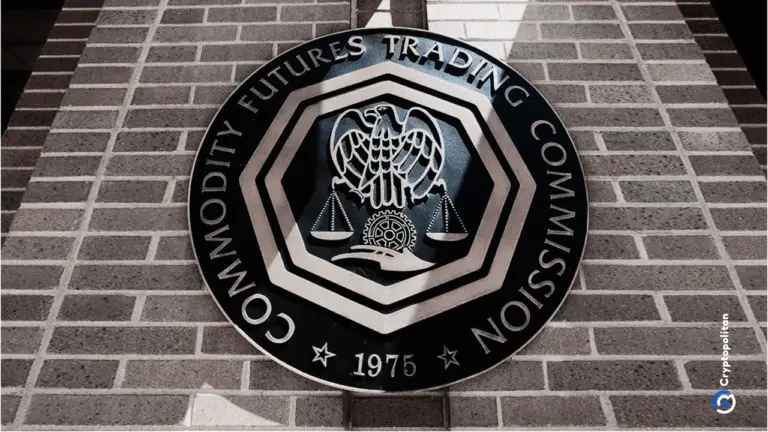
- The CFTC has asked a federal court to dismiss CME Group’s lawsuit.
- The regulator argues the exchange cannot show it was financially harmed by the approval of US crypto perpetual futures.
- CME says perpetuals are swaps under Dodd-Frank, not futures, because they never expire.
On October 16, 2026, the Commodity Futures Trading Commission (CFTC) asked a federal judge to throw out CME Group’s lawsuit over US crypto perpetual futures. The regulator argues that CME has not shown how allowing competing exchanges to offer these contracts would hurt its business.
In its latest filing, the CFTC challenged CME’s standing in CME v. Selig, before Judge Colleen Kollar-Kotelly (1:26-cv-02157). It first moved to dismiss on September 2, 2026.
“CME must plausibly allege an actual or imminent increase in competition,” the agency wrote. “CME has not even done that.”
The regulatory body referred to the remarks made by CME Chairman Terence Duffy on July 22, 2026. He said that there was non-demand from their clients for these perpetuals, which cannot be an alternative for firms trying to hedge their position.
“CME cannot have it one way with the court and another way with the investing public on earnings calls,” the agency added.
What CME argued when it sued in June
CME filed the lawsuit on June 18, 2026, after the CFTC’s approval of KalshiEX’s Bitcoin perpetual contract, BTCPERP, on May 29, 2026, a mere day after its filing. At the time, Michael Selig was the only confirmed commissioner of the organization.
Unlike traditional futures contracts, perpetuals have no expiration date. CME argues that this makes them swaps rather than futures under the Dodd-Frank Act and the Commodity Exchange Act. The distinction is important because swaps and futures have different margin requirements, registration rules, and tax treatment. CME also objects to the CFTC approving the contract without seeking public comments, then allowing other exchanges to list similar products through self-certification.
As Cryptopolitan reported in June, Selig brushed aside CME’s objections, calling them predictable resistance from an “incumbent” player.
The classification fight a dismissal would leave open
A ruling on standing would leave the swaps-versus-futures matter unresolved. Dismissal would allow the CFTC to use its case-by-case practice without getting a ruling on that classification.
TD Cowen analyst Jaret Seiberg stated:
“What increasingly concerns us is the growth in perps while the litigation is playing out.”
He added that further growth “could create complications in trying to unwind this market if the CME prevails.”
CME winning on the merits could disrupt US perpetual markets. On the other hand, a ruling in the regulators’ favor could reinforce the classification of futures.
Volume on both sides of the dispute
CME reported September 2026 cryptocurrency average daily volume of 174,000 contracts, worth $8.6 billion in notional value. That supports the regulator’s argument, but growth alone cannot rule out diverted trades.
CryptoQuant’s 2026 report puts Binance’s 2025 perpetual volume at roughly $25 trillion, up 20%. Perpetuals account for 70%–90% of trading at several major exchanges.

Those figures show the market’s scale, not how its risks should be supervised. In their April 23, 2026, BIS/FSI paper, Cryptoasset service providers as financial intermediaries: risks and policy approaches, Denise Garcia Ocampo, Peter Goodrich and Gian-Piero Lovicu warn that “many MCIs do not publish financial statements,” highlighting oversight gaps as crypto firms expand into lending and derivatives.
That is why the lawsuit matters beyond CME’s competitive position. A dismissal could leave perpetuals expanding under the CFTC’s futures framework without settling whether that classification is legally correct—or whether the safeguards accompanying it can keep pace with the market.
Don’t just read crypto news. Understand it. Subscribe to our newsletter. It's free.
FAQs
Why does the CFTC say CME's lawsuit should be dismissed?
The CFTC argues CME lacks standing because it has not shown an actual or imminent increase in competition or financial injury, pointing to CME's own statements to investors that customers were not demanding perpetual products.
What is CME's core legal argument against the perpetual futures approval?
CME contends that perpetual contracts have no expiration date, which it says makes them swaps under the Dodd-Frank Act and the Commodity Exchange Act rather than futures, a distinction that changes margin, registration, and tax treatment.
When did the CFTC approve the first US crypto perpetual contract?
On May 29, 2026, the CFTC approved Kalshi's Bitcoin perpetual contract, BTCPERP, as a futures contract, one day after Kalshi applied, prompting CME to sue on June 18.
Disclaimer. The information provided is not trading advice. Cryptopolitan.com holds no liability for any investments made based on the information provided on this page. We strongly recommend independent research and/or consultation with a qualified professional before making any investment decisions.

Ibiam Wayas
Ibiam Wayas has covered the crypto news beat since 2019. He studied Computer Science at National Open University of Nigeria. His work has appeared on various crypto news platforms, including Coinfomania, Crypto News Australia, and AltcoinBuzz. Drawing on his background in Computer Science, he now focuses on crypto, robotics, and longevity news.









