


Florida Governor DeSantis challenges President Trump’s AI deregulation push

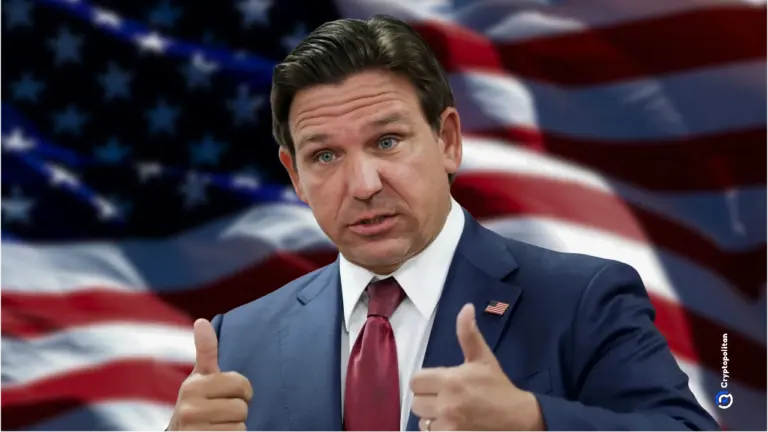
- Governor Ron DeSantis is pushing for a state-level “AI Bill of Rights” to protect privacy and children, warning that unregulated AI could “displace human beings.”
- President Donald Trump has issued a sweeping executive order to block states from passing their own AI rules.
- The president argues that a “patchwork” of state regulations hurts American competition with China.
Florida’s Governor, Ron DeSantis, has challenged President Trump for enforcing AI deregulation, sharing his concern that AI could “displace human beings.”
U.S. President Donald Trump is currently pushing for AI deregulation in order to maintain its lead in the technology competition with China.
Florida lawmakers are specifically targeting “hyperscale” data centers and proposing laws to stop these facilities from draining local water supplies or raising electricity bills for residents.
Is Florida resisting Trump’s AI order?
During Florida Governor Ron DeSantis’ final State of the State address on January 13, 2026, he issued a stark warning about the risks of rapidly advancing technology. He told the Florida Legislature that AI could soon “displace human beings as the central players on Earth’s stage.”
The Trump administration is currently making moves to remove regulatory barriers for Big Tech companies, but DeSantis is urging Florida lawmakers to pass some of the strictest AI protections in the country. The governor is particularly concerned about “hyperscale” data centers and the impact of chatbots on children.
The primary obstacle for the anti-AI state DeSantis wants is a new executive order signed by President Trump in December 2025 titled “Ensuring a National Policy Framework for Artificial Intelligence.”
The order aims to create a single national “rulebook” for AI development. Trump’s reasoning for this is that American companies will struggle to innovate and eventually lose the tech race to adversaries like China if every state creates its own rules.
On January 10, 2026, Trump’s “AI Litigation Task Force” created within the Department of Justice began operations. The task force is authorized to sue states that pass “onerous” AI laws.
The White House has also threatened to withhold $42 billion in federal broadband funding from states that refuse to repeal regulations that conflict with federal policy.
Can Florida really refuse an executive order?
In response to Trump, DeSantis said that an executive order cannot legally stop a state legislature from passing its own laws. He pointed out that while the U.S. House previously attempted to ban state AI regulations for ten years through the “One Big Beautiful Bill,” the U.S. Senate voted 99-1 to remove that ban.
DeSantis believes the public supports state-level protections and that Florida would prevail in a legal battle against the federal government.
DeSantis intends to pass a bill called the “Citizen AI Bill of Rights,” which proposes a ban on minors from accessing AI chatbots without explicit parental consent.
Under the bill, companies would have to provide parents with tools to see what their children are discussing with AI and receive alerts if a child shows “concerning behavior.” The law would also ban AI from acting as a licensed therapist or mental health counselor without a human being involved.
DeSantis and local residents in Palm Beach County have raised alarms that “hyperscale” data centers, which use millions of gallons of water for cooling and consume more electricity than entire small cities, could drain local aquifers and force regular citizens to pay higher utility rates to cover the power grid’s expansion.
The proposed law would require public hearings before any such center is built and would ban them near environmentally sensitive lands.
Texas recently passed its own “Responsible AI Governance Act” on January 1, 2026, which focuses on data privacy and preventing discrimination. Colorado is facing potential federal lawsuits over its “algorithmic discrimination” law, which is set to take effect later this year.
The smartest crypto minds already read our newsletter. Want in? Join them.

Hannah Collymore
Hannah is a writer and editor with nearly a decade of blog writing and event reporting experience in the crypto space. At Cryptopolitan, Hannah contributes to the news page, reporting and analyzing the latest developments in DeFi, RWA, crypto regulation, AI and frontier tech industries. She graduated from Arcadia university with a degree in Business Administration.