








- Crypto funds lost $920 million this week as inflation fears returned.
- Bitcoin products saw $830 million in outflows and underperformed gold and stocks.
- US inflation, higher oil prices, firm retail sales, and strong jobs data gave the Fed little room to turn dovish.
Crypto funds bled almost $1 billion this week as hotter US inflation numbers pushed investors away from risk and hit Bitcoin harder than the rest of the market.
CoinShares (STO: CS) said global crypto exchange-traded products lost $920 million, while Bitcoin products alone saw $830 million leave.
The pressure started after US producer prices came in much higher than expected. The increase came from services and energy, but energy is the bigger problem for markets right now. Oil prices have climbed because of the ongoing US-Iran conflict, and that is feeding into inflation again.
Inflation keeps the Fed boxed in as investors pull money from Bitcoin products
The rate outlook has dragged on Bitcoin this week. The asset is down 1.4% so far, while gold has gained 0.5% and equities have added 0.3%. That is not the type of performance crypto traders want when inflation fear comes back into the room. Bitcoin did not just trail stocks. It also lost ground while gold held up better.
Even the flow of funds reflected the same stress tone. The Bitcoin products have lost $830 million in a week, virtually erasing the amount of $920 million withdrawn from global crypto ETPs.
It is worth noting that this week differs significantly from the previous seven weeks, when the investments kept rising. The inflation data influenced the interest rate discussion, making the market react instantly.
The current outflow took place immediately following a week with positive flows into funds. The US made the main contribution by adding $776.6 million to the inflows, which is an impressive jump from $47.5 million from the previous week.
Germany added $50.6 million, slightly exceeding its weekly inflow. Switzerland attracted $21.1 million, while the Netherlands accounted for $5.0 million. Thus, the funds were flowing back into the market, both in the US and certain European countries.
Bitcoin proved more promising at the beginning of the week under analysis, with $706.1 million added to its inflow, resulting in $4.9 billion inflow since the beginning of the year.
Meanwhile, short-Bitcoin products suffered the largest outflow of $14.4 million, indicating that traders were unwinding their bearish positions instead of buying downside protection. The concerns about inflation caused a further decline in Bitcoin products.
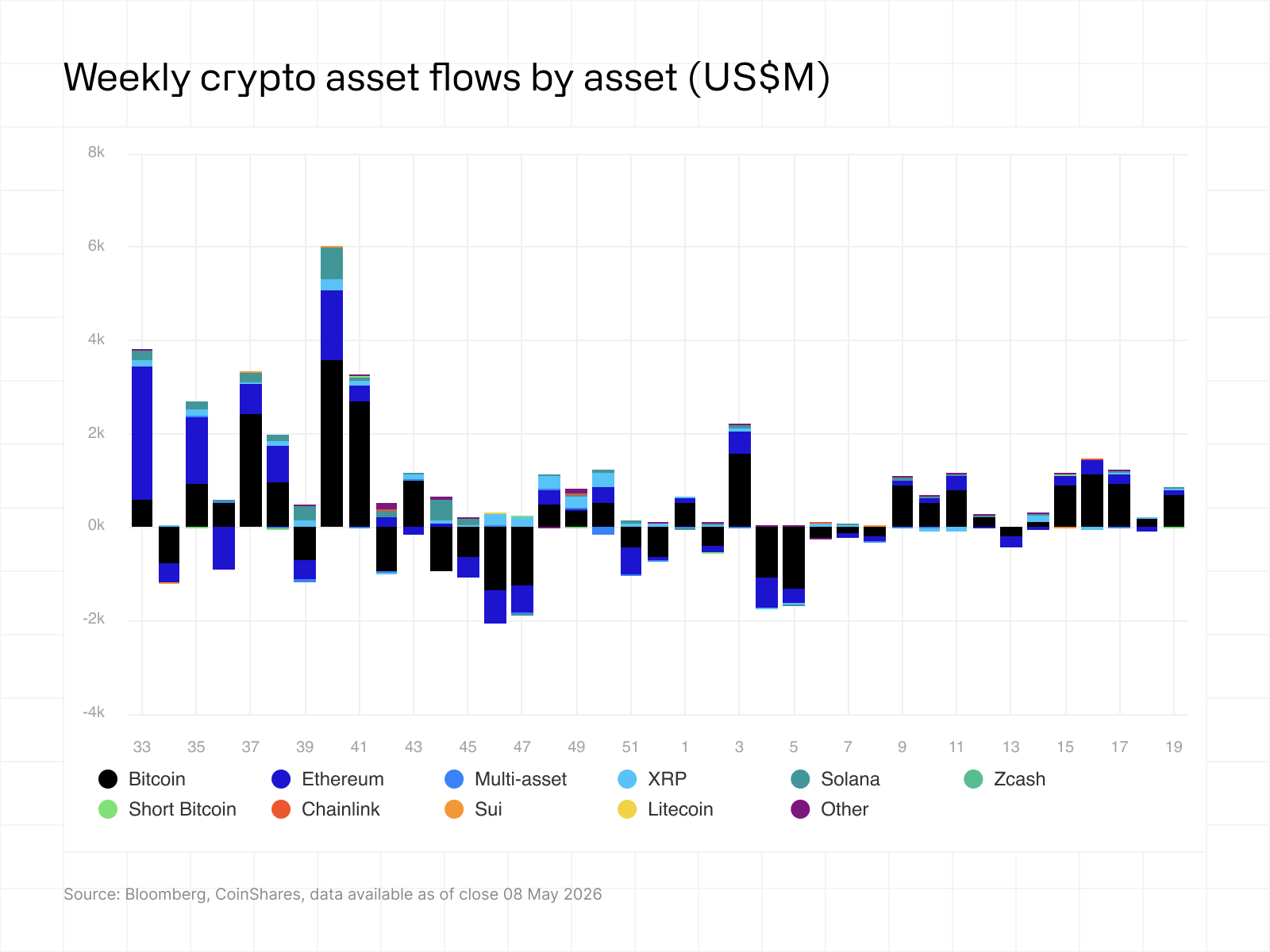
Ethereum proved attractive for investors, receiving $77.1 million inflow from its $81.6 million weekly outflow. Solana received $47.6 million inflows, while XRP received $39.6 million. It should be emphasized that the inflows increased compared to recent weeks. Multi-asset products demonstrated the only considerable weakness, with $5.5 million outflow.
Lawmakers push the Clarity Act forward while stablecoin rewards split banks and crypto firms
With a vote of 15-9, the Senate Banking Committee paved a way forward for the Clarity Act by providing a bipartisan majority vote, as Cryptopolitan previously reported.
Though the bill is not yet the law, the decision shows a concrete path for the act going through the Senate after many delays.
The new draft is much larger compared to its January version, standing at 309 pages against 278 pages. More than 100 amendments have been proposed prior to the markup. The main point of debate was concerning yield and reward programs associated with stablecoins. There were disagreements between the two sides – whether banks or crypto firms have control over users’ funds.
It seems that the committee’s version of the bill prevents interest payments on idle stablecoin balances clearly. Nevertheless, the reward programs can be based on network activity and usage. That way, both the banks and crypto firms get some of what they wanted.
That compromise made more senators agree on the act, despite the common political situation. At least, the bill will move on rather than die out in the committee.
There were also ethics issues raised by Democrats, including bans for officials and their family members from gaining profits through crypto projects while serving as public officers.
Furthermore, they advocated for limiting power on major tech companies, which could issue stablecoins. Unfortunately, the proposals did not pass in the hearing.
A number of other components of the bill require further discussion, such as DeFi, software developers’ liability, and section 1960 wording.
The smartest crypto minds already read our newsletter. Want in? Join them.
Disclaimer. The information provided is not trading advice. Cryptopolitan.com holds no liability for any investments made based on the information provided on this page. We strongly recommend independent research and/or consultation with a qualified professional before making any investment decisions.

Jai Hamid
Jai Hamid has been covering crypto, stock markets, technology, the global economy, and the geopolitical events that affect markets for the past 6 years. She has worked with blockchain-focused publications including AMB Crypto, Coin Edition, and CryptoTale on market analyses, major companies, regulation, and macroeconomic trends. She has attended London School of Journalism and thrice shared crypto market insights on one of Africa’s top TV networks.









