






States crack down on Crypto ATMs as Tennessee signals broader U.S. regulatory shift
 Collins J. Okoth
3 mins read
Collins J. Okoth
3 mins read
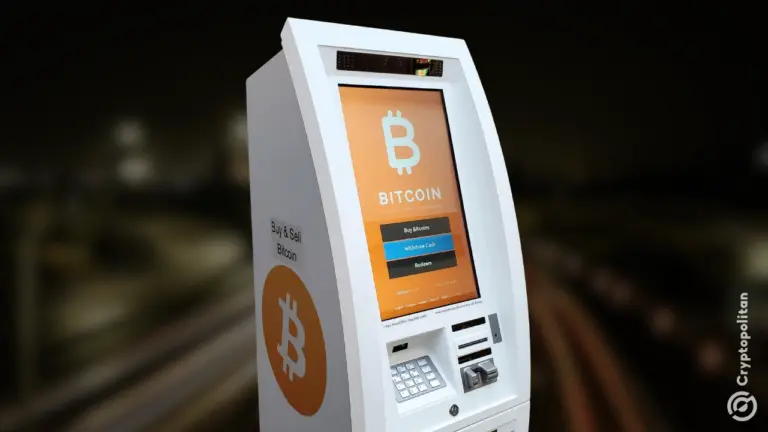
- Tennessee banned crypto ATMs and criminalized operators under new statewide House Bill 2505.
- Minnesota introduced regulations limiting kiosks while balancing consumer protection and continued market access.
- Regulators targeted crypto ATMs as fraud surged and victims, especially seniors, lost funds irreversibly.
Crypto ATMs continue facing growing legal pressure across the United States, with Tennessee emerging as one of the latest states to move toward criminalizing their operation. The legal pressure reflects a growing national effort to limit decentralized, street-level access to digital currencies amid concerns about financial control, regulation, and fraud.
On April 24, Tennessee lawmakers passed a law making it illegal to operate cryptocurrency ATMs, signaling a broader crackdown on these devices across the U.S. A similar action is taking place in Minnesota as legislators are working on a bill that would completely outlaw virtual currency kiosks, demonstrating that several states are independently targeting the same access points.
Tennessee bans ATMs while Minnesota regulates access
🚨 BOOM: Tennessee lawmakers PASS legislation authorizing LETHAL force when a criminal storms your property and starts unleashing havoc, in several cases
This is a citizens-first policy!
You shouldn’t have to WAIT to defend what you own 🇺🇸 pic.twitter.com/Mm5fkuB0FI
— Eric Daugherty (@EricLDaugh) April 24, 2026
The law goes beyond regulation by making it illegal to operate cryptocurrency ATMs and designating infractions as Class A misdemeanors, the same category as crimes like simple drug possession or domestic abuse under Tennessee law. Sponsors like Jay Reedy and Cameron Sexton contended that the machines have become a crucial tool for con artists, noting that victims rarely get their money back after a transaction is complete.
Tennessee took strong action to ban cryptocurrency ATMs completely. The Tennessee General Assembly passed House Bill 2505, which effectively outlawed the machines statewide by requiring operators to deactivate any kiosks that allow customers to purchase digital assets like Bitcoin with cash by July 1.
On April 13, 2026, Governor Bill Lee signed the legislation into law, citing an increase in fraud cases involving these kiosks, especially those targeting senior citizens who are frequently coerced into making irreversible payments.
A similar strategy emerged in Minnesota, where lawmakers introduced Senate File 3868 to impose strict regulations on virtual currency kiosks rather than outright prohibit them. The proposal outlined a regulatory paradigm that prioritizes consumer protection over prohibition, requiring kiosk operators to provide thorough risk disclosures. The lawmaker’s proposal imposed a $2,000 daily transaction limit for new clients. The proposal also guarantees complete reimbursement to fraud victims within a specified 72-hour window.
Minnesota’s framework permits kiosks to continue operating under stricter compliance requirements and disclosure standards, unlike Tennessee’s law, which criminalizes operators. These actions demonstrate that states are independently pursuing various enforcement tactics while, taken together, focusing on the same issue.
Crypto ATMs trigger fraud fears and industry pushback
The growing evidence that cryptocurrency ATMs have emerged as a significant conduit for fraud, especially scams targeting older Americans, is a major factor driving this policy convergence. A Cryptopolitan report, dated January 11, 2026, revealed that the FBI said $240 million of the $333 million Americans lost to cryptocurrency ATM fraud disappeared in the first half of 2025, twice as much as they lost in the first half of 2024.
According to the Federal Bureau of Investigation’s 2025 annual report, scammers routinely trick victims, typically older adults, into depositing money into Bitcoin ATMs under pretenses, such as posing as law enforcement or threatening legal action, resulting in losses of hundreds of millions of dollars per year.
The report revealed that law enforcement authorities have identified the irreversible nature of these transactions as a critical issue, as victims usually cannot recover funds once they are sent.
Even as regulators tighten regulations, industry participants and proponents of cryptocurrency are resisting the increasing number of prohibitions. More than 85 companies are attempting to increase real-world cryptocurrency payments and financial access, according to a recent Cryptopolitan piece on the Ripple and Mastercard relationship.
The report further noted that proponents contended that ATMs and other cryptocurrency infrastructure are essential for onboarding customers who don’t have access to conventional banking institutions.
Another Cryptopolitan report revealed that cryptocurrency firms are quickly marketing digital assets as alternatives to conventional financial systems, particularly in regions or demographics that banks do not sufficiently serve. According to the report, Industry voices cautioned that complete prohibitions may restrict innovation and decrease the number of access points available to regular users.
Don’t just read crypto news. Understand it. Subscribe to our newsletter. It's free.
Disclaimer. The information provided is not trading advice. Cryptopolitan.com holds no liability for any investments made based on the information provided on this page. We strongly recommend independent research and/or consultation with a qualified professional before making any investment decisions.
Collins J. Okoth
Collins Okoth is a journalist and markets analyst with 8 years of experience covering crypto and technology. He is a is a Certified Financial Analyst and holds a degree in Actuarial Mathematics. Collins has previously worked with Geek Computer and CoinRabbit as a writer and editor.









