



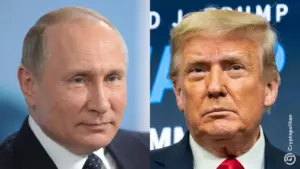



- Trump is pressuring the Federal Reserve to slash interest rates and lower oil prices, but the Fed seems firm on holding rates at 4.25%–4.5%.
- Investors are watching Fed Chair Jay Powell closely, as Trump’s demands could shake up future policy decisions.
- Trump’s trade policies have pushed global markets to sideline the U.S., while nations like China and the EU grab bigger trade shares.
President Donald Trump wants rate cuts, and he wants them now. The Federal Reserve, however, seems unlikely to budge.
Investors are betting the Fed will hold interest rates steady at 4.25-4.5% during this Wednesday’s policy announcement, following three rate cuts last year.
Fed Chair Jerome Powell will face the press soon after the policy meeting, and all eyes are on whether he addresses Trump’s public calls for rate cuts or not. It adds to a long-standing tension between the president and Powell, whom Trump has threatened to remove from his position time and time again.
But Powell has said firmly that he plans to serve out his term and he has also reiterated that the president has no authority to fire him. Per the US Constitution, he’s right.
And Trump is also calling for lower oil prices, which could make inflation even worse. Investors are watching closely, but knowing Powell, he will probably stay silent on the whole Trump matter.
The Fed’s current stance on interest rates is backed by economic data. Inflation has slowed, and job growth remains strong, according to Jan. 23rd reports. Powell’s team had already said in December that they were likely to pause rate cuts for now.
The Fed’s independence has always been key to its credibility, so any perceived tampering from the White House could have serious consequences for the entire global economy.
Trump’s economic policies complicate things more
While Trump pressures the Fed, his trade policies are creating their own chaos too. The U.S. has used tariffs as a key economic weapon for eight years now, starting during Trump’s own first term. Tariffs on China were ramped up under Trump and later expanded by President Joe Biden.
China is actually dominating five of the ten fastest-growing trade corridors right now. Meanwhile, America has largely been sidelined in major trade discussions.
Meanwhile, the U.S. economy remains strong. America’s share of global GDP has inched up to 25%, and its financial markets dominate, making up nearly 70% of global equity indices.
Global trade talks stalled after the 2008 financial crisis, but smaller bilateral and regional agreements continued to thrive. When Trump took office, he abandoned major trade negotiations with the European Union and Asia.
By the time Trump’s second term began on Jan. 20, trade partners were rushing to finalize agreements to protect themselves from more tariffs.
The smartest crypto minds already read our newsletter. Want in? Join them.
Disclaimer. The information provided is not trading advice. Cryptopolitan.com holds no liability for any investments made based on the information provided on this page. We strongly recommend independent research and/or consultation with a qualified professional before making any investment decisions.

Jai Hamid
Jai Hamid has been covering crypto, stock markets, technology, the global economy, and the geopolitical events that affect markets for the past 6 years. She has worked with blockchain-focused publications including AMB Crypto, Coin Edition, and CryptoTale on market analyses, major companies, regulation, and macroeconomic trends. She has attended London School of Journalism and thrice shared crypto market insights on one of Africa’s top TV networks.









