







- Anthropic warns human-level AI could arrive by 2028 and urges US to tighten export controls on China
- Industry experts slam the company’s approach as “irresponsible”
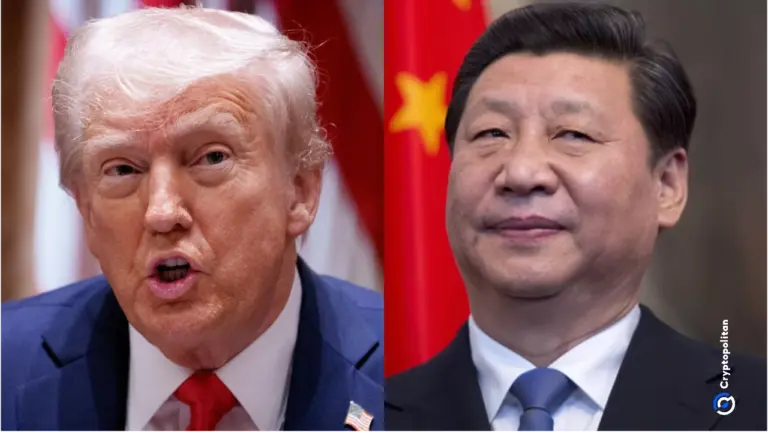
- Trump and Xi discussed AI cooperation and Nvidia chip shipments
A top American artificial intelligence corporation issued a strong warning about Chinese AI growth just as Presidents Donald Trump and Xi Jinping concluded technology collaboration talks in Beijing, resulting in an uncommon gap between industry rhetoric and political reality.
The AI company Anthropic put out a research paper on Thursday claiming that machines with human-level intelligence could arrive by 2028.
The company called on Washington to keep America ahead of China in developing advanced AI systems.
Their paper, called “2028: Two Scenarios for Global AI Leadership,” paints a picture of AI systems soon capable of handling complicated work in science, engineering, and cybersecurity at expert human levels.
Anthropic paints two futures for AI leadership
Anthropic describes a future with what it calls “a country of geniuses in data centers.”
AI could accelerate scientific discoveries, software development, and the creation of even more advanced AI.
Anthropic contends that the country that leads in advanced AI will gain significant economic, political, and military advantages.
The report was released as Trump wrapped up the first day of his summit with Xi in Beijing.
Anthropic encouraged the United States and its partners to strengthen export regulations and prevent “distillation” in China, where smaller AI models are trained on larger, more sophisticated systems.
Anthropic, the creator of Claude AI, has previously cautioned about China’s AI advances and supported US chip export limits.
According to the corporation, Chinese leadership in advanced AI might pose a significant worldwide threat, enabling large-scale repression beyond what humans alone could accomplish.
The corporation expressed concerns about dictatorships deploying sophisticated AI for mass monitoring, digital attacks, and population control.
According to the report, America currently has an advantage in AI because it dominates the development of high-end computer chips and the computational power required to train advanced AI models.
However, Anthropic warned that this edge could dwindle if gaps in semiconductor export restrictions, access to computing capacity abroad, and AI model availability are not addressed.
Anthropic described two possible outcomes for 2028.
In one, the U.S. and its allies tighten export controls, crack down on chip smuggling, and accelerate AI adoption at home, helping democratic nations stay 12–24 months ahead of China.
The company said this lead could create opportunities to work with Chinese AI experts on safety and governance.
In the second scenario, weak enforcement and continuous access to abroad infrastructure enable China to maintain its competitiveness in advanced AI.
Anthropic cautioned that China might gain major influence in the global AI scene.
Critics and diplomats push back on conflict framing
But some industry watchers are calling Anthropic’s push for America to expand its lead over China “irresponsible” and motivated by self-interest.
Alvin Wang Graylin, a Digital Fellow at the Stanford Institute for Human-centered Artificial Intelligence and senior fellow at the Asia Society Policy Institute, said the company raises valid worries about potential misuse that deserve attention.
However, its “arms-race framing pushes us in the wrong direction at exactly the wrong moment,” he said.
While the debate played out publicly, the two presidents were actually discussing AI cooperation.
Trump told reporters on Air Force One flying home that the two countries “talked about possibly working together for guardrails” on AI, describing them as “standard guardrails that we talk about all the time.”
The talks also covered Nvidia’s H200 chips.
Beijing hasn’t yet approved shipments of these graphics processing units.
Trump confirmed the topic “did come up” in meetings and that he “thinks something could happen.”
He noted China hasn’t bought the hardware yet because it “chose not to” and instead “wants to try and develop their own” domestic options.
Chinese foreign ministry spokesman Guo Jiakun said Friday that “China has always advocated that all parties jointly promote the development of artificial intelligence in an open, inclusive, beneficial and good-for-all direction.”
On the Nvidia chip question, he said China had repeatedly shared its position without giving details.
Beijing has previously said it strongly opposes the misuse of export controls.
If you're reading this, you’re already ahead. Stay there with our newsletter.

Hania Humayun
Hania joined Cryptopolitan with a long history of analyzing finance, economic trends, and prediction markets. She covered topics in emerging technology, AI, and fintech. Hania’s experiences as a licensed architect have added verve and precision to newswriting. She graduated from the National College of Arts in Lahore with an Architecture degree,









