




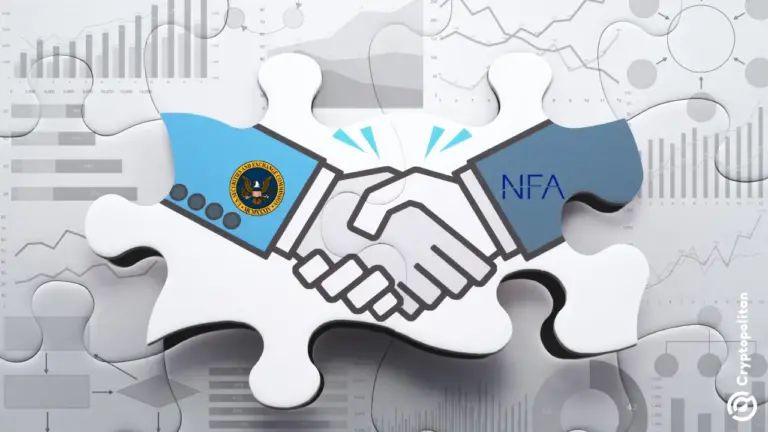
- The SEC and NFA signed an MOU on May 21 to share regulatory information, coordinate examinations, and reduce duplicative oversight.
- The deal follows the March SEC-CFTC harmonization agreement and extends coordination to the derivatives industry’s self-regulator.
- The MOU does not address digital asset classification but covers firms that trade crypto derivatives.
A Memorandum of Understanding was signed between the U.S. Securities and Exchange Commission and the National Futures Association on May 21, formalizing how they will coordinate examinations, share information, and monitor risks across the securities and derivatives markets.
The MOU covers three areas: emerging risk management, examination program coordination, and financial market conditions monitoring. Staff from both institutions will hold periodic coordination meetings, per the SEC press release.
SEC and NFA staff can now share compliance data
The agreement formalizes cooperation that had largely taken place informally. Staff from the SEC and NFA can share information on compliance with securities and derivatives regulations independent of any individual request process.
Coordination between regulatory organizations provides businesses a predictable, straightforward path to compliance and comprehensive protections for investors that build trust in our markets.
SEC Chairman, Paul S. Atkins
He described the MOU as another step toward streamlining cooperation between regulatory authorities.
Thomas W. Sexton, president and chief executive officer of NFA, described this agreement as an “important milestone” that would help protect customers and maintain market integrity.
The March SEC-CFTC deal set the framework
The agreement is part of a wider strategy being pursued by U.S. financial regulators to coordinate oversight of securities and derivatives markets.
In March, the SEC and the Commodity Futures Trading Commission signed a separate MOU focused on harmonizing oversight for cross-market products and dually regulated firms.
As Cryptopolitan reported, SEC Chairman Atkins framed that deal as ending decades of regulatory turf wars that had “stifled innovation and pushed market participants to other jurisdictions.”
Traditionally, the SEC has relied upon such arrangements when working with FINRA and state securities commissions for exam coordination and enforcement matters. This method has led to mixed outcomes.
Industry groups have repeatedly pointed out that even with formal coordination efforts in place, dual registrants continue to receive duplicative document requests and examinations.
Regulators counter that the frameworks have improved information sharing and reduced gaps in supervision during market stress.
The SEC-FINRA coordination model is often cited as a partial success. It established clearer examination protocols for broker-dealers and enabled joint enforcement referrals.
But firms regulated by multiple agencies have continued to complain about duplicated reporting obligations and differing compliance expectations. The SEC-NFA agreement appears aimed at addressing similar frictions in the derivatives sector.
The MOU skips digital asset classification but covers crypto derivatives
There is no specific mention of digital assets or cryptocurrency within the MOU. However, the NFA regulates a number of companies involved in the cryptocurrency derivatives market, and thus information sharing under the MOU may have an impact on their regulation and examination.
Coinbase Financial Markets received NFA approval to operate as a futures commission merchant in 2023. Other crypto-native firms with NFA registrations would fall under the coordinated oversight framework.
Earlier this year, the SEC and the CFTC used their March MOU to issue a joint interpretation establishing a taxonomy for crypto assets and addressing how federal securities laws apply to common crypto activities.
That March 17 release was the first concrete product of the harmonization initiative. The SEC-NFA MOU could produce similar practical outputs for the derivatives side, particularly if the two authorities begin conducting joint examinations rather than separate ones.
The MOU does not answer one major outstanding question: which specific tokens should be classified as securities and which as commodities.
That determination still depends on pending legislation, primarily the CLARITY Act, and future joint guidance from the SEC and CFTC.
Dual registrants want fewer overlapping exams
The agreement’s effectiveness depends on how aggressively both agencies apply the framework. Inter-agency MOUs typically include provisions for information sharing and regular meetings, but follow-through varies.
Companies supervised by both the SEC and NFA will be keenly observing whether overlaps between inspections actually fall in the next few quarters.
Three MOUs in three months (SEC-CFTC in March, the March 17 joint crypto taxonomy, and now SEC-NFA) represent the fastest period of regulatory coordination activity in US financial markets since the Dodd-Frank era.
For crypto firms operating across securities and derivatives, the coordination chain is forming. The rules have not changed yet. The agencies enforcing them are starting to talk to each other.
The smartest crypto minds already read our newsletter. Want in? Join them.
FAQs
What is the SEC-NFA memorandum of understanding?
It is a formal agreement signed on May 21, 2026, that allows SEC and NFA staff to share information on emerging risks, examination planning, and market conditions, to reduce duplicative regulatory oversight.
Does the SEC-NFA MOU change crypto regulation?
The agreement does not specifically address individual crypto assets or their classification, but because the NFA supervises firms involved in crypto derivatives, the coordination framework could affect how those entities are examined.
How does the SEC-NFA deal relate to the SEC-CFTC agreement?
The SEC signed a separate memorandum of understanding with the CFTC in March 2026 focused on harmonizing oversight of dually regulated firms and cross-regime products. The NFA agreement extends the same coordination approach to the futures industry's self-regulatory body.
Disclaimer. The information provided is not trading advice. Cryptopolitan.com holds no liability for any investments made based on the information provided on this page. We strongly recommend independent research and/or consultation with a qualified professional before making any investment decisions.

Micah Abiodun
Micah Abiodun makes good use of his Environmental Engineering and Management (MSc) at Tallinn University of Technology (TalTech) to polish content and price prediction news at Cryptopolitan. Now on his 7th year in the crypto media space, he covers major cryptos, altcoins, DeFi, stablecoins, macro trends, and emerging tech.









