





U.S. and China agree to government-level AI collaboration after Trump-Xi summit

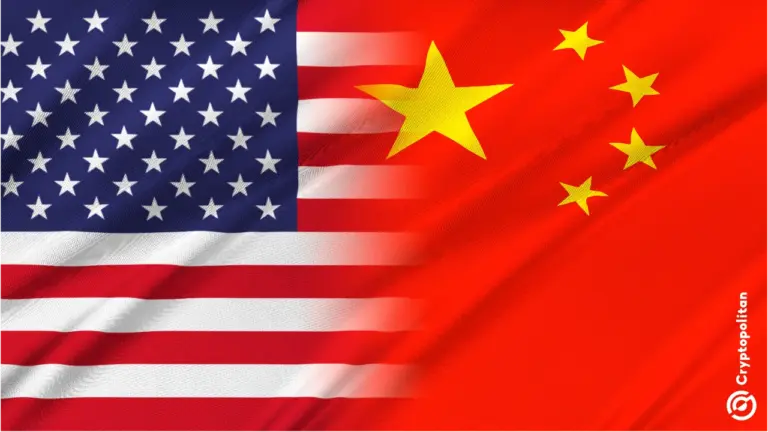
- The U.S. and China agreed to start a government-level AI dialogue after Trump and Xi discussed AI governance.
- Trump said both countries talked about AI guardrails, but he also said they are still competing hard.
- Nvidia is still waiting for China to approve H200 chip sales, even after getting U.S. licenses.
The United States and China have agreed to open a direct government channel on AI collaboration following Donald Trump and President Xi Jinping’s summit, which was covered live by Cryptopolitan.
Beijing confirmed the plan on May 19 through Chinese Foreign Ministry spokesperson Guo Jiakun, who spoke at a regular press briefing after a reporter asked about the AI talks between both leaders.
According to Guo, China and the US are the two great powers in AI, and hence both countries must work together to develop AI and regulate it. This will help the technology promote human development for the good of the entire world population.
He further indicated that Trump and Xi had productive talks about AI during the visit and decided to begin a government-to-government discussion on the matter. Nevertheless, it is important to note that there is no official confirmation from the White House concerning this channel.
Trump says Washington and Beijing discussed AI guardrails while racing each other
Trump did speak about an AI discussion with Jinping in an interview with Bret Baier of Fox News (FOXA, FOX). Bret asked whether the United States and China had reached any kind of agreement on guardrails so AI does not “go crazy.”
Trump answered, “We talked about it. Yes, we talked about it. AI is mostly a great thing. Mostly.”
He then said the United States is ahead of China in AI and tied that lead to electricity.
Trump said he allowed AI companies to build their own power plants because the existing grid would not have been enough. AI data centers need huge amounts of power, and Trump said private energy projects now give U.S. companies more room to build.
Trump then said, “Now you have these very rich companies, headed by lots of geniuses, building electric plants. Because of that, we are leading China by a lot in the AI race.”
He also said the global AI race is between Washington and Beijing, even though other countries are still involved.
Trump said, “Whoever wins the AI race, and we are going to win it. If we are smart, we are going to win it. If we are not smart, we are not.”
He added that Xi was surprised by the speed of U.S. AI progress, because allegedly, China once thought it had a huge early lead, but he now believes the United States is far ahead.
Bret then asked whether both sides could still agree on a setup for AI rules. Trump said it was possible, but not simple, because both countries are trying to beat each other in the same field. He said, “It is a little hard to say, ‘Let’s put on guardrails,’ when we are competing with each other.”
Nvidia waits for China chip approval as senators prepare a $500 million AI bill
The AI talks also sit right inside the chip fight, because Nvidia (NVDA) CEO Jensen Huang (who flew to the Beijing summit with Elon Musk and Trump on AF1) told Bloomberg TV Monday that he thinks China’s market will eventually open again to U.S. chip companies.
While Nvidia already has the license from the U.S. government to sell the chips, it does not automatically allow them to be shipped to China at once. The Chinese officials have not given permission for the sale, and Beijing continues to support its home-grown semiconductor producers. Jensen stated, “My sense is that, over time, the market will open.”
The matter is important as Washington is working on another law regarding Chinese tech sales abroad. According to Reuters, two U.S. senators are set to present a bill on Tuesday, as seen in a document allegedly obtained by the news agency.
The bill is sponsored by Democratic Senator Jeanne Shaheen of New Hampshire and Republican Senator Pete Ricketts of Nebraska.
The bill would create an office inside the State Department to help allied governments buy American technology. It would also make the buying process easier and set up a $500 million fund to help pay for the program if it passes.
The bill says foreign governments are buying cyber and digital tools from strategic competitors such as China because those products often cost less.
Don’t just read crypto news. Understand it. Subscribe to our newsletter. It's free.

Jai Hamid
Jai Hamid has been covering crypto, stock markets, technology, the global economy, and the geopolitical events that affect markets for the past 6 years. She has worked with blockchain-focused publications including AMB Crypto, Coin Edition, and CryptoTale on market analyses, major companies, regulation, and macroeconomic trends. She has attended London School of Journalism and thrice shared crypto market insights on one of Africa’s top TV networks.









