




- Uniswap governance has proposed extending its UNI token burn mechanism to BNB Chain, Polygon, and Celo.
- The protocol fee rollout will now expand to 11 chains beyond Ethereum mainnet.
- The vote uses an expedited governance process and opens May 24, 2026.
The Uniswap DAO has pushed out a new proposal to expand its UNIfication program by activating protocol fee collection and UNI token burning to the BNB, Polygon and Celo networks.
The proposal to expand on the three networks will be looking at replicating the rally that the initial rollout sparked when it launched on the Ethereum mainnet in late December 2025, as Cryptopolitan reported at the time. UNI trades at $3.30, down 92.7% from its May 2021 all-time high of $44.97, per CoinMarketCap data.
When will voting start to expand UNIfication?
Proposal 96, titled “Protocol Fee Expansion: Vote 3,” has gone live on the Uniswap governance portal, and voting will kick off on May 24, 2026, according to the Uniswap Foundation’s voting platform.
If approved, it would deploy the same fee-to-burn infrastructure already running on Ethereum, Arbitrum, Base, OP Mainnet, and five other chains to BNB Chain, Polygon, and Celo.
The proposal relies on two on-chain contracts at the core of UNIfication, the governance overhaul that Uniswap Labs and the Uniswap Foundation passed in late 2025. Protocol fees on each chain flow into a contract called TokenJar. To withdraw those fees, searchers must burn an equivalent value of UNI through a companion contract called Firepit, then bridge the burned tokens back to Ethereum mainnet and send them to the `0xdead` address, according to the original UNIfication proposal (Proposal 93).
On BNB Chain and Polygon, the proposal would set the v2 factory’s fee recipient to the local TokenJar and transfer ownership of the v3 factory to a V3OpenFeeAdapter contract.
The Celo deal is not as straightforward. A previous proposal (Vote 1, Proposal 94) to add Celo had already failed due to a configuration error. The new vote is expected to avoid the same issues, requiring the additional steps of transferring the v2 `feeToSetter` role from Wormhole to a DUNI-owned CrossChainAccount, and handing ownership of the v4 PoolManager to that same account.
The governance portal clarifies that Wormhole’s Native Token Transfer mechanism will handle cross-chain messaging for BNB Chain and Polygon, while Celo follows the same OP-stack architecture as other Layer 2 chains.
Uniswap’s fee burn program has been popular so far
The fee expansion has become a big feature of the Uniswap ecosystem since UNIfication cleared governance in December 2025. Around that time, Cryptopolitan reported that the UNI token broke the $7 barrier for the first time in weeks, staging a recovery from as low as $4.95 to $9.25 in less than a week.
When Proposals 94 and 95 passed in early March 2026 with more than 62 million and 77 million UNI votes in favor respectively, it extended fees to eight chains: Arbitrum, Base, OP Mainnet, Soneium, X Layer, Worldchain, Zora, and Celo.
If Proposal 96 passes, UNIfication would have expanded to 11 chains in addition to the Ethereum mainnet.
Protocol fee levels on the newly added chains mirror those already live elsewhere. For v2 pools, activation splits the existing 0.3% LP fee into 0.25% for liquidity providers and 0.05% as a protocol fee. For v3 pools, the tier-based V3OpenFeeAdapter sets protocol fees uniformly by LP fee tier, with no per-pool governance action required, according to the Proposal 94 specification.
How much funds flow through Uniswap?
Uniswap’s cumulative fees across all deployments have reached $5.57 billion, with annualized fees running at roughly $477 million, according to Defillama data. The protocol holds $3.3 billion in total value locked across more than 40 chains.
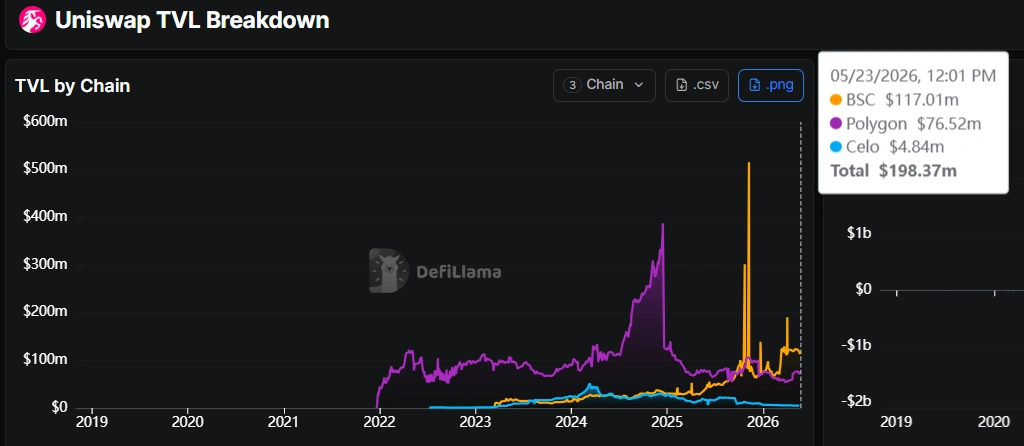
BNB Chain accounts for $117 million in TVL and $3.53 million in fees over the past 30 days, while Polygon holds $76.5 million in TVL and $1.02 million in 30-day fees. Neither chain currently generates protocol revenue for UNI holders, Defillama’s revenue figures show, since the fee switch has not yet been activated on those networks.
The UNIfication initiative also included a retroactive burn of 100 million UNI from the treasury, executed as part of the original December 2025 vote. Hayden Adams, Ken Ng, and Devin Walsh authored that proposal, describing it as an estimate of what would have been burned had protocol fees been active since Uniswap’s launch, according to the governance forum post.
Notably, Proposal 96 uses the expedited governance process approved under UNIfication, which allows fee parameter updates to skip the RFC stage and proceed directly to a five-day Snapshot vote followed by an onchain vote.
The smartest crypto minds already read our newsletter. Want in? Join them.
FAQs
What does Uniswap's Proposal 96 do?
Proposal 96 activates protocol fee collection on BNB Chain, Polygon, and Celo, routing those fees into TokenJar contracts where they are converted into UNI token burns bridged back to Ethereum mainnet.
How many chains have Uniswap protocol fees active?
With Proposals 94 and 95 already executed, protocol fees are live on Ethereum mainnet and eight additional chains (Arbitrum, Base, OP Mainnet, Soneium, X Layer, Worldchain, Zora, and Celo). Proposal 96 would add BNB Chain, Polygon, and complete Celo's activation after a prior configuration error.
How does the UNI burn mechanism work?
Protocol fees accumulate in onchain TokenJar contracts on each chain. Searchers can claim those fees only by burning an equivalent value of UNI through a Firepit contract, then bridging the burned tokens back to Ethereum and sending them to the `0xdead` address.
Disclaimer. The information provided is not trading advice. Cryptopolitan.com holds no liability for any investments made based on the information provided on this page. We strongly recommend independent research and/or consultation with a qualified professional before making any investment decisions.

Hannah Collymore
Hannah is a writer and editor with nearly a decade of blog writing and event reporting experience in the crypto space. At Cryptopolitan, Hannah contributes to the news page, reporting and analyzing the latest developments in DeFi, RWA, crypto regulation, AI and frontier tech industries. She graduated from Arcadia university with a degree in Business Administration.









