






Trump says “Anthropic is no longer a national security threat” after G7 lunch with Amodei

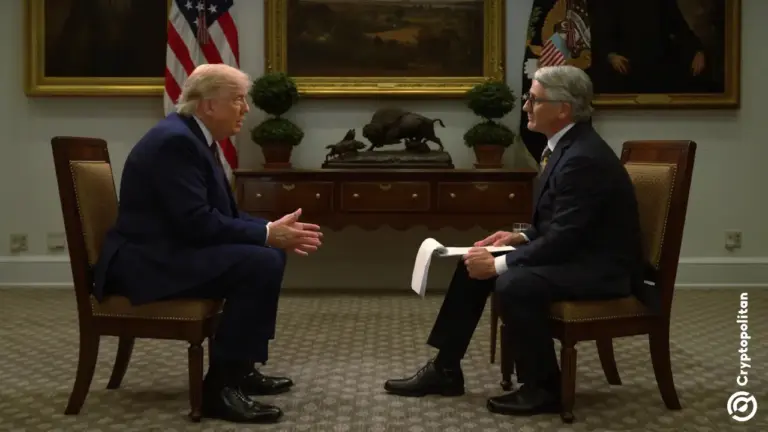
Trump sitting with Axios' Gil during the The Axios Show | Source: Axios.com
- Trump told Axios he no longer sees Anthropic as a national security threat after meeting CEO Dario Amodei at the G7 summit on June 17.
- The Commerce Department’s June 12 export-control order on Mythos 5 and Fable 5 stays in force, as does the Pentagon’s March supply-chain risk designation.
- The softening lands as Anthropic prepares an October IPO at a $965 billion valuation that depends on the export-control timeline resolving.
President Donald Trump told Axios’s Marc Caputo in a pre-taped interview published June 19 that he no longer views Anthropic as a national security threat, two days after meeting CEO Dario Amodei at the G7 summit. Asked whether Anthropic or Amodei posed a threat, Trump said, “Well, not now, but a week ago, maybe.”
⚠️ NEW on The Axios Show: President Trump tells @MarcACaputo that a week ago, he might’ve considered Anthropic a national security threat when his administration restricted access to its new model.
"People get put in prison immediately for that." pic.twitter.com/LQQGgqOHGL
— Axios (@axios) June 19, 2026
The Commerce Department’s June 12 order requiring federal approval before foreign nationals can access Mythos 5 and Fable 5 remains in force, and the Pentagon’s March 3 supply-chain risk designation barring federal agencies from using Anthropic technology has not been rescinded.
Trump kept the Defense Production Act in reserve, telling Axios he could invoke it but does not see the need.
Amodei pitched Trump a US-led AI coalition at the G7 lunch
The G7 summit in Évian-les-Bains, France, on June 15-17 gave Amodei the venue to repair the relationship in person. At a working lunch on Wednesday, June 17, with G7 heads of state and roughly a dozen tech CEOs in the room, Amodei and Demis Hassabis put forward a coalition framework that would have democracies coordinate frontier AI trade and standards under US leadership, with China deliberately outside the tent.
Amodei urged leaders to “resist the temptation to splinter” their AI regulatory approaches, per a Financial Times report.
Other notable individuals present were Sam Altman (OpenAI), Marc Benioff (Salesforce), Alex Wang (Meta), Arthur Mensch (Mistral), Aidan Gomez (Cohere), Victor Riparbelli (Synthesia), Robin Rombach (Black Forest Labs), and the founders of India’s Sarvam and Japan’s Sakana.
Trump described Amodei as smart and personable after the lunch. That impression matters because the Pentagon and Trump’s February Truth Social directive had framed Anthropic’s leadership as ideologically hostile to the Defense Department. The G7 lunch was the first face-to-face Trump-Amodei interaction since the supply-chain risk designation in March, and it became the trigger for the public softening.
Amazon’s vulnerability report triggered the Commerce shutdown
There was a new piece of information in the Axios interview that changed the perspective on the June 12 directive. According to Trump, the source of alarm for Commerce Secretary Howard Lutnick to call Amodei was a competitor who was also an owner of Anthropic.
That description matches Amazon, which has invested $8 billion in Anthropic and operates competing models on AWS Bedrock. Per Axios, Amazon detailed a vulnerability in Mythos and brought it to the administration. When the White House escalated to Anthropic leadership and got pushed back, Lutnick sent the export-control letter at 5:21 PM ET on Friday, June 12.
Anthropic had 90 minutes from the 1 PM ET call to take Mythos 5 and Fable 5 offline. The company disabled both models for all users, including non-US Anthropic staff, after concluding it could not reliably enforce nationality-based access controls.
A competitor-investor delivering a vulnerability report that becomes a national-security action is a structurally unusual basis for an export-control directive. Alex Stamos’s open letter, signed by close to 150 security leaders, characterized the cybersecurity community’s response as restrained compared with the administration’s framing.
Anthropic’s $965 billion IPO valuation hangs on the export-control timeline
The reversal carries direct financial weight. Anthropic closed a $65 billion Series H-1 round in late May at a $965 billion post-money valuation, eclipsing OpenAI for the first time, per Fortune.
The company confidentially filed its S-1 with the SEC on June 1, targeting an October 2026 Nasdaq listing with Goldman Sachs, JPMorgan, and Morgan Stanley as lead underwriters. The offering is expected to raise more than $60 billion, which would make it the largest technology IPO since Facebook in 2012.
The June 12 export controls hit Anthropic at the worst possible moment in that timeline. Annual recurring revenue reached roughly $47 billion in early June, up from $9 billion at the end of 2025.
Anthropic’s competitive position depends on the Mythos and Fable lines that the export-control order took offline. The longer the order stays in place, the harder it gets to price the IPO at the May valuation.
Trump’s softening signals the White House is prepared to negotiate rather than escalate, which steadies investor sentiment without yet restoring foreign access.
Allied governments are using the dispute to push AI sovereignty
The Trump-Anthropic flip-flop has consequences beyond US borders. Canadian Prime Minister Mark Carney addressed the issue on his way to the G7, telling reporters in Dublin that the Anthropic restrictions highlight a need to “build out and diversify.”
Canada announced a plan earlier in June to help middle powers and like-minded countries develop alternatives to the major US AI players. Japan’s draft policy committing to actively and continuously review AI laws, revealed June 19, was framed around the same problem. Allies cannot lock in policy responses when US export controls flip within days.
As Cryptopolitan reported on June 13, the original shutdown forced Anthropic to deactivate Fable 5 and Mythos 5 with 90 minutes of warning, the kind of whiplash that prompted Carney’s “build out and diversify” framing and that Japan’s continuous-review framework was designed around.
If you're reading this, you’re already ahead. Stay there with our newsletter.
Disclaimer. The information provided is not trading advice. Cryptopolitan.com holds no liability for any investments made based on the information provided on this page. We strongly recommend independent research and/or consultation with a qualified professional before making any investment decisions.

Micah Abiodun
Micah Abiodun makes good use of his Environmental Engineering and Management (MSc) at Tallinn University of Technology (TalTech) to polish content and price prediction news at Cryptopolitan. Now on his 7th year in the crypto media space, he covers major cryptos, altcoins, DeFi, stablecoins, macro trends, and emerging tech.









